
Vietnam’s stock market has just reached a milestone more than a decade in the making: FTSE Russell has officially confirmed the upgrade to Secondary Emerging Market status, effective September 21, 2026.Báo Chính phủ According to SSI Research estimates, passive capital inflows from ETFs tracking the FTSE Emerging Markets index are expected to reach approximately $1.5-1.6 billion, allocated across 4 phases over 12 months.Fili
In simple terms, this is the first time Vietnam has been “invited to the big table” of international capital flows. The most practical question right now isn’t “how much will the market rise,” but rather which approach fits your available capital.
The 4-Phase Roadmap: Capital Flows Gradually, Not All at Once
The first thing to understand: the $1.5 billion won’t arrive in a single wave. FTSE Russell applies a 4-phase allocation roadmap to ensure orderly capital flows.VnEconomy
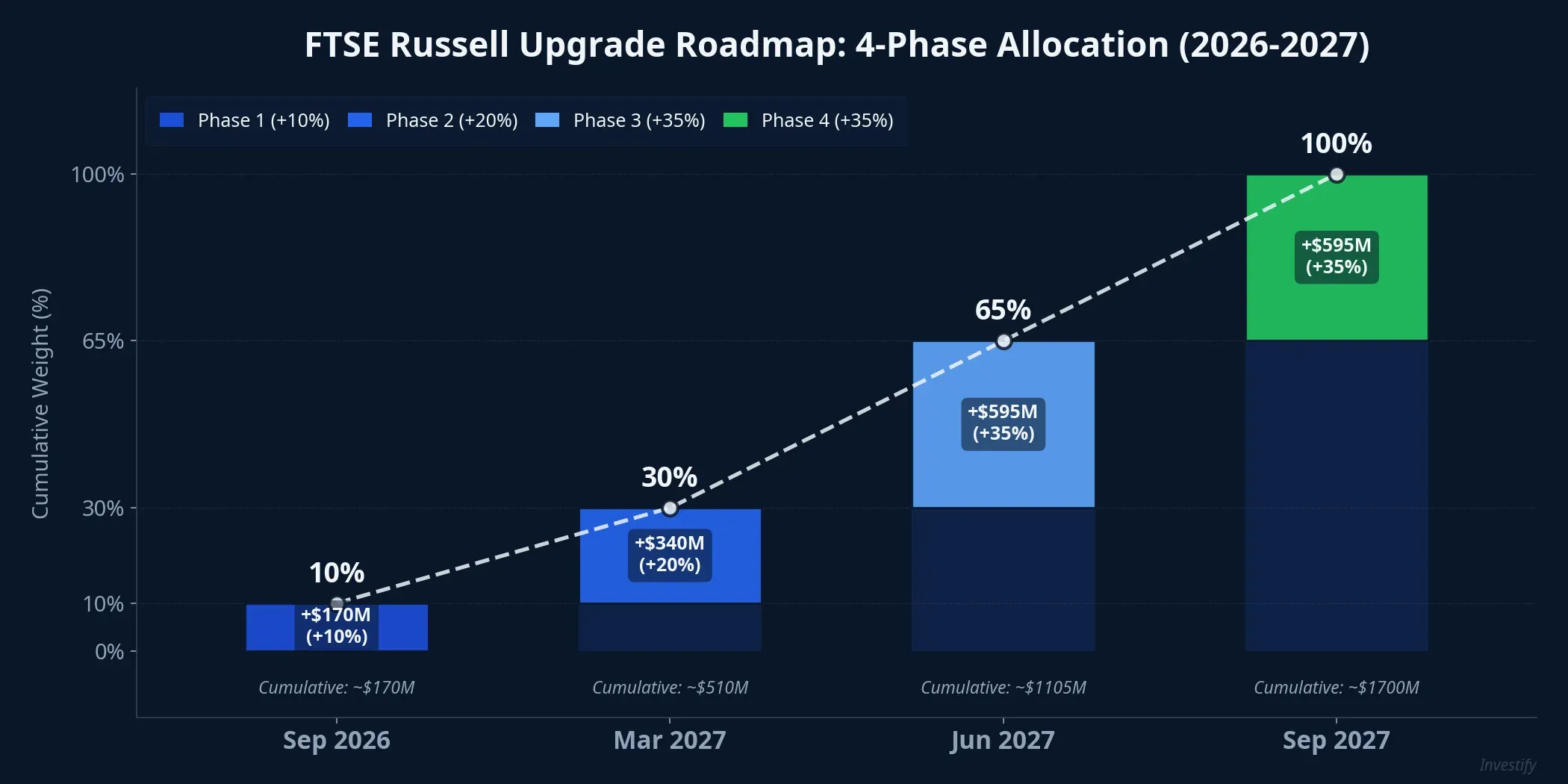
Phase 1 in September 2026 accounts for only 10% of total capital flows (approximately $150-170 million). The majority of passive capital (70%) will flow in during the second half of the roadmap, in Phases 3 and 4 of 2027. Simply put, you have time to prepare without rushing before September 2026.
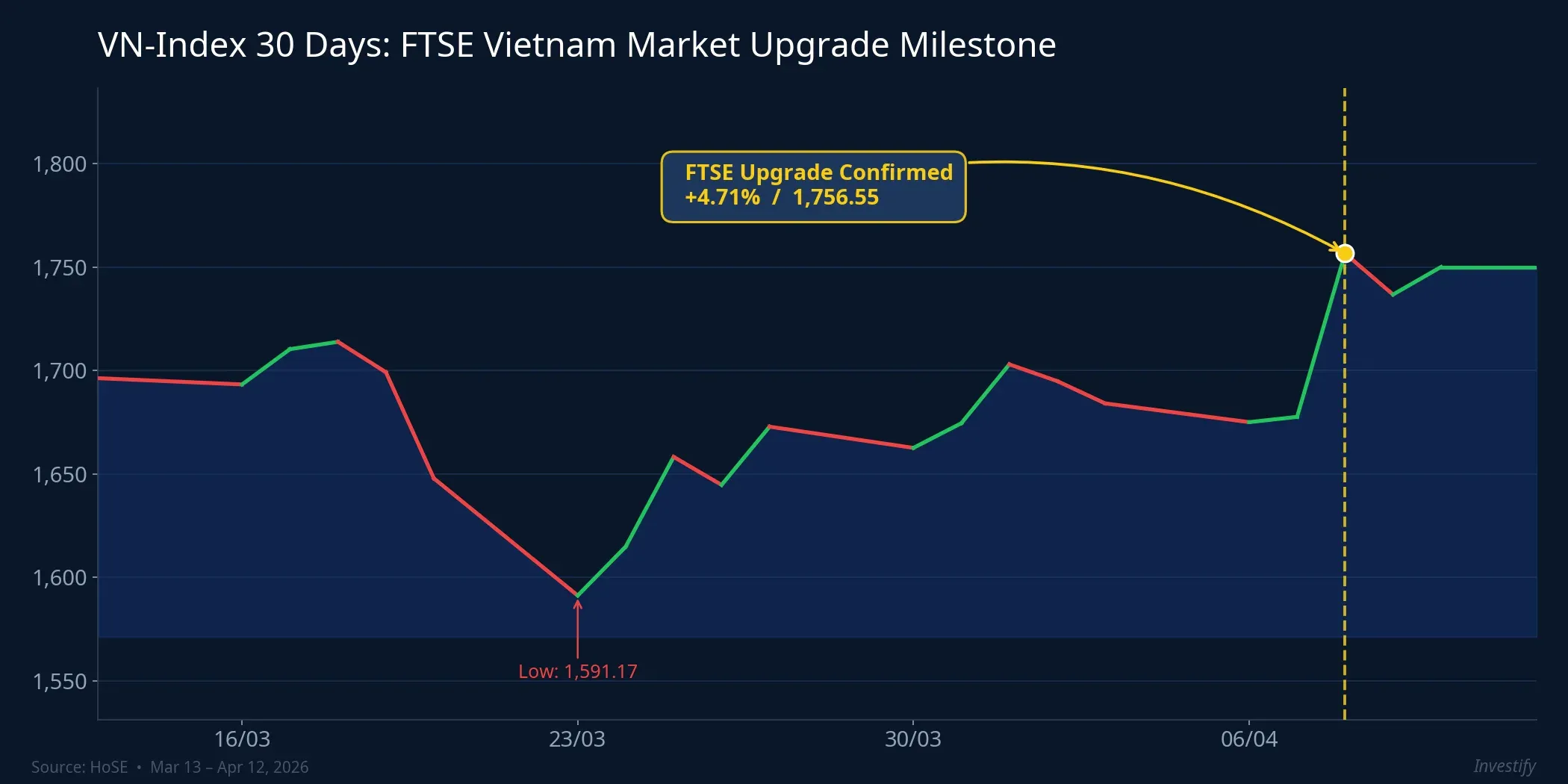
The VN-Index closed at 1,750 points on the last session of April 12, up 0.77%. On the day FTSE confirmed the upgrade (April 8), the VN-Index surged 4.71% to 1,756.55 points, showing an immediate positive market reaction.
32 Stocks Expected in the FTSE GEIS Index
FTSE Russell has published a reference list of 32 Vietnamese stocks meeting screening criteria, including familiar names such as HPG, VCB, BID, VHM, FPT, VNM, SSI, MSN, and SAB.Tuổi Trẻ The official list will be announced on August 21, 2026 after the semi-annual review, and some stocks may be added or removed depending on liquidity and free-float conditions at that time.
Buying a minimum lot (100 shares) of all 32 stocks requires significant capital. For example: VCB is at VND 59,800/share (1 lot = VND 5.98 million), FPT at VND 77,700/share (1 lot = VND 7.77 million), HPG at VND 28,000/share (1 lot = VND 2.8 million). The total minimum capital to buy all 32 stocks is estimated at VND 150-200 million (approximately $6,000-8,000). This is a real barrier for most individual investors.

Three Ways to Ride the FTSE Wave
Approach 1: Buy Individual Stocks from the Index
Think of this as “cooking at home” instead of dining out. You have full control over weightings, timing, and pay no annual fund management fees. However, transaction fees multiply 32 times for each rebalancing cycle, and lot-size rounding creates weighting mismatches, especially for high-priced stocks. If the official list on August 21 differs from the reference list, you may need to restructure your entire portfolio.
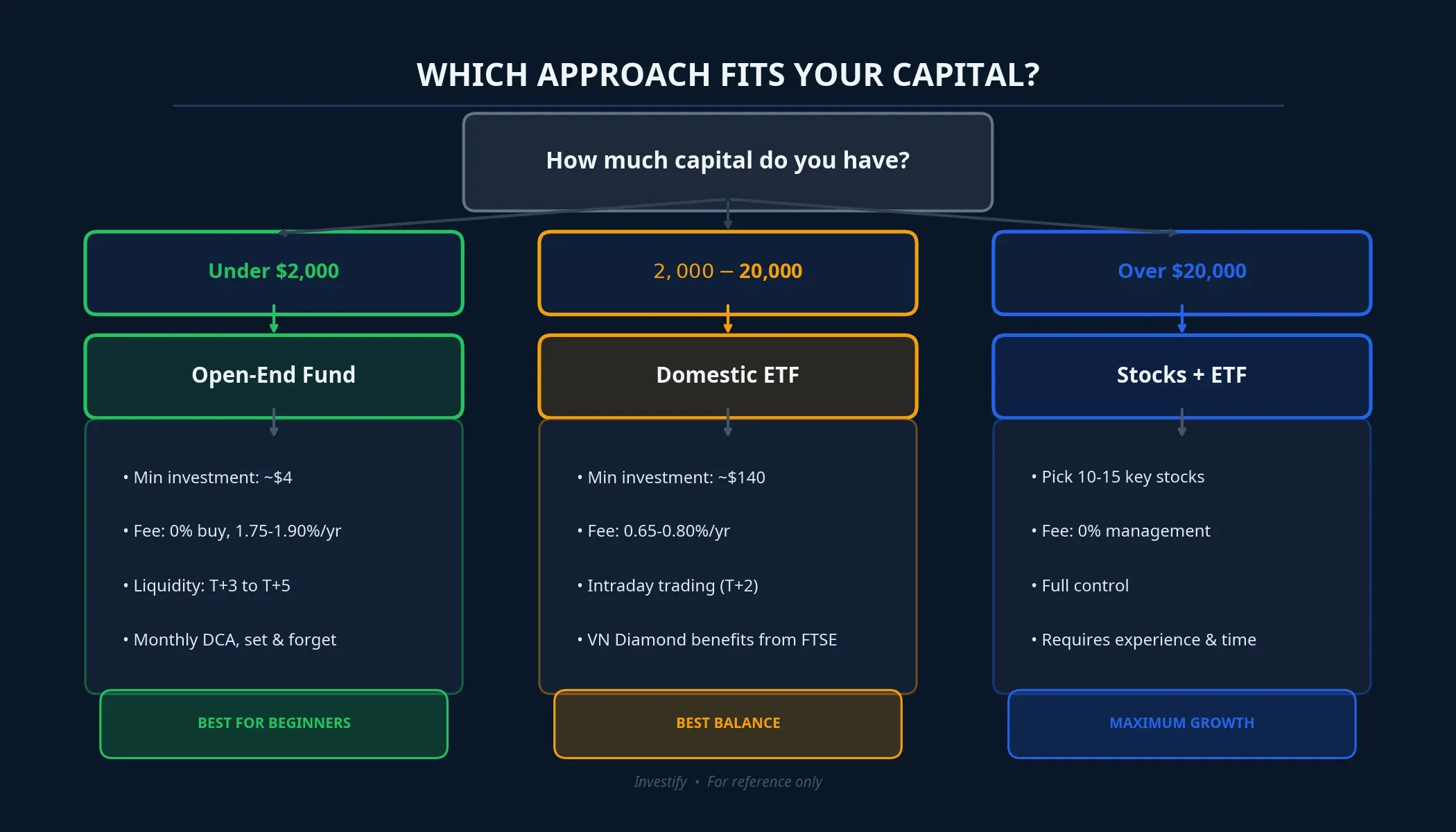
This approach suits investors with over VND 500 million (approximately $20,000), stock analysis experience, and time to monitor the market daily.
Approach 2: Buy Domestic ETFs
One ETF purchase equals owning 20-30 top stocks simultaneously. Popular domestic ETFs for this strategy include E1VFVN30 (tracking VN30, 0.65%/year fee), FUEVFVND (VN Diamond, 0.80%/year fee), and FUESSVFL (VNFin Lead, approximately 0.70%/year fee).VietstockVietstockSSIAM
The minimum investment is only about VND 3.2-3.7 million (~$130-150) for 100 fund certificates, and you can trade intraday like regular stocks (T+2). Notably, FUEVFVND (VN Diamond) has a special advantage for the FTSE wave because the VN Diamond index focuses on stocks that have hit their foreign ownership limits. When foreign funds want to buy these stocks, they must buy through the ETF instead of directly, creating demand pressure on FUEVFVND itself.
However, domestic ETFs have significant tracking errors: E1VFVN30 at approximately 12%/year versus VN30, FUEVFVND at approximately 16%/year versus VN Diamond. These are much higher than international ETFs, and investors should understand that actual performance may deviate from the reference index.
This approach suits investors with VND 10-500 million ($400-$20,000) who want to ride the FTSE wave but don’t have time to pick individual stocks.
Approach 3: Buy Open-End Fund Certificates
This is the simplest approach: invest from VND 100,000 (~$4) through distribution platforms like Fmarket, TCBS, or VPS without needing a securities account.Fmarket Popular stock mutual funds include VCBF-BCF (1.90%/year fee), VEOF by VinaCapital (1.75%/year fee), and VCBF-MGF (1.90%/year fee).FmarketFmarketVCBF
The biggest advantage is its suitability for a DCA (dollar-cost averaging) strategy aligned with the 4 FTSE phases. The fund has a professional analysis team that rebalances the portfolio for you. Management fees are higher than ETFs (1.75-1.90%/year vs. 0.65-0.80%/year), but in return, you don’t need to watch the market or make buy/sell decisions.
The downsides are lower liquidity (T+3 to T+5) and no control over the specific portfolio. This approach suits investors with VND 10-100 million ($400-$4,000) who prefer a “set & forget” strategy prioritizing simplicity.
Choosing the Right Approach by Capital Size
| Criteria | Individual Stocks | Domestic ETF | Mutual Fund |
|---|---|---|---|
| Minimum Capital | ~VND 150-200M | ~VND 3.2-3.7M | VND 100,000 |
| Annual Fee | 0% | 0.65-0.80% | 1.75-1.90% |
| Liquidity | High (T+2) | High (T+2) | Medium (T+3 to T+5) |
| Control Level | Highest | Medium | Lowest |
| Capital Range | Over VND 500M | VND 10-500M | VND 10-100M |
International Capital: The Real Scale
Once the upgrade takes effect, international ETFs tracking the FTSE Emerging Markets index will automatically add Vietnamese stocks to their portfolios. Vanguard VWO, the world’s largest emerging markets ETF with approximately $102 billion in AUM, will allocate a portion to Vietnam.Vanguard Just a 1% allocation from VWO would equal approximately $1 billion. Additionally, SSI Research assesses that the probability of Vietnam being placed on MSCI’s watchlist during the June 2026 or June 2027 review is very high. If this happens, capital flows would be significantly larger than FTSE alone.Fili
Execution Strategy Along the Roadmap
Regardless of which approach you choose, consider allocating capital across 4 phases synchronized with the FTSE roadmap. From now until September 2026, prioritize gradual accumulation and start DCA immediately if choosing ETFs or mutual funds. From Phase 1 to Phase 2 (September 2026 to March 2027), monitor actual Phase 1 capital flows and assess price effects before adding more. Phases 3 and 4 (2027) represent the strongest inflow period, requiring caution against front-running effects as many investors will try to buy ahead.
Risks to Monitor
Three risk factors deserve attention. First, the official list may differ from the reference list since the current 32 stocks are based on December 31, 2025 data. Second, actual capital flows may be lower than the approximately $1.5-1.6 billion estimate, depending on global market conditions. Third, stock prices may have already partially priced in upgrade expectations before passive capital actually arrives (front-running risk).
Where to Start
If you have under VND 50 million, mutual funds through Fmarket or TCBS are the most practical choice at VND 100,000 minimum with monthly DCA. If you have VND 50-500 million, domestic ETFs, especially FUEVFVND (VN Diamond), offer the best balance between cost, liquidity, and exposure to passive capital flows. If you have over VND 500 million with experience, combine direct stock picking of 10-15 key names with ETFs for the remainder.
The deciding factor isn’t choosing the “best approach” but the one that best fits your ability to execute. The official list announcement on August 21, 2026 and actual Phase 1 capital flows in September 2026 will be the two most important signals to watch over the next 5 months.