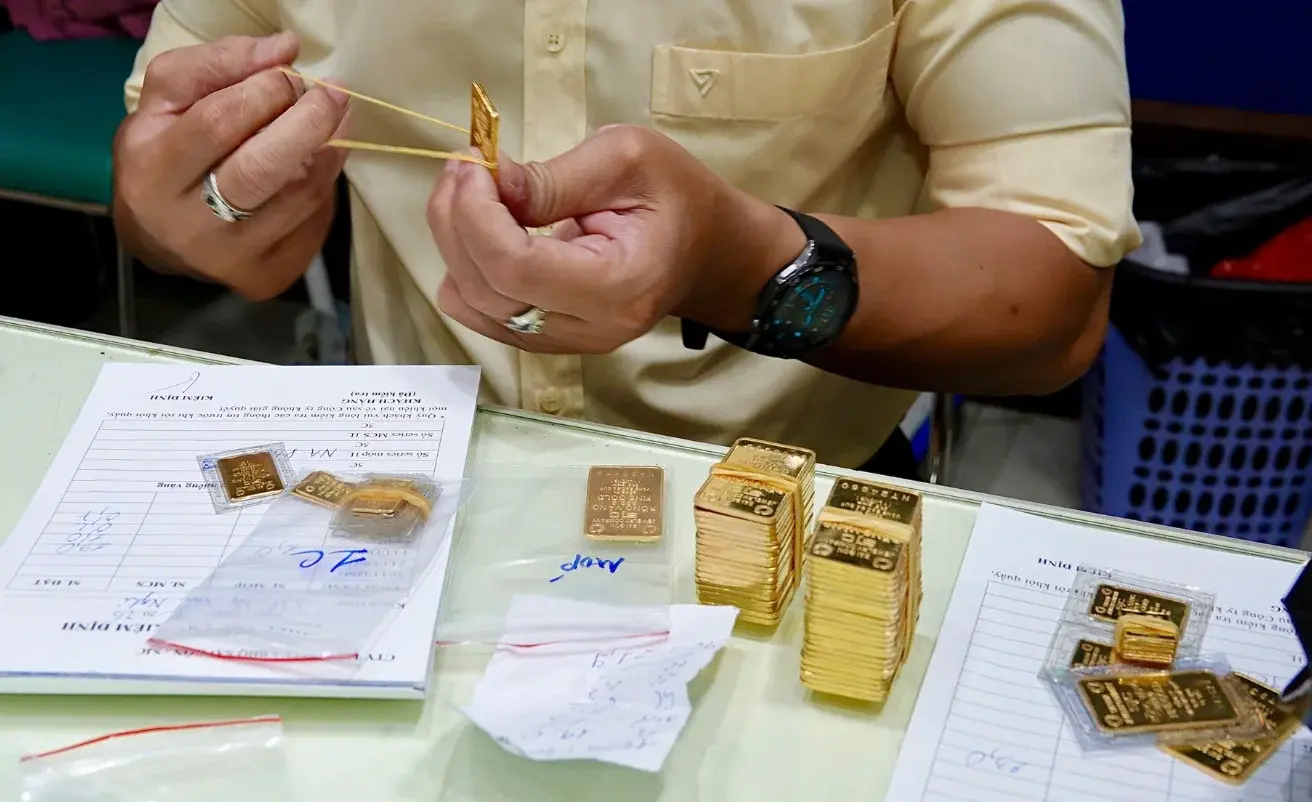

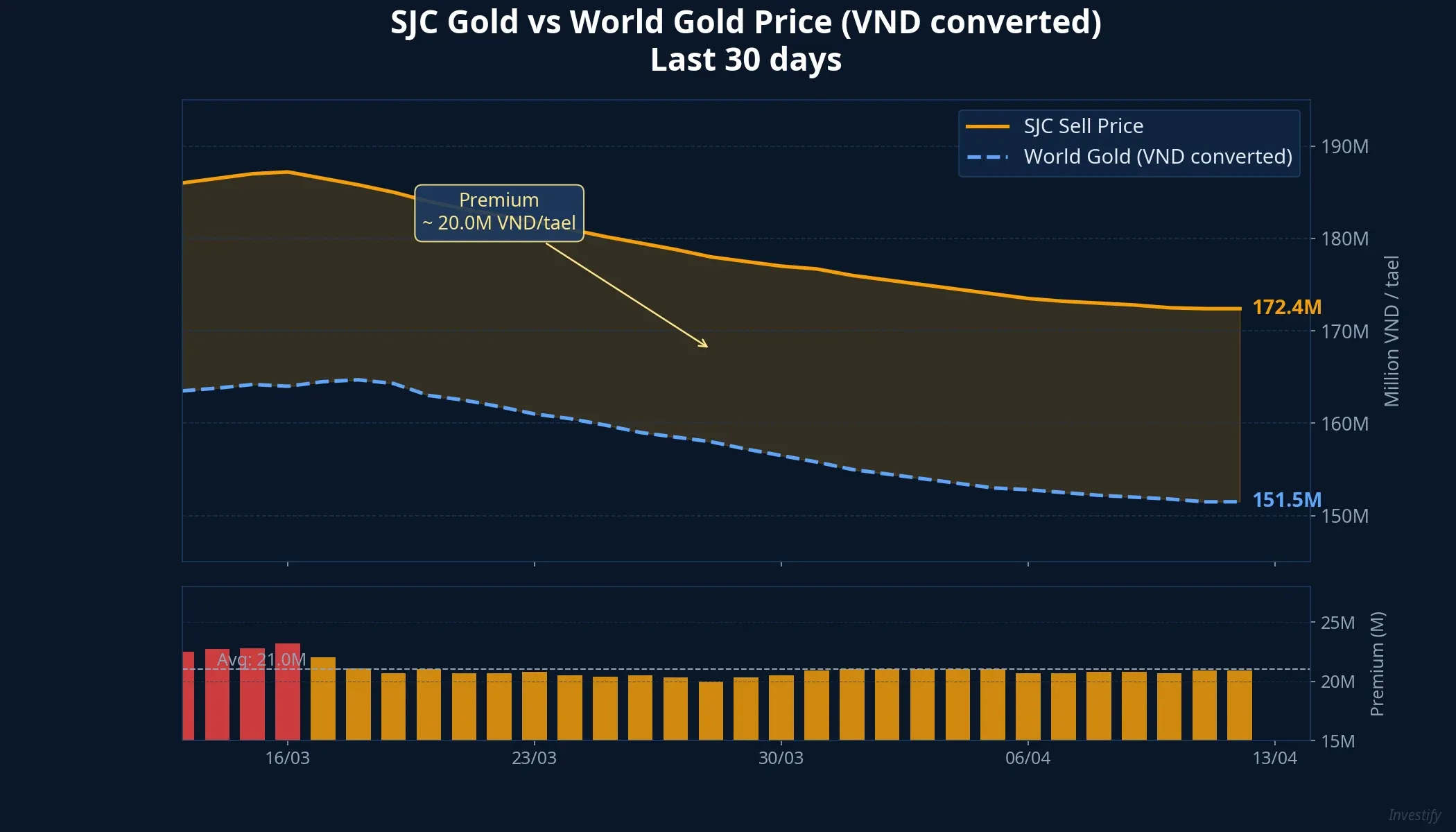
On April 11, 2026, SJC gold bars were listed at 172.4 million VND/tael (sell price), while international gold traded around 4,772 USD/oz — equivalent to approximately 151.5 million VND/tael when converted at the central exchange rate of 26,336 VND/USD. The gap: over 20.9 million VND for the same amount of gold, corresponding to a premium of approximately 13.8%.
This figure is not an anomaly. Throughout April 2026, the spread between SJC sell price and converted world gold price ranged from 20.3 to 25.4 million VND/tael. The widest gap occurred at the beginning of the month, when SJC sold at 176.7 million VND/tael on April 1 while converted world gold was only about 151.9 million VND. This is not a temporary phenomenon. It is the product of 13 years operating within a closed system, beginning with a decree issued in 2012.
2012: Decree 24 and the Monopoly System
Before 2012, Vietnam’s gold market operated relatively freely. Dozens of gold bar brands coexisted, and commercial banks could mobilize and lend in gold. However, the “goldization” of the economy became severe.Government Portal In 2011, inflation surged to 18.58%, gold hoarding sentiment spread widely, putting enormous pressure on exchange rates and monetary policy.
On April 3, 2012, the Government issued Decree 24/2012/ND-CP with three key pillars.Legal Library First, the State holds a monopoly on gold bar production: only the State Bank of Vietnam (SBV) may organize production and import/export gold raw materials. Second, SJC became the national gold bar brand, having already held approximately 90% market share at the time.Anti-Counterfeiting Techniques Third, gold was banned as a means of payment, ending gold mobilization and lending within the banking system.
Decree 24 achieved its initial objectives: combating “goldization,” stabilizing exchange rates, and decoupling gold from the monetary system. But it also created a consequence lasting 13 years: the gold bar market was sealed off, supply was controlled by a single state entity, and SJC became a product with virtually no competition.
Three Layers Creating the Price Gap
Import Restrictions and Supply Control
Under Decree 24, only the SBV may import gold raw materials for gold bar production. Enterprises and banks cannot independently import to supplement supply. When demand spikes during periods of global gold price volatility, domestic supply cannot respond quickly enough. The result: domestic prices are pushed above world prices due to localized scarcity.
SJC’s Monopoly Position
With SJC as the only recognized gold bar brand, all demand for gold bars concentrates on a single product. 9999-purity gold rings have equivalent gold content but are not classified as “gold bars” under regulations, so they trade at lower prices. On April 11, 2026, SJC 99.99% gold rings sold at 170.6 million VND/tael — 1.8 million VND less than SJC gold bars. This difference reflects the “brand premium” created by monopoly status.
Lack of Integration with International Markets
Vietnam does not yet have a centralized gold exchange. Gold bar transactions occur in a fragmented manner at individual enterprises, with no unified listing mechanism or real-time connection to international prices. When world gold prices drop sharply, SJC prices typically decline more slowly due to lack of competitive pressure and automatic adjustment mechanisms.
Data from March–April 2026 clearly illustrates this effect: world gold fell 8.0% from its peak of 5,189 USD/oz (March 10) to 4,772 USD/oz (April 10), while SJC declined a similar 7.9% from 187.2 million to 172.4 million VND/tael. But because SJC already carried a large premium, the absolute gap remained above 20 million VND.

These three factors interact with each other: controlled supply slows market response, brand monopoly reinforces pricing power, and the lack of international connectivity prevents self-correction mechanisms from functioning effectively.
Decree 232: The Reform Door Opens from October 2025
On August 26, 2025, the Government issued Decree 232/2025/ND-CP, effective from October 10, 2025, with three crucial changes.Policy Development
The most significant change eliminates the monopoly on gold bar production. Enterprises with charter capital of 1,000 billion VND or more, and commercial banks with capital of 50,000 billion VND or more, may register to produce gold bars under their own brands, subject to technical requirements and SBV licensing.Government Portal
Additionally, all gold transactions valued at 20 million VND per day or more must be conducted via bank payment accounts, increasing transparency and combating money laundering.Legal Library The decree also brings gold account trading and gold derivatives under regulatory oversight, establishing a legal foundation for new gold-related financial products.

6 Months Later: Why Does the Premium Remain Above 20 Million?
Decree 232 took effect in October 2025, yet by April 2026, the SJC-to-world premium still ranges around 20–25 million VND/tael. Following the reform trajectory, three main factors explain the delay.
First, licensing new gold bar manufacturers takes time. The SBV must issue detailed implementing circulars, and enterprises must meet technical, capital, and vetting requirements. As of April 2026, there is no official information about any private enterprise being licensed to produce gold bars apart from SJC.
Second, the national gold exchange remains in the implementation phase. The Prime Minister has directed the SBV to urgently launch the gold exchange, with a target before February 10, 2026.CafeF However, actual progress has been slower than expected as the SBV takes a cautious approach to designing a model aligned with macroeconomic stability objectives.Policy Development
Third, market habits are difficult to change in the short term. Gold bar buyers still prefer the SJC brand, and the distribution system remains concentrated on this product. The mindset that “SJC gold is the standard” has been deeply embedded in Vietnamese consumers’ perception for over a decade.
Looking Ahead: Narrowing or Persistent?
In the medium term, two groups of factors pull the price gap in opposite directions.
On the narrowing side: if the SBV completes licensing for 2–3 enterprises or banks to produce gold bars, supply will diversify. When the gold exchange officially operates, transparent listing mechanisms and international price connectivity will create competitive pressure. Bank payment requirements also enhance oversight, limiting speculative price inflation.
On the persistence side: demand for SJC gold bars remains very strong due to consumer habits and sentiment. The SBV may control the licensing pace to avoid supply shocks. Global gold price volatility amid geopolitical tensions continues to stimulate domestic gold hoarding demand.
Notably, with the premium sustained at 20–25 million VND/tael, investors buying SJC gold are paying approximately 13–17% more than the pure gold value at international prices. If the premium narrows in the future due to the gold exchange operating or supply increasing, this “brand premium” could decline, affecting resale prices. This is a risk that SJC gold buyers at current price levels should factor in.
Conclusion
13 years after Decree 24/2012, Vietnam’s gold market structure has created a systemic price gap between domestic and international prices. Decree 232/2025 opens the door to reform, but the transition from a closed to an open system takes time.
The decisive factor in the next 12 months is the pace of licensing new gold bar manufacturers and the progress of launching the national gold exchange. If both proceed on schedule, the price gap could begin narrowing meaningfully by late 2026. If delays continue, the 20+ million VND/tael premium will remain a reality that Vietnamese gold buyers must accept for some time longer. Three factors worth monitoring: (1) implementing circulars for gold bar production licensing, (2) the national gold exchange launch timeline, (3) the SBV’s gold raw material import decisions.