
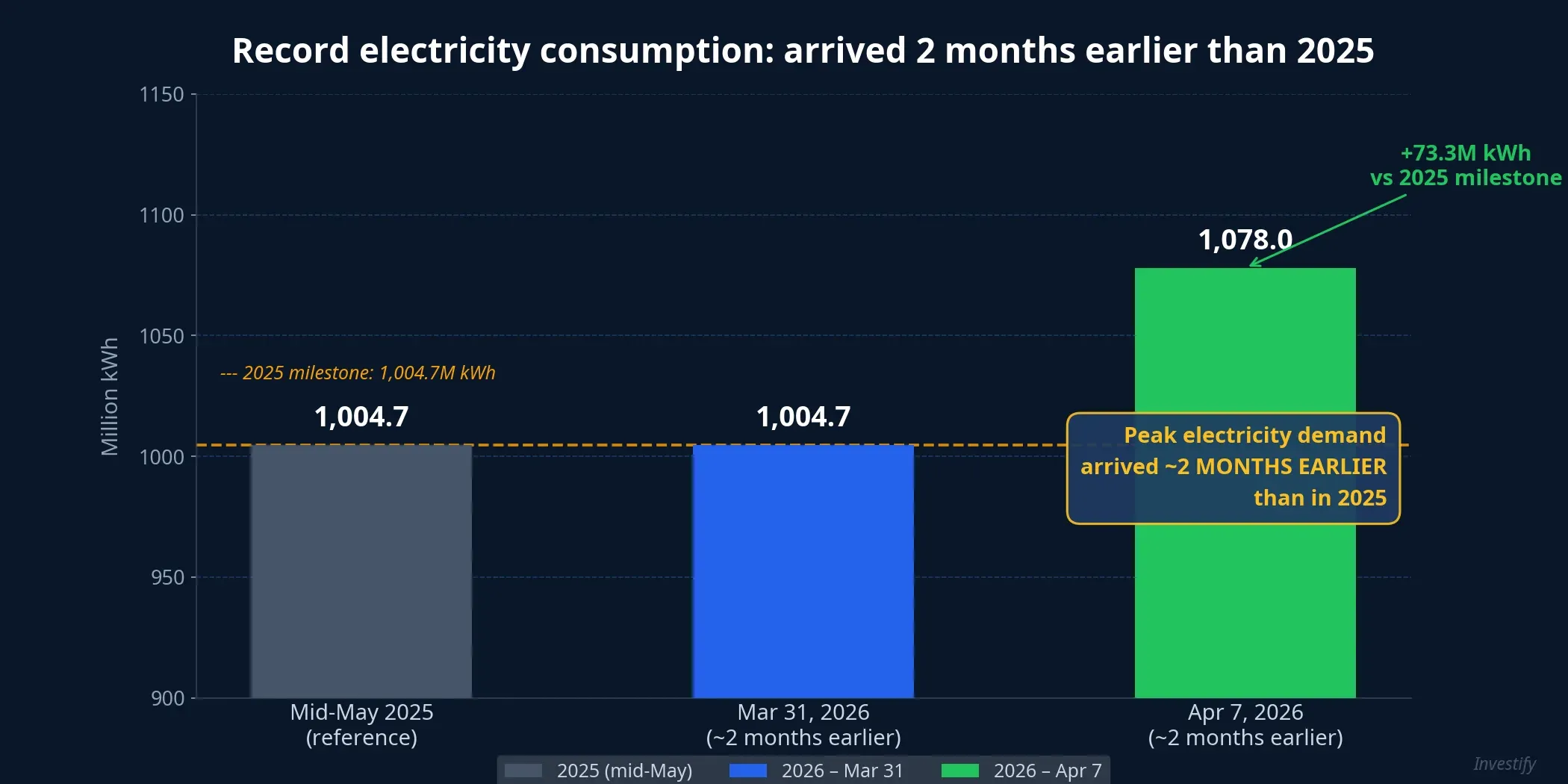
On April 7, 2026, Vietnam’s national power grid recorded daily consumption of 1,078 million kWh, up 15.2% year-on-year.VietnamPlus What stands out is not just the absolute figure, but the timing: in 2025, the 1-billion-kWh/day milestone only appeared in mid-May. This year, the system hit that threshold on March 31 — roughly two months earlier.EVN
This abnormally early record is not merely a weather story. It reflects three overlapping risk layers testing the energy system, while simultaneously creating clear divergence among power stocks.
Surging demand: manufacturing and weather push load simultaneously
The first driver comes from the manufacturing sector. Continued FDI expansion at industrial zones in both northern and southern Vietnam has been pulling industrial load steadily higher since the start of the year. Northern Vietnam alone saw a 49-million-kWh increase on March 31, equivalent to 11.9% year-on-year.EVN
The second driver is weather. Intense heat arrived from late March instead of mid-May as per seasonal norms, sharply boosting residential and commercial cooling demand. Peak capacity (Pmax) on April 7 reached 51,691 MW at 3:55 PM, with the North leading at 501 million kWh (46.6%), the South at 467 million kWh (43.5%), and the Central region at 106 million kWh (9.9%).VietnamPlus
With both industrial and residential loads surging simultaneously, the system must dispatch at levels far exceeding initial plans. According to SSI Research, nationwide electricity demand in 2026 is projected to grow approximately 8.5% year-on-year.Stockbiz The power sector is preparing for a peak dry-season scenario with load growth up to 14.1% year-on-year.CafeBiz With heat expected to persist through at least July, load pressure will continue throughout Q2 and Q3.
Supply bottleneck: 170+ stalled projects and the Power Plan VIII challenge
While demand surges, the supply side faces a serious bottleneck. Over 170 renewable energy projects (wind and solar) are stalled due to pricing mechanism disputes, power purchase agreement (PPA) negotiations, and prolonged administrative procedures.Tien Phong This represents significant capacity that cannot enter operation precisely when the system needs it most.
Power Plan VIII, though approved with revisions, has seen many projects fall behind schedule. Large-scale LNG gas power projects — expected to add critical baseload capacity — have mostly not broken ground. According to the Ministry of Industry and Trade, virtually no major new power project has been commissioned in the past 10 years, creating a dangerous gap in the system.Nguoi Quan Sat
Hydropower, the lowest-cost source, depends entirely on hydrological conditions. The dry season means falling reservoir levels and declining hydro output at exactly the moment the system needs it most. If heat persists abnormally, reserve margins could narrow to the point where the system must increase thermal dispatch — which is more expensive and tied to fuel price risk.
Fuel costs escalating: the double leverage from oil and coal
Brent crude has risen from $77.74/barrel in early March to $101.78/barrel on April 13, equivalent to approximately a 31% increase in just 6 weeks. This is a direct consequence of geopolitical tensions at the Strait of Hormuz and U.S. sanctions on Iran. International coal prices have also climbed from $118.50/ton in late February to $134.90/ton on April 10, up approximately 14% over the same period. Natural gas is hovering around $2.67/MMBtu, down slightly from the mid-March peak of $3.23/MMBtu but still elevated.
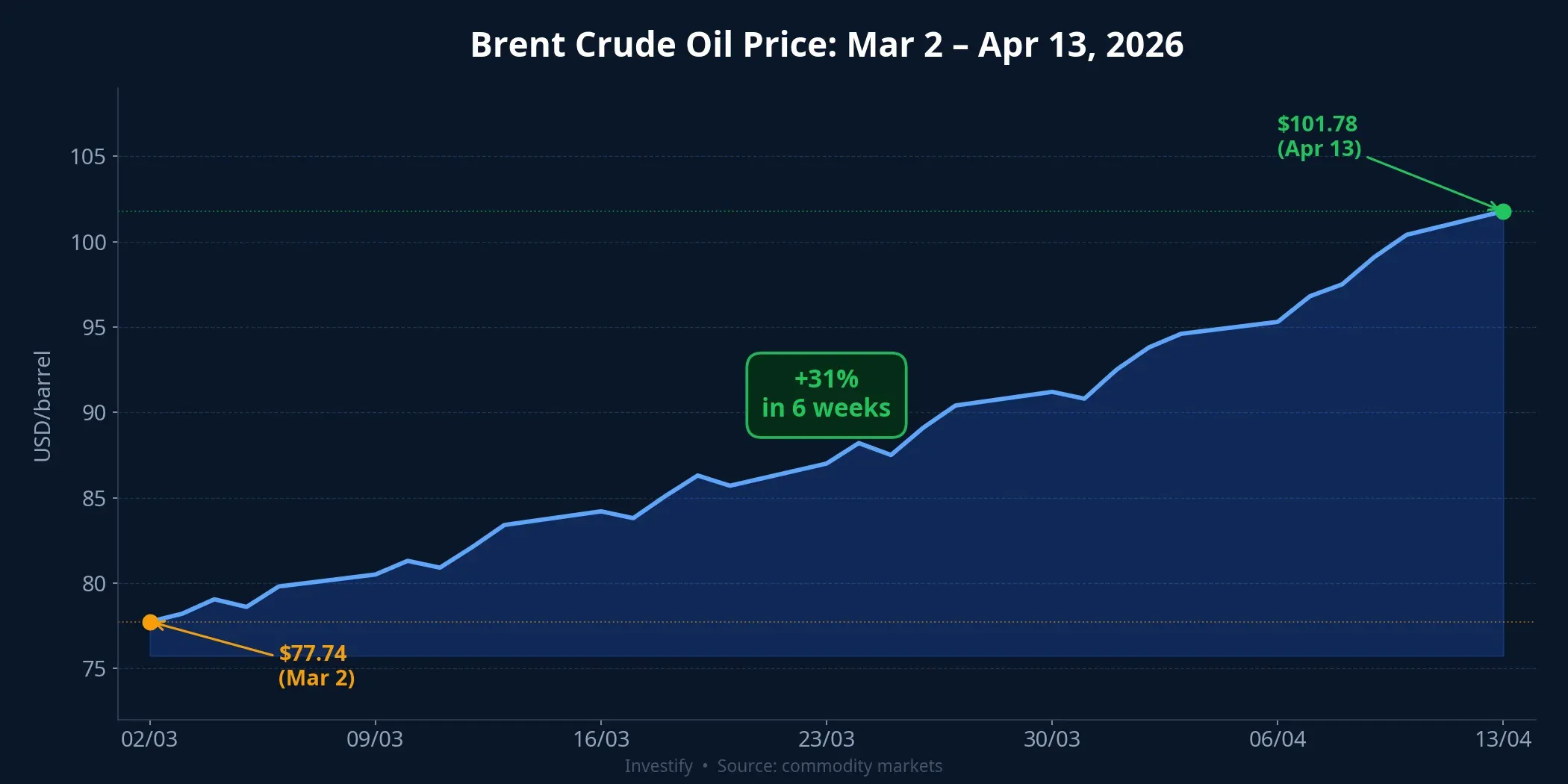
In Vietnam’s power generation mix, thermal power (coal + gas) accounts for approximately 50% of total output. As hydropower declines during the dry season, the share of thermal power rises, and the marginal cost of generation becomes more sensitive to global fuel prices. Brent above $100/barrel and coal above $130/ton translate to significantly higher generation costs. This is the “double leverage”: fuel costs rising at precisely the time the system must dispatch more thermal power.
Government response: conservation directives and load management
On March 30, 2026, the Prime Minister signed Directive No. 10/CT-TTg on strengthening electricity conservation and promoting rooftop solar power.NNMT Specific targets include: saving at least 3% of total national electricity consumption in 2026; achieving at least 10% savings during peak months (April through July); and cutting at least 3,000 MW of peak-hour load through demand management programs.
The Ministry of Industry and Trade has also committed to “absolutely no power shortages” during the dry season and throughout 2026.Dai Doan Ket However, policy commitments are a necessary condition, not a sufficient one. Execution on a system facing all three pressure layers simultaneously remains an open question, particularly if heat persists abnormally or fuel prices continue rising.
Power stocks: clear divergence over 6 weeks
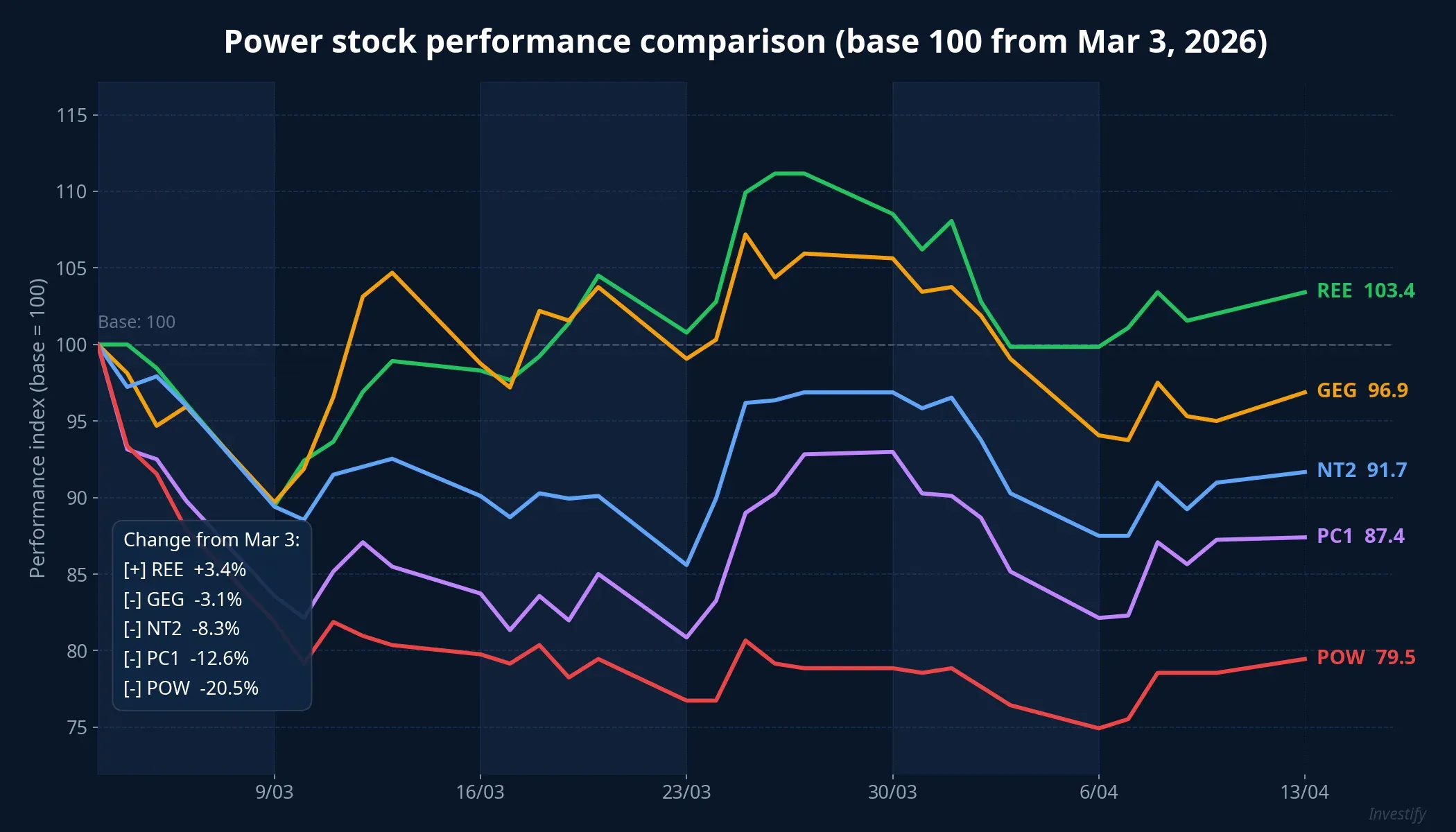
The strained energy landscape creates both opportunities and risks for power stocks. Price action over the past six weeks shows sharp divergence.
REE is trading at VND 66,700, up approximately 3.4% from early March — the only stock in the group with positive performance. Its diversified portfolio of wind and hydropower assets, plus an office real estate segment, provides stable cash flows with a market cap of VND 36,100 billion.
POW at VND 13,150, down approximately 20.5% from early March, underperforming the broader market. The market is pricing in concerns about rising input gas costs. However, POW benefits when hydropower declines during the dry season; full-year 2026 projections show output potentially increasing 24% year-on-year.Alias The question is whether profit margins can hold as input gas prices surge.
PC1 at VND 27,400, down approximately 12.6%. PC1 has a distinct advantage from its large power grid construction backlog, benefiting from the 2026–2030 grid investment cycle. NT2 at VND 26,400, down 8.3%, is a pure gas thermal power company with stable dividend cash flows but direct sensitivity to fuel prices. GEG at VND 15,500, down just 3.1%, offers upside potential from the renewable energy push in the revised Power Plan VIII, though its higher leverage is a risk to monitor.
Three decisive variables over the next 90 days
Vietnam’s power system faces pressure from three overlapping risk layers: demand arriving earlier and stronger than expected, supply bottlenecked by 170+ stalled projects, and fuel costs escalating with geopolitics. Three specific variables will determine the direction of power stocks in Q2–Q3:
Hydrology and hydropower output. If heat persists, hydropower drops sharply, and thermal dispatch increases. This benefits POW on volume but pressures profit margins if gas prices stay high. REE, with its diversified hydro portfolio, would face greater downside in this scenario.
Global fuel prices. Brent sustained above $100/barrel would sharpen the divide between thermal power companies (POW, NT2 — facing cost pressure) and renewable/construction players (REE, PC1, GEG — less sensitive to fuel prices).
Progress on unblocking 170+ renewable projects. Any positive policy signals (new pricing mechanism, PPA framework) would catalyze GEG and the broader renewable energy group.
Amid these three overlapping risk layers, REE and PC1 hold the best-balanced positions thanks to diversified portfolios and low fuel price dependency. POW offers strong volume potential but profit margins remain the biggest unknown. Q2 earnings reports from thermal power companies will be the decisive data point for assessing the true impact of fuel costs on sector profitability.