
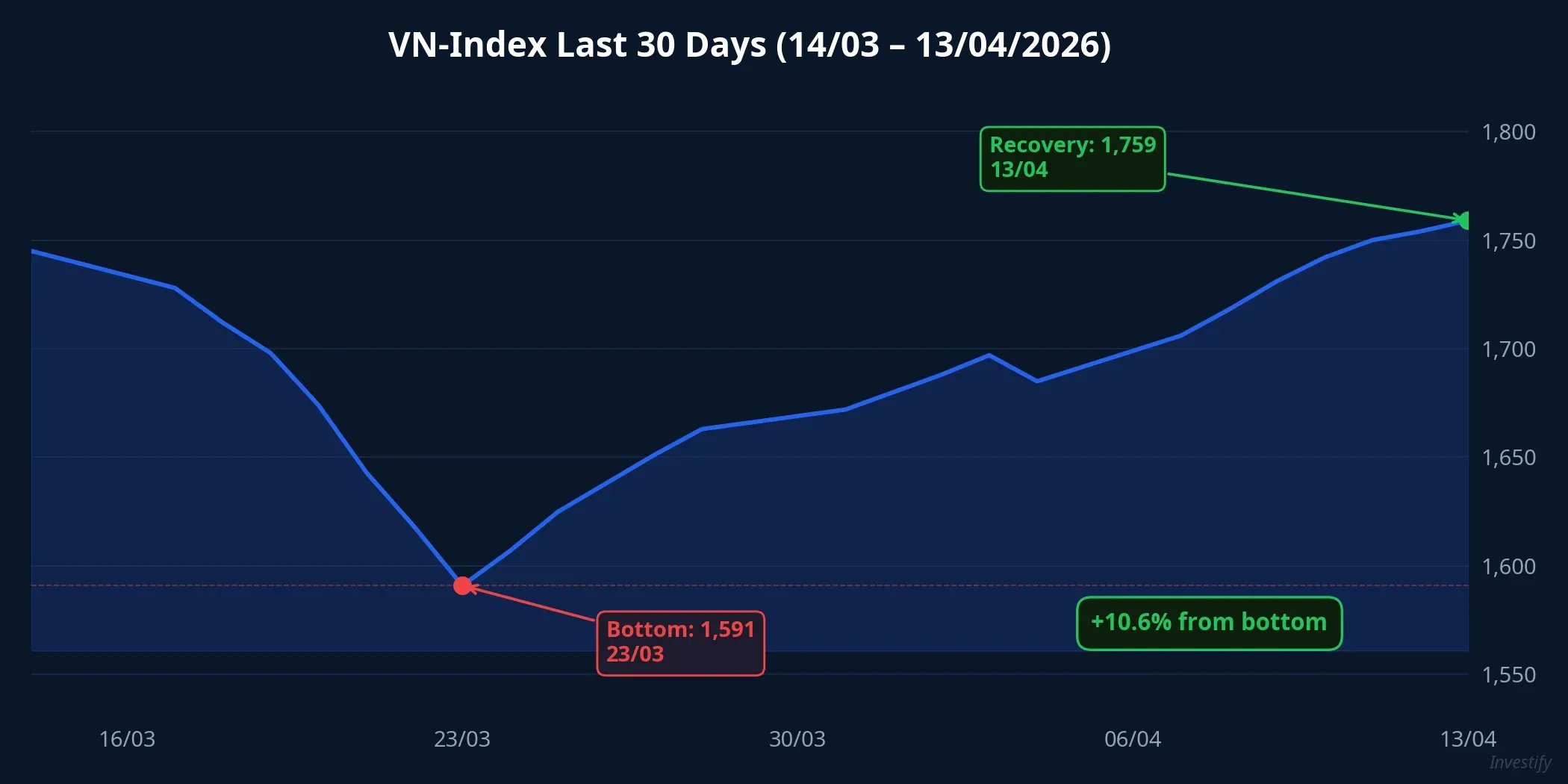
VN-Index has recovered roughly 10.5% from its 1,591-point bottom on March 23, closing at 1,758.96 on April 13. But the institutional flow picture tells a different story: Q1/2026 recorded over 14,400 billion VND in net outflows from equity funds, marking the fifth consecutive quarter of negative flows. When prices rise but money leaves, who is reading the market correctly?
An impressive recovery, but deteriorating quality
Three consecutive weeks of gains lifted VN-Index from the 1,591 zone to nearly 1,760. However, the April 13 session recorded only 140 advancing stocks versus 187 decliners, showing that gains were concentrated in large-cap leaders rather than spreading broadly.ASEANSC Session volume reached approximately 880 million shares, below the average during the period before the index hit its 1,818-point peak in early March.
Weak breadth combined with declining volume suggests that money is being selective rather than flowing into the market evenly. This is precisely the factor keeping many large asset managers in a defensive posture despite the significant index recovery.
Q1/2026: record quarterly outflow exceeding 14,400 billion VND
Total net outflows from equity funds in Q1/2026 surpassed 14,400 billion VND, a 2.6x increase year-on-year.VnEconomy This figure equals 41.7% of total net outflows for all of 2025 (a record year with approximately 31,000 billion VND in redemptions).VnEconomy
Redemption pressure was concentrated in equity funds, accounting for 64% of total industry-wide net outflows.VnEconomy
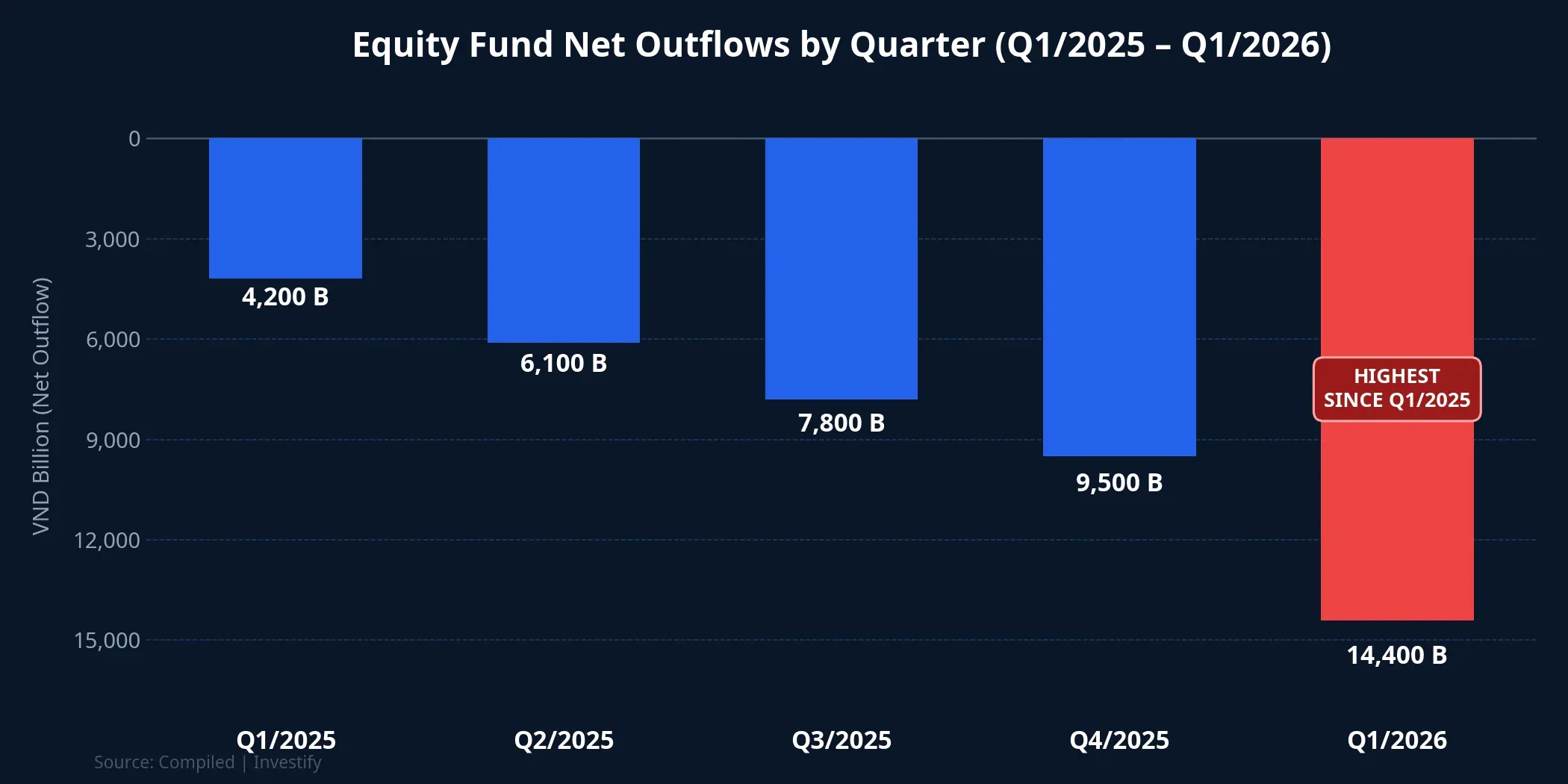
March 2026 alone saw over 5,400 billion VND in net outflows, a 59% increase from February.VnEconomy This was the month VN-Index experienced its sharp correction from the 1,810 zone down to the 1,591-point bottom before beginning its recovery. ETFs bore the heaviest pressure with over 3,200 billion VND in outflows, the highest since August 2025.VnEconomy
Clear divergence: Dragon Capital hit by outflows, Vinacapital bucks the trend
The two largest ETFs suffered the sharpest outflows in March: VanEck Vietnam ETF (VNM) saw approximately 1,900 billion VND in net redemptions — a record for this fund — and DCVFM VN Diamond ETF lost approximately 1,000 billion VND.VnEconomy Together, these two funds accounted for nearly 90% of ETF outflows in March, reflecting selling pressure from foreign and institutional investors.
Among domestic open-end funds, the picture diverges sharply. DCDS (VFMVF1) — Dragon Capital’s largest domestic equity fund — suffered over 449 billion VND in net outflows during Q1/2026, equivalent to 7.1% of beginning-of-period AUM. EVESG (an ESG-focused fund) also lost over 203 billion VND. In contrast, Vinacapital’s funds maintained positive inflows: VESAF recorded +144 billion VND and VMEEF +139 billion VND.
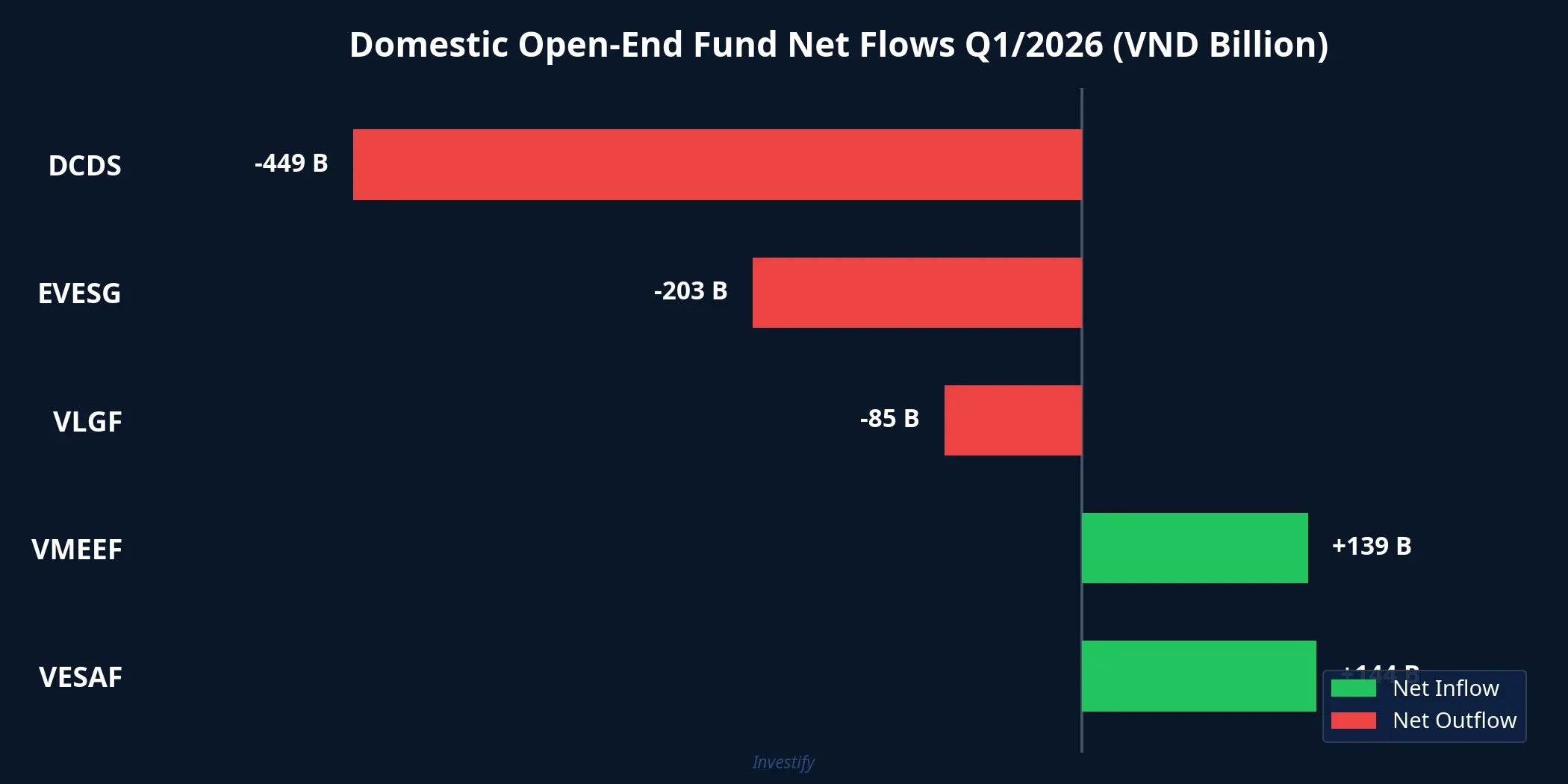
This divergence shows that fund investors are not withdrawing en masse, but rather reallocating their capital. Growth-oriented funds (VESAF, VMEEF) still attracted new capital, while large index-linked funds (DCDS) faced outflow pressure.
Cash positions at unusual highs: a clear defensive signal
Beyond suffering net outflows, large equity funds are actively raising their cash positions. DCDS — with over 5,800 billion VND in AUM — holds 15% in cash. MBVF has raised its cash ratio to 16.19%, while VCAMDF sits at 27.67%.
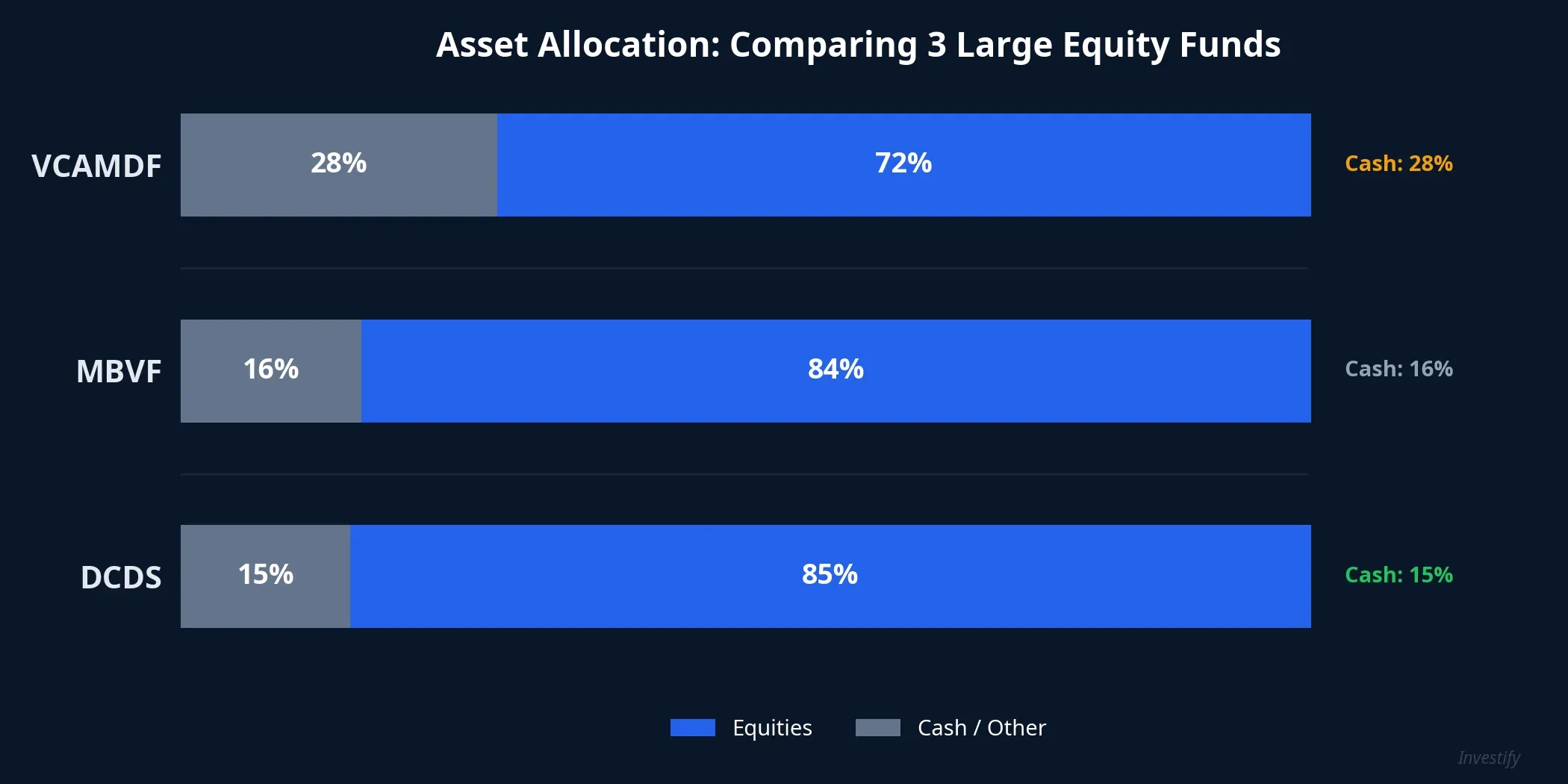
Cash positions of 15-28% are unusually high for equity funds during a market recovery phase. Normally, equity funds maintain cash ratios below 10% when uptrends are clear. The trend of rising cash positions is concentrated among large-scale funds (NAV above 5,000-8,000 billion VND), while smaller funds have been reducing cash to ride the market recovery.VnEconomy
This picture shows large funds trading short-term opportunity for defensive liquidity, while smaller funds are willing to take on more risk to chase the rally.
Three factors behind the defensive stance
Weak breadth undermines the rally’s foundation. VN-Index gained 10.5% from its bottom, but the April 13 session had only 140 out of 327 stocks advancing. Multiple sessions during the recovery recorded more decliners than advancers, indicating money is flowing to blue-chip leaders rather than spreading broadly. This is a sign the rally is vulnerable if the leading stocks lose momentum.
Unresolved macro risks. The US-Iran conflict and the risk of a Hormuz blockade remain major variables. With March 2026 CPI rising 4.65% YoY, the high-interest-rate and rising-inflation environment is pushing large funds to prioritize liquidity over short-term returns.
Valuations less attractive after the strong 2025 rally. VN-Index rose significantly in 2025, and many blue-chip stocks had already priced in earnings growth expectations. With valuations elevated, large funds typically reduce exposure to wait for better entry points, especially ahead of the upcoming Q1/2026 earnings season.
Two scenarios, one decisive factor
The divergence between price (VN-Index rising) and fund flows (record outflows) is not an absolute buy or sell signal, but rather one that must be interpreted in context.
If funds are right: the current recovery is merely a technical bounce after the 12.5% drop from the 1,818 peak to the 1,591 bottom. Weak breadth, narrow money flows, and unresolved macro risks could cause the market to reverse once the bounce runs its course.
If the market is right: FTSE’s official upgrade of Vietnam to Emerging Market status (effective September 2026) is expected to bring approximately $1.5 billion in passive capital inflows. Q1/2026 GDP grew 7.83% YoY, and the economy maintains positive momentum.ASEANSC Large funds may be overly cautious, and capital will return as the upgrade event draws closer.
The decisive factor is the Q1/2026 earnings season, expected in late April. If corporate profits show strong growth, funds will need to deploy capital or accept underperformance against their benchmarks. Conversely, if earnings disappoint, the current defensive strategy will be vindicated.
An important distinction: institutional on-exchange trading flows (net buying/selling of stocks) and fund subscription/redemption flows are two different signals. A fund can be net buying on the exchange while simultaneously facing net redemptions from investors. Current signals show: funds are holding stocks but raising defensive cash positions, while retail investors through funds are pulling money out.
Three factors to watch in the coming week: will breadth improve as VN-Index pushes above 1,760? Will foreign ETF flows reverse? And will early Q1 earnings reports be strong enough to shift the large funds’ strategy?