

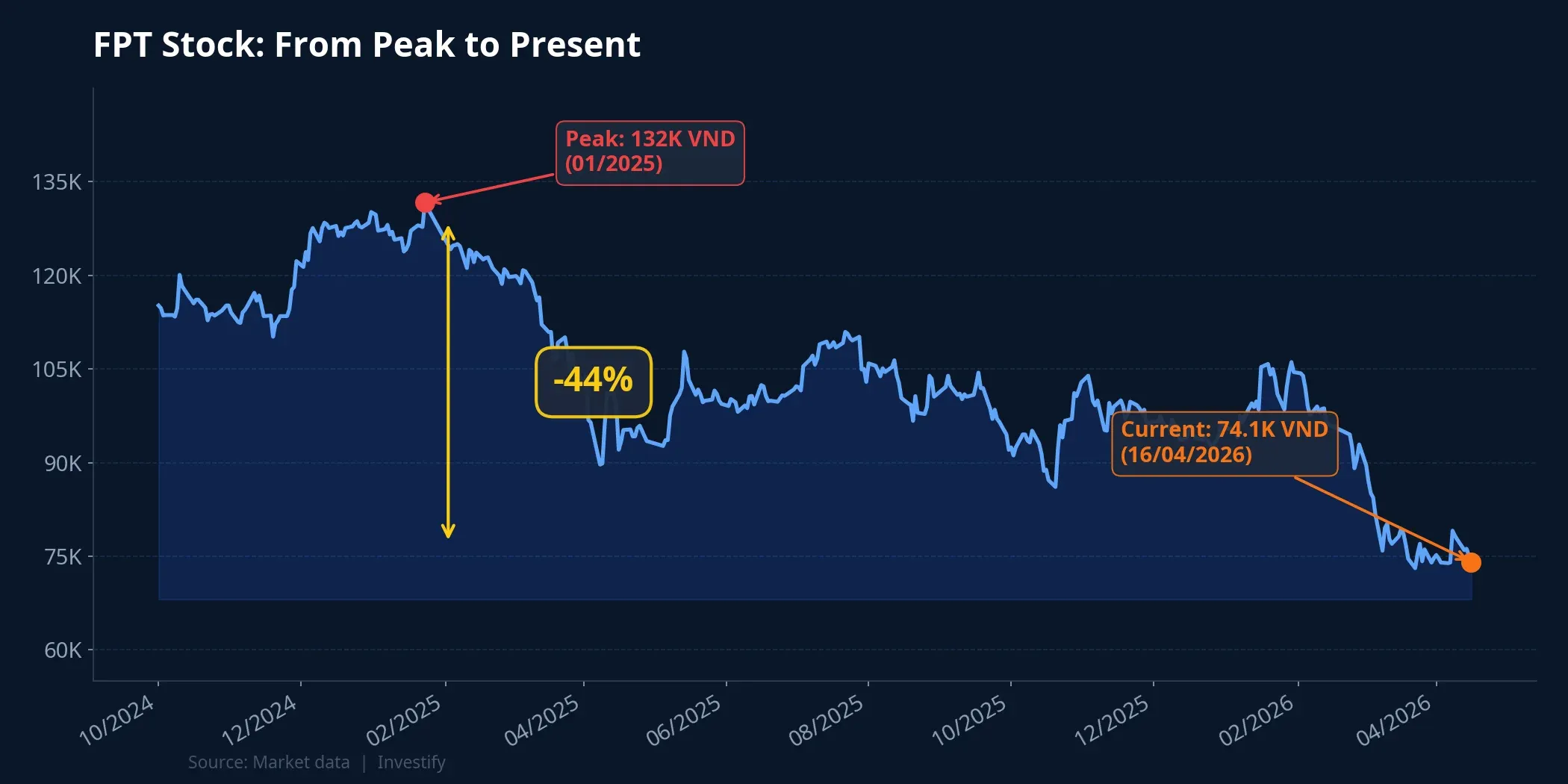
FPT shares closed at VND 74,100 on April 16, down 43.7% from their all-time high of VND 131,666 set in January 2025. At the annual general meeting held the same day, Chairman Truong Gia Binh made a rare acknowledgment from a top-tier bluechip leader: “I deeply sympathize with shareholders given how long and deep the stock has fallen.”Tuoi Tre It was the first time in years that the head of Vietnam’s largest technology conglomerate publicly admitted the extent of losses shareholders have endured.
By the numbers, market capitalization shrank from approximately VND 193,700 billion at the peak to VND 126,200 billion, a loss of roughly VND 67,500 billion. Year-to-date in 2026 alone, the stock has declined 22.7%. The key question: has the current price fully priced in the risks, or is there still room to fall?
A Bluechip Out of Sync With the Market
The most notable pattern in recent months is the stark divergence between FPT and the broader market. Since the VN-Index bottomed at 1,652 points on March 9, the benchmark has rallied 10.1% to 1,819 points on April 16. Over that same period, FPT slid from VND 75,900 to VND 74,100, losing another 2.4%. The divergence gap reached 12.5 percentage points, making FPT one of the most disappointing bluechips on the exchange in the recent quarter.
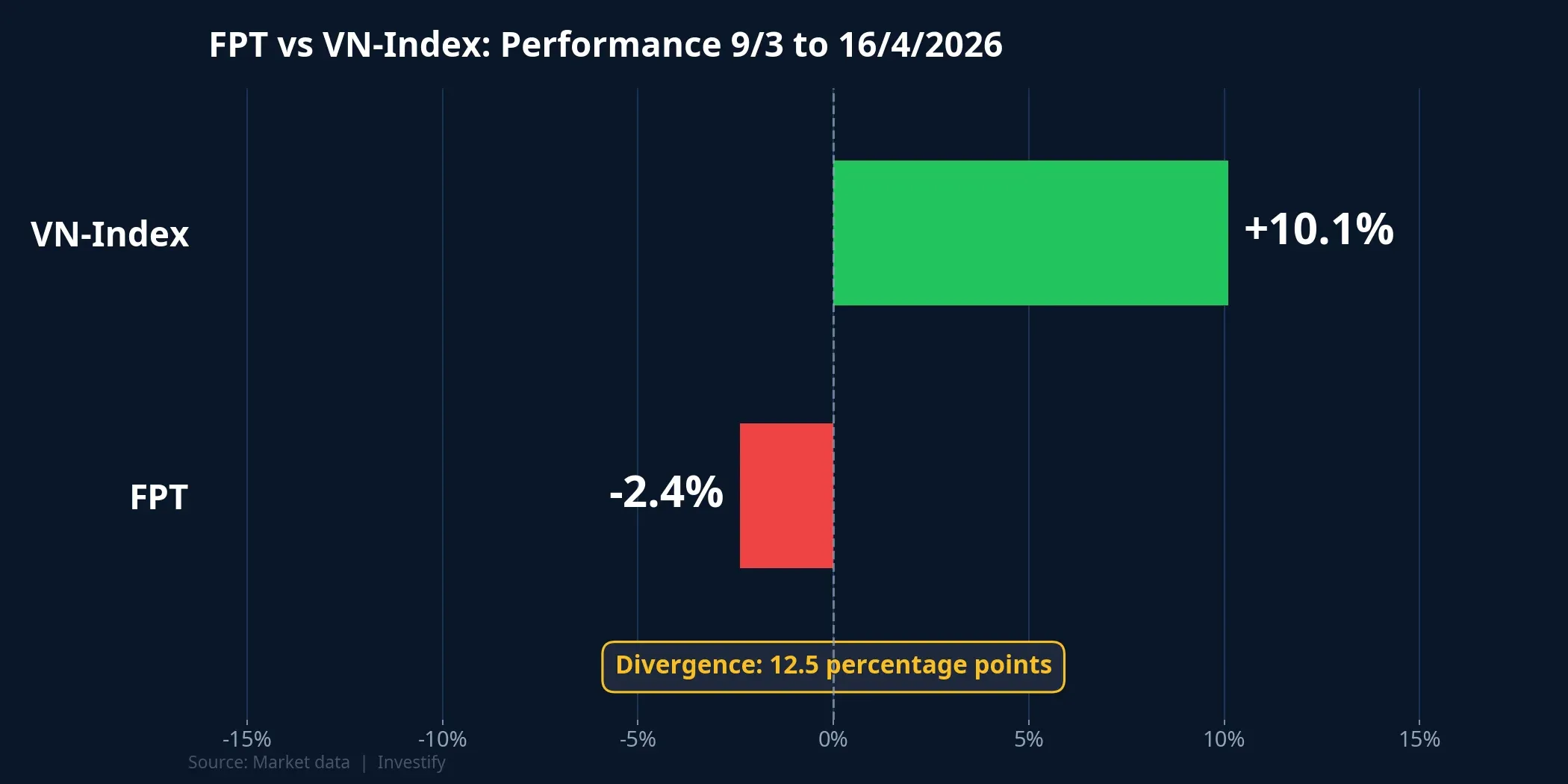
This decoupling signals that selling pressure on FPT is structural, not merely a market trend. Its large capitalization and high liquidity make it a priority target when foreign funds rebalance their portfolios.
Three Reasons Behind FPT’s Deep Decline
Intense Foreign Net Selling
The most direct factor has been the wave of foreign net selling. On February 25, 2026 alone, foreign investors dumped VND 2,333 billion in a single session.Suc Khoe & Doi Song Sustained selling over multiple weeks has significantly reduced foreign ownership compared to the peak period. Contributing factors include regional ETF rebalancing and capital outflows from emerging markets amid a strengthening US dollar.Tuoi Tre
AI Disruption Fears for the Labor-Intensive Model
A deeper concern lies in the fear that AI will displace FPT’s core business model itself.VietnamFinance As AI tools demonstrate the ability to write code and modernize systems autonomously, FPT’s labor-intensive IT services model — the engine of its rapid growth for years — faces serious questions. The irony is that AI, the very thing FPT is betting biggest on, is the factor making the market most anxious about the future of its traditional revenue streams.
Sky-High Peak Valuation and Macro Shocks
In early 2025, FPT traded at nearly 30x P/E and roughly 7.5x P/B, pricing in very high growth expectations. When global tech stocks weakened and US tariff policies weighed on Vietnamese market sentiment, FPT became the first target for profit-taking. Global IT budgets also decelerated, lowering expectations for FPT’s overseas IT revenue growth.
2026 Business Plan: Double-Digit Growth Despite Consolidation Change
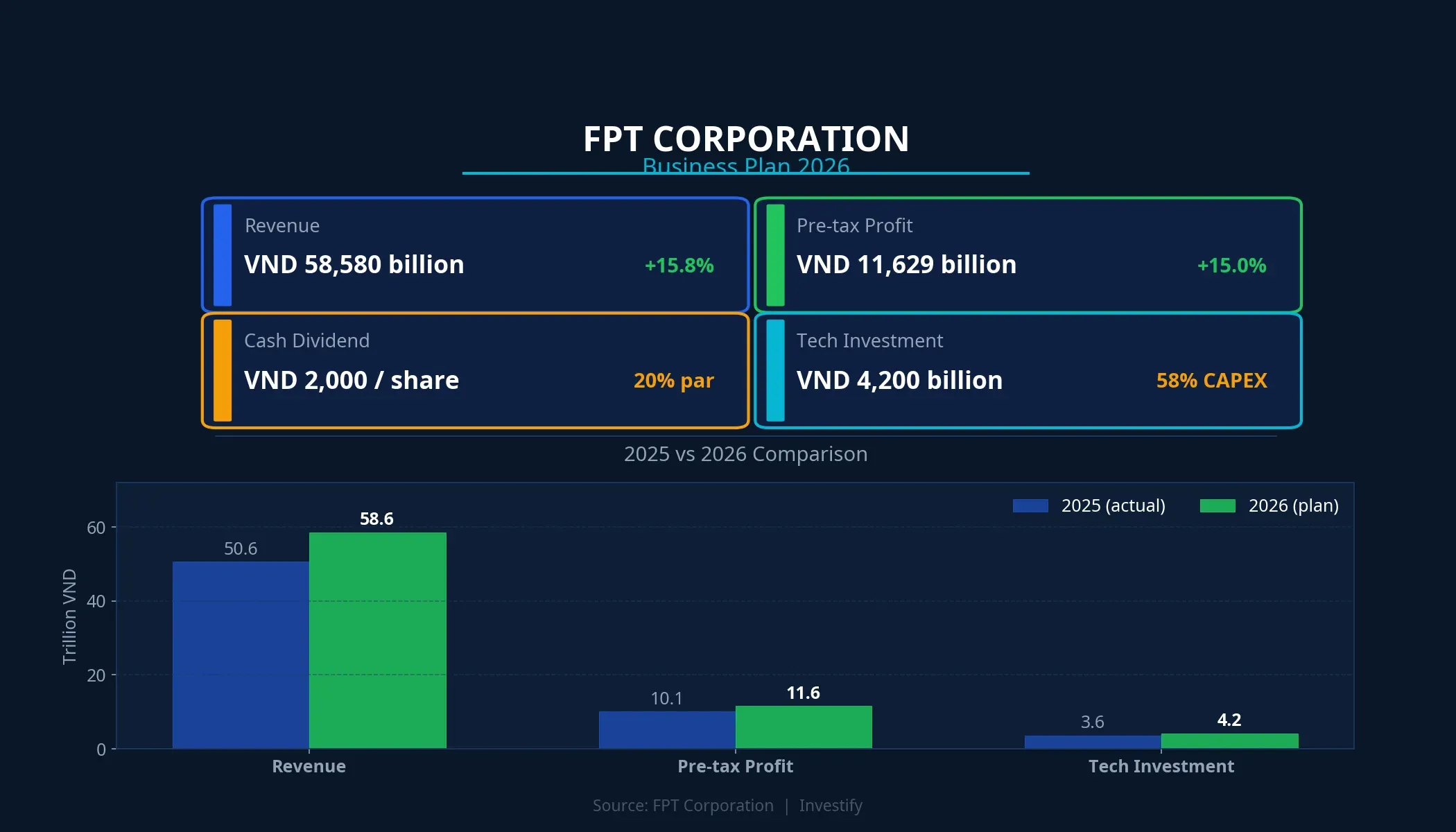
The AGM approved 2026 targets of VND 58,580 billion in revenue and VND 11,629 billion in pre-tax profit, up 15.8% and 15% respectively versus 2025.Vietstock Analysts project approximately VND 10,998 billion in after-tax profit and EPS of roughly VND 6,419.
An important note: this year’s figures have changed because FPT Telecom (FOX) shifted from full consolidation to the equity method. This makes reported revenue and profit appear approximately 11% lower under the old methodology, but does not affect the actual profit attributable to parent company shareholders.VietnamBiz
Within the structure, the technology segment is expected to contribute VND 52,650 billion in revenue and VND 7,350 billion in pre-tax profit, up 18.4% and 24.9% year-on-year.DNSE This remains the main growth pillar, suggesting management expects the IT services business to be unaffected by AI in the near term.
AI-First Strategy: Five Keywords for the New Phase
Chairman Truong Gia Binh outlined five strategic keywords: “Intelligence, Semiconductors, EVs, Digital, Green” (AI, Semiconductors, Electric Vehicles, Digital Transformation, Green Transformation). FPT declared a shift from pure growth to investing in core technologies.
On AI, the ecosystem comprising FPT.AI, AI Agents, AI Studio, and FleziPT is being deployed across finance, healthcare, manufacturing, and logistics. The AI Factory in Vietnam reached breakeven in late 2025; the Japan facility targets breakeven by mid-2026. Binh stated FPT has entered “phase 3” with contracts worth hundreds of millions of dollars, becoming the first Southeast Asian company to join Microsoft’s AI alliance.
Beyond AI, FPT is expanding into semiconductor chip design, UAVs (unmanned aerial vehicles), cybersecurity, and blockchain. The 2026 investment budget totals approximately VND 7,200 billion, of which VND 4,200 billion is earmarked for technology, accounting for 58% of total capital expenditure.DNSE
Dividend and Issuance Resolutions
The AGM approved a maximum cash dividend of 20% of par value, equivalent to VND 2,000 per share. Of this, 10% has already been paid, with the remainder expected in Q2/2026 for a total exceeding VND 1,700 billion. Additionally, a capital increase at a 10:1 ratio (existing shareholders may purchase 1 additional share for every 10 held) and an ESOP program for 2026-2028 capped at 0.5% of outstanding shares were also approved.DNSE
Current Valuation: From “Most Expensive in Sector” to Average
FPT’s trailing P/E stands at 14.53x, nearly equal to the sector peer average of 14.68x. This is a negligible gap, especially compared to early 2025 when P/E reached nearly 30x. Based on projected 2026 EPS of VND 6,419, the forward P/E comes to approximately 11.5x, meaningfully below the sector average.
However, the trailing P/E of 14.53x does not yet fully reflect the impact of the FPT Telecom consolidation method change. Once Q1-Q2/2026 results under the new accounting standard are released, the valuation picture will become clearer.
Three Risks to Monitor
Foreign net selling pressure has not ended. While selling intensity has eased from the February peak, the foreign outflow trend has not clearly reversed. If foreign capital continues to withdraw, the stock may not have bottomed.
Japan AI Factory has not yet broken even. The mid-2026 deadline remains a target, not a reality. A delay would pressure margins further and raise market questions about the effectiveness of the AI-First strategy.
Global IT budget deceleration. With 90% of the technology segment’s revenue coming from overseas markets (Japan, APAC, US), FPT will be directly impacted if the trend of delayed IT spending persists.
Outlook: Recovery Hinges on Three Specific Signals
By the numbers, FPT continues to deliver double-digit profit growth, and its valuation has returned to significantly more reasonable levels compared to the peak. A forward P/E of approximately 11.5x for a company growing at 15% annually is not expensive, especially as the AI-First strategy begins showing tangible results.
However, whether the stock price recovers depends on three signals investors should watch closely. First, foreign capital flows need to at least shift from net selling to neutral to reduce price pressure. Second, the Japan AI Factory needs to break even on schedule by mid-2026, proving the AI-First strategy creates value rather than just consuming capital. Third, Q1-Q2/2026 results need to meet or exceed expectations to trigger a market re-rating.
The Q1/2026 earnings season in the coming weeks will be the first test. If Q1 EPS indicates growth consistent with the full-year target of VND 6,419, FPT’s “revival” narrative will gain practical grounding. Conversely, if results disappoint while foreign selling continues, the VND 73,100 low (March 23, 2026) could be tested again.