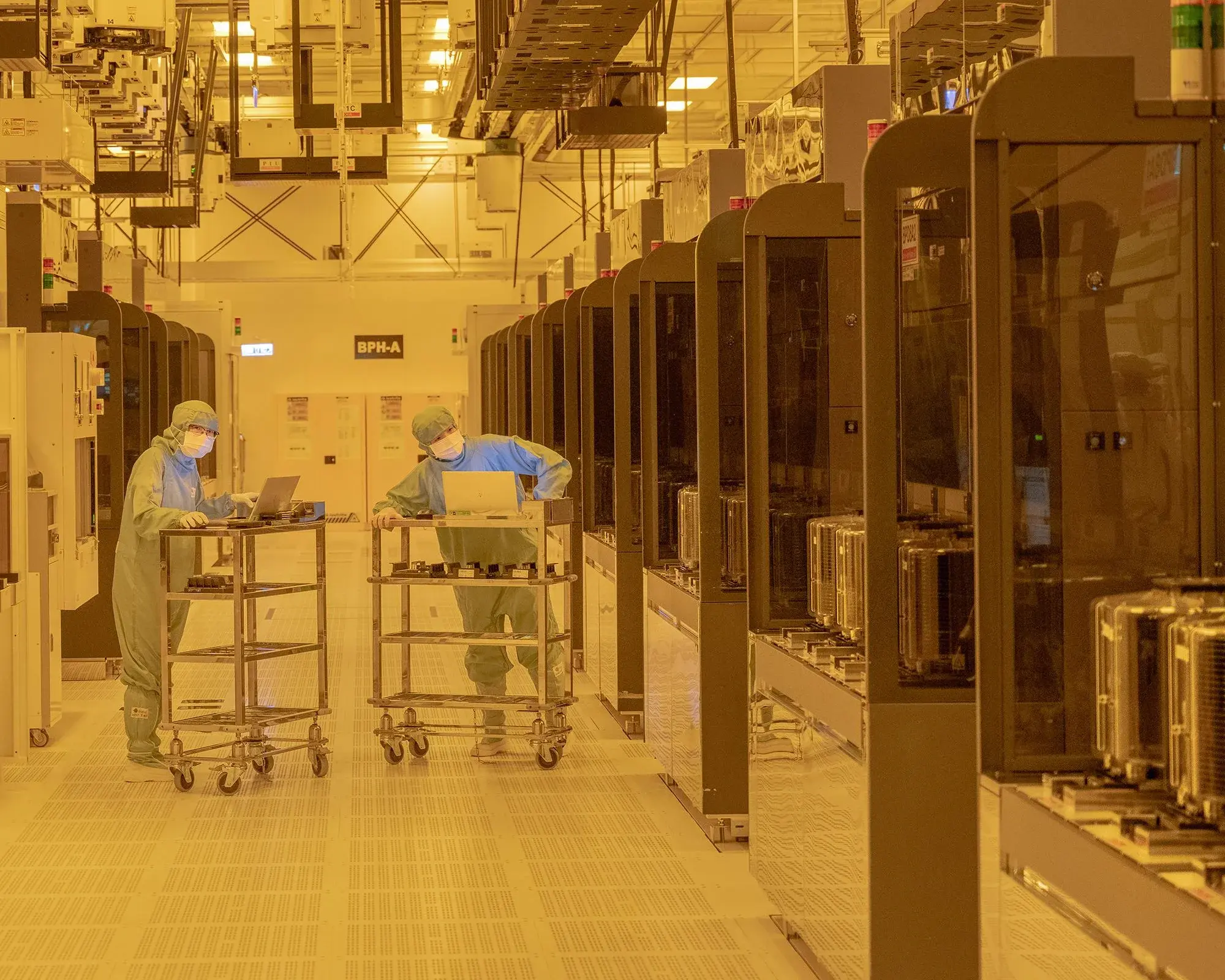

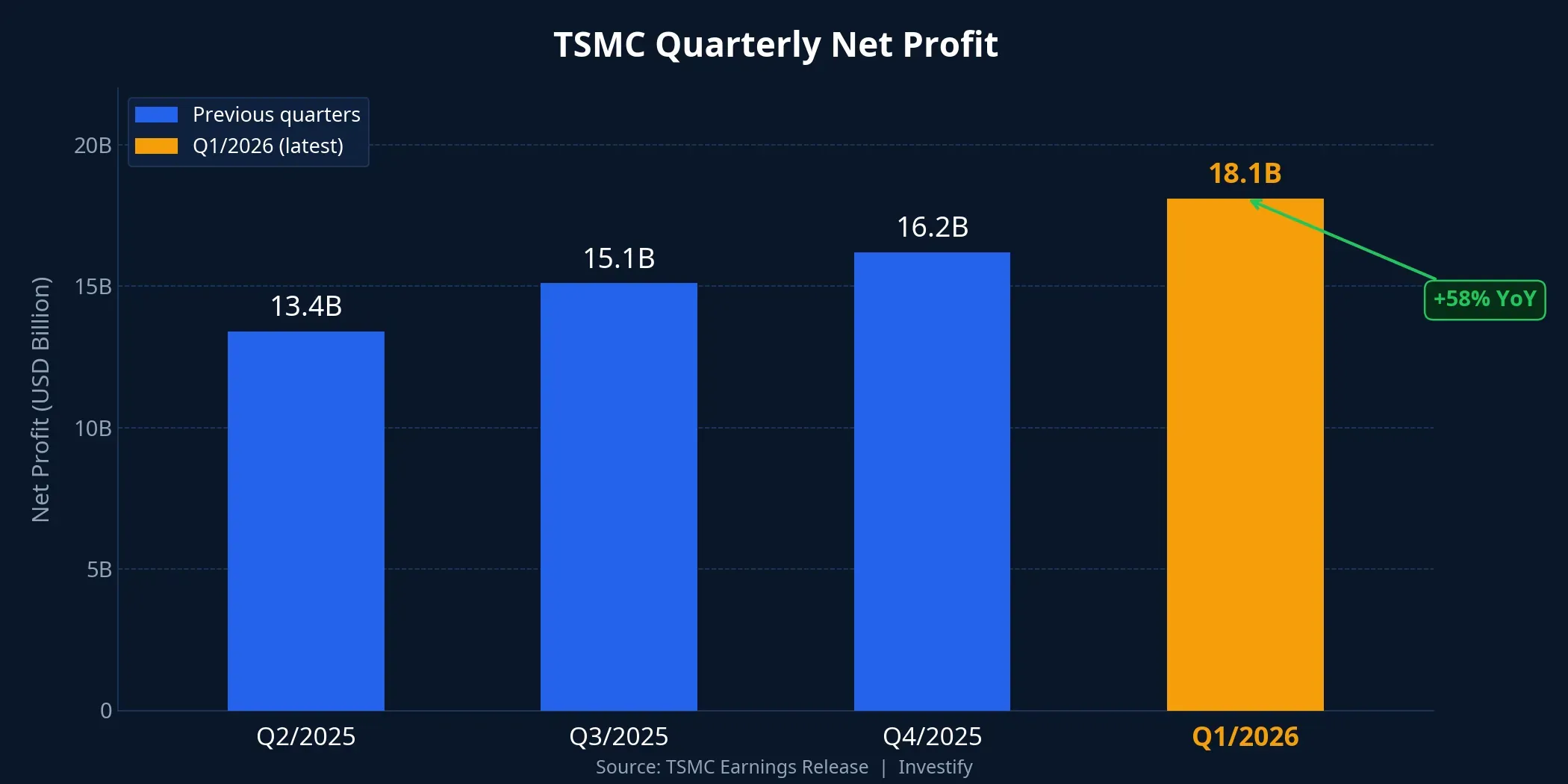
On April 15-16, 2026, the global tech industry witnessed two opposing events stemming from a single cause: artificial intelligence. TSMC reported Q1/2026 net profit of approximately $18.1 billion, up 58% year-over-year. At the same time, Snapchat laid off roughly 1,000 employees because AI enabled smaller teams to accomplish what previously required more people. One side prints money selling infrastructure for the AI race; the other cuts staff because those very AI tools replace human workers. Two sides of the same coin, and this divergence is reshaping how investors evaluate tech stocks.
TSMC: the AI era’s profit machine
TSMC’s Q1/2026 results exceeded expectations across every key metric. Revenue reached $35.7 billion, up 35% YoY, hitting the top end of January guidance.Techi Net profit came in at approximately 572.5 billion TWD (roughly $18.1 billion), up 58% YoY.CNBC Gross margin improved to 66.2%, beating the market consensus of 64.5%.
The revenue mix reveals AI’s central role. The high-performance computing (HPC) segment — covering AI chips, data centers, and supercomputers — accounted for approximately 61% of quarterly revenue, up from 58% on average in 2025.BreakingTheNews Advanced technologies below 7nm contributed approximately 74% of wafer revenue, with 3nm chips alone at approximately 25%, up from 22% in Q1/2025.TechiIndexBox
The most striking figure lies in the investment plan: management raised Q2/2026 guidance to $39-40.2 billion, above the $38.1 billion consensus. More importantly, TSMC raised 2026 capex to $52-56 billion, up from $40.9 billion in 2025. This accounts for over one-quarter of the estimated $200 billion in global semiconductor capex for 2026.Motley Fool Roughly 70-80% of that capex is earmarked for advanced process technology serving AI and HPC chips.
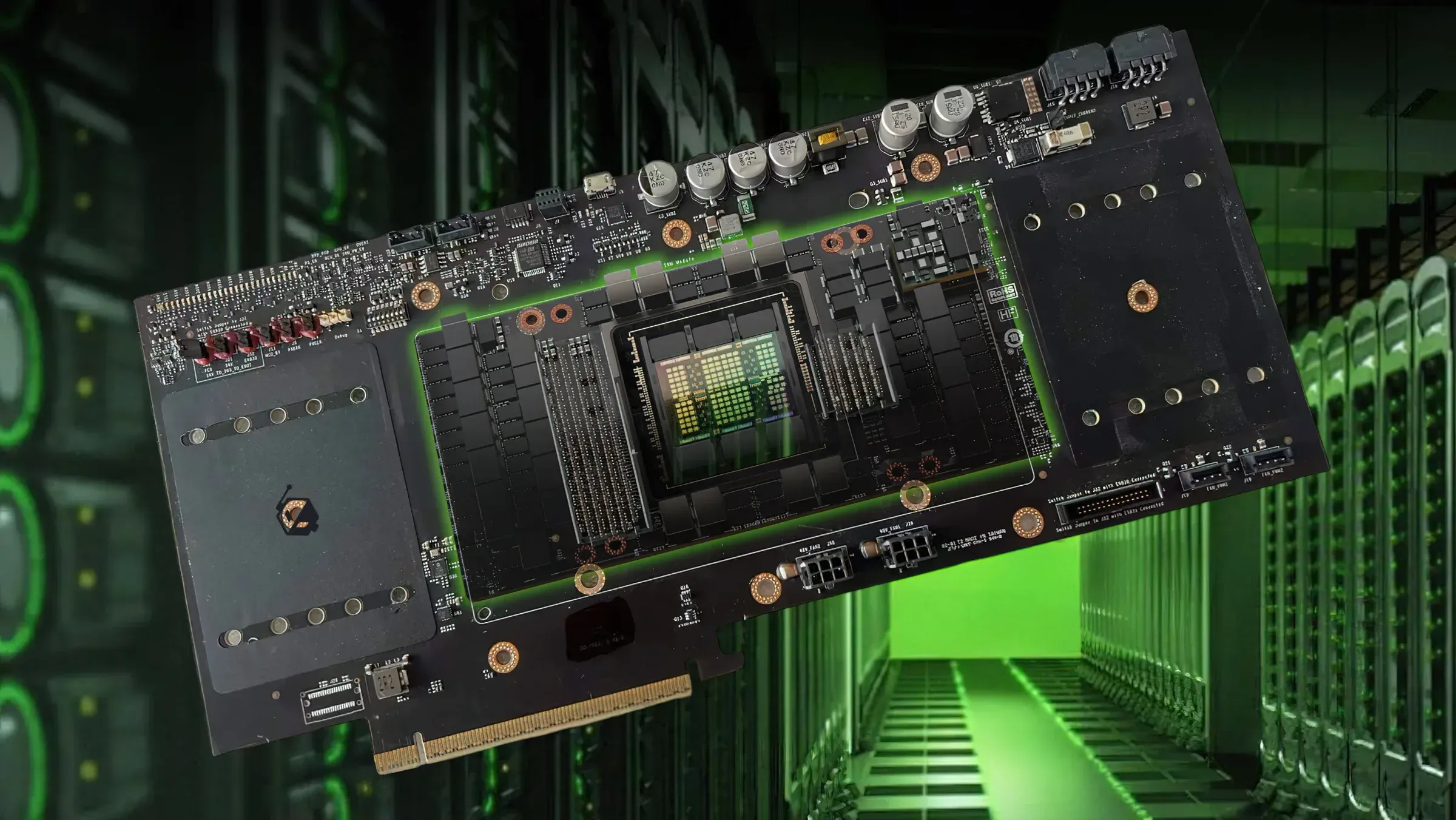
TSMC is also expanding manufacturing globally: Fab 21 in Phoenix with over $150 billion in total investmentTech Insider, a $17 billion project for 3nm AI chips in JapanDigiTimes, and a facility in Germany. The message is clear: AI chip demand shows no signs of slowing, and TSMC is betting big on that trajectory.
Snapchat: when AI replaces its own creators
On the opposite end, Snap Inc. announced it would lay off approximately 1,000 full-time employees and close over 300 open positions, representing 16% of its workforce.Fortune CEO Evan Spiegel stated directly in an internal memo: AI is enabling smaller teams to accomplish work that previously required more people.TechCrunch Notably, 65% of Snap’s new code is now generated by AI.CNBC

Wall Street reacted positively: SNAP stock jumped 7.7% on April 15, at one point surging 11% in pre-market trading.Motley Fool Deutsche Bank and Jefferies maintained Buy ratings, while BMO Capital raised its target to $15. The expected payoff: over $500 million in annualized operating cost savings from H2 2026, at a restructuring cost of $95-130 million.CNBC
The market cheers because margins improve, but the underlying story is more profound: AI is enabling application-layer companies to do more with fewer people. Good news for shareholders, but a serious signal for the tech labor market.
The divergence: who sells pickaxes wins
These two events are not coincidental. They reflect the structural logic of the AI revolution, where the tech industry is stratifying clearly along the value chain.
Layer 1: Chips and infrastructure — the highest profit accumulation with massive technological barriers. TSMC achieved 66.2% gross margin, NVIDIA maintains near-monopoly in AI GPUs, and ASML raised its 2026 outlook. This is the “pickaxe seller” group, and they are collecting record profits.
Layer 2: Cloud and data centers — benefiting from surging demand but with lower margins. Global data center availability has dropped to historic lows, with most new capacity already pre-booked.
Layer 3: AI platforms — Microsoft/OpenAI, Google, and Amazon dominate with foundation models (LLMs). Extremely high barriers, limited room for newcomers.
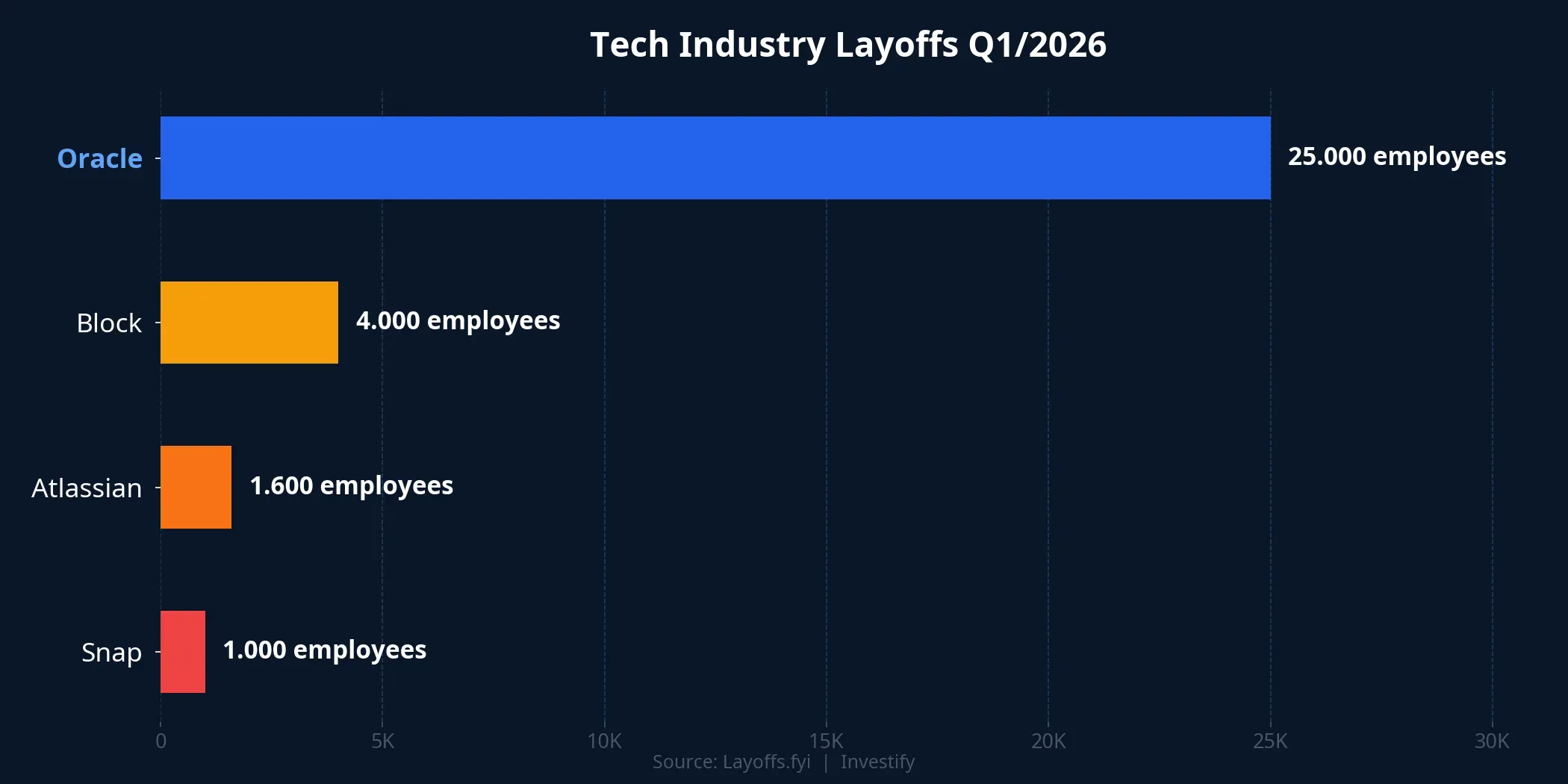
Layer 4: Applications — under the greatest pressure, and where Snapchat belongs. In Q1/2026, the global tech industry recorded nearly 78,000 layoffs, with approximately 48% attributed to AI and automation.Tom’s Hardware Snap is not an isolated case: Oracle cut 20,000-30,000, Block cut 4,000, and Atlassian cut 1,600.
The pattern is clear: the closer to the infrastructure layer, the higher the margins and the stronger the position; the closer to the application layer, the greater the competitive pressure and displacement risk.
Where does Vietnam fit in the AI value chain?
The global divergence raises the question: which Vietnamese companies are well-positioned?
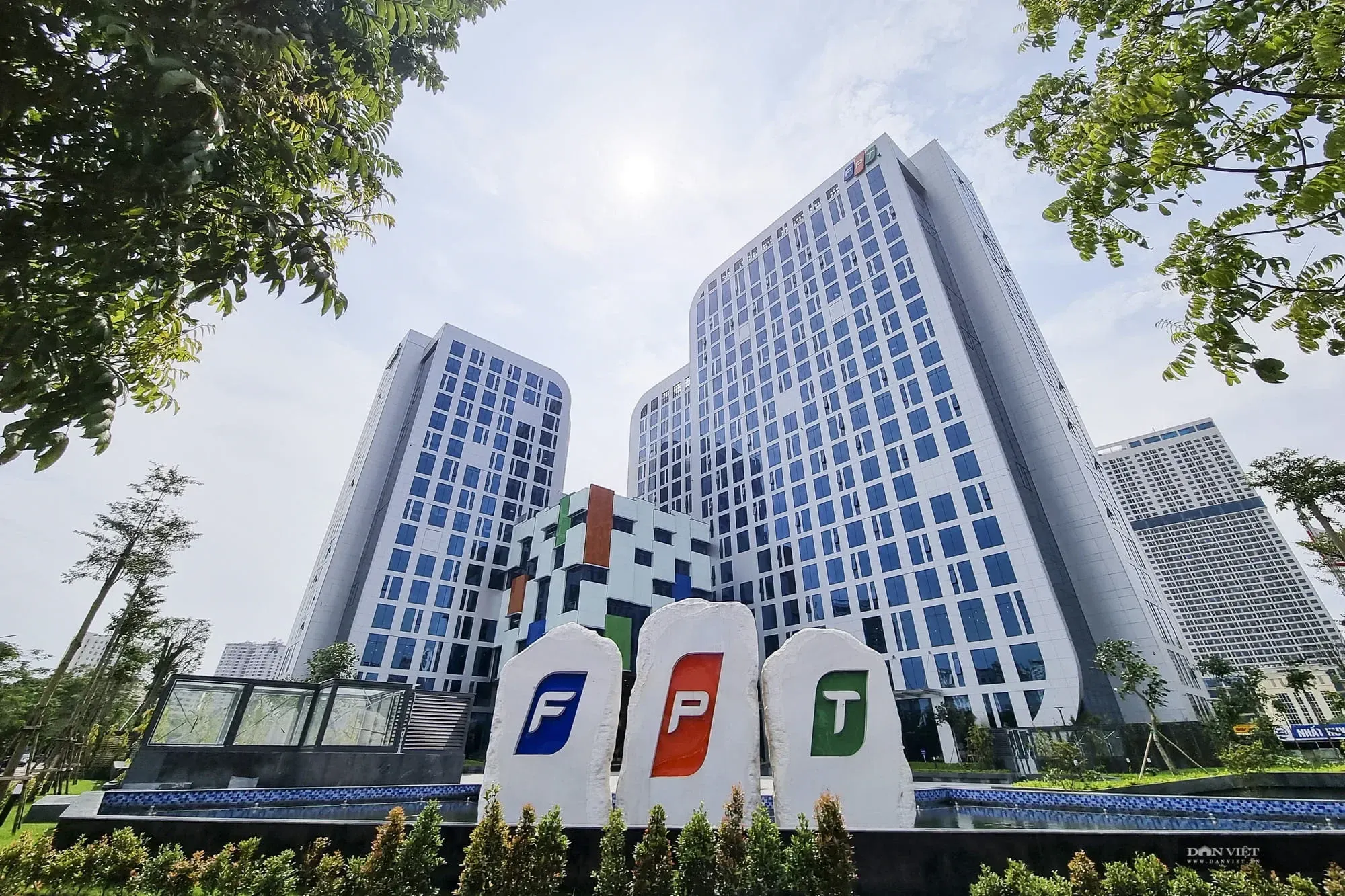
FPT sits between the infrastructure and application layers — providing global IT services (outsourcing, digital transformation) while investing heavily in AI infrastructure: partnering with NVIDIA to build AI Factories in Vietnam and Japan, with Sumitomo and SBI holding 40% of FPT Smart Cloud Japan, and investing in the FPT Fornix HCM02 data center. FPT’s stock price on April 16 was VND 74,100, with a market cap of VND 126,200 billion. FPT boasts a trailing four-quarter ROE of 25.68% and gross margin of 37% — among the most efficient on the exchange.
CMC (ticker: CMG) focuses on domestic cloud infrastructure with CMC Cloud and its C.OpenAI platform. CMG’s stock on April 16 was VND 28,500, with a market cap of VND 6,600 billion. CMG has significantly lower margins than FPT (approximately 19% gross margin, ROE above 12%) but holds a unique advantage in national AI infrastructure — a segment that will grow increasingly important as Vietnam prioritizes data sovereignty.
It is important to note that neither FPT nor CMG is “Vietnam’s TSMC.” No domestic company manufactures advanced chips, and the technology gap with global Layer 1 players is vast. FPT’s position is closer to an IT services provider that benefits indirectly from global AI spending, while CMG serves as domestic cloud infrastructure.
Three factors to watch
The AI divergence is intensifying with no signs of reversal. When TSMC raises 2026 capex to $52-56 billion and guidance beats expectations, it signals that AI chip demand remains strong — benefiting the entire supply chain, including Vietnamese companies in IT services and infrastructure. However, risks concentrate in two areas: if global AI spending slows due to recession or unmet expectations, the entire value chain will be affected; additionally, competition from automated services could impact outsourcing businesses in the long term.
Three factors to monitor in the coming weeks: (1) Q1 results from NVIDIA and hyperscalers (Microsoft, Google, Amazon) — which will confirm or deny the strong AI spending trend; (2) Q2 tech layoff data — if accelerating, application-layer pressure will spread further; (3) FPT’s 2026 business plan at its AGM — which will reveal whether the company is genuinely committing to AI infrastructure or still primarily relying on traditional outsourcing.