

The trading week of April 20-24, 2026 opens with four big signal streams hitting almost at once: a packed bank AGM calendar, peak Q1/2026 earnings releases across large listed companies, the US-Iran talks resuming in Pakistan on Monday, and a VN-Index wobbling around 1,800 points after closing last week at 1,817.17. You can think of it simply: a week where the volume of information to read, process and decide on is well above average.
This is also the context in which many retail investors — people with a day job who can only spend a few evening hours on their portfolio — get stuck. Nobody has time to carefully read 30+ Q1 reports and 13 AGM resolutions in the same week. Is there a way to participate in earnings season without having to be right on every single stock? Yes — but first you need to see the week ahead clearly.
One packed week: 13 AGMs and peak Q1 earnings
Based on CafeF compilations and Investify internal data, at least 13 banks and major corporates hold annual AGMs in the five trading sessions of Apr 20-24:
- Tuesday Apr 21: PGBank
- Wednesday Apr 22: VPBank, SHB, Sacombank (STB), Saigonbank, DCM
- Thursday Apr 23: Kienlongbank, HD Securities
- Friday Apr 24: Vietcombank (VCB), VietinBank (CTG), BIDV (BID), HDBank (HDB), TPBank (TPB), MSB
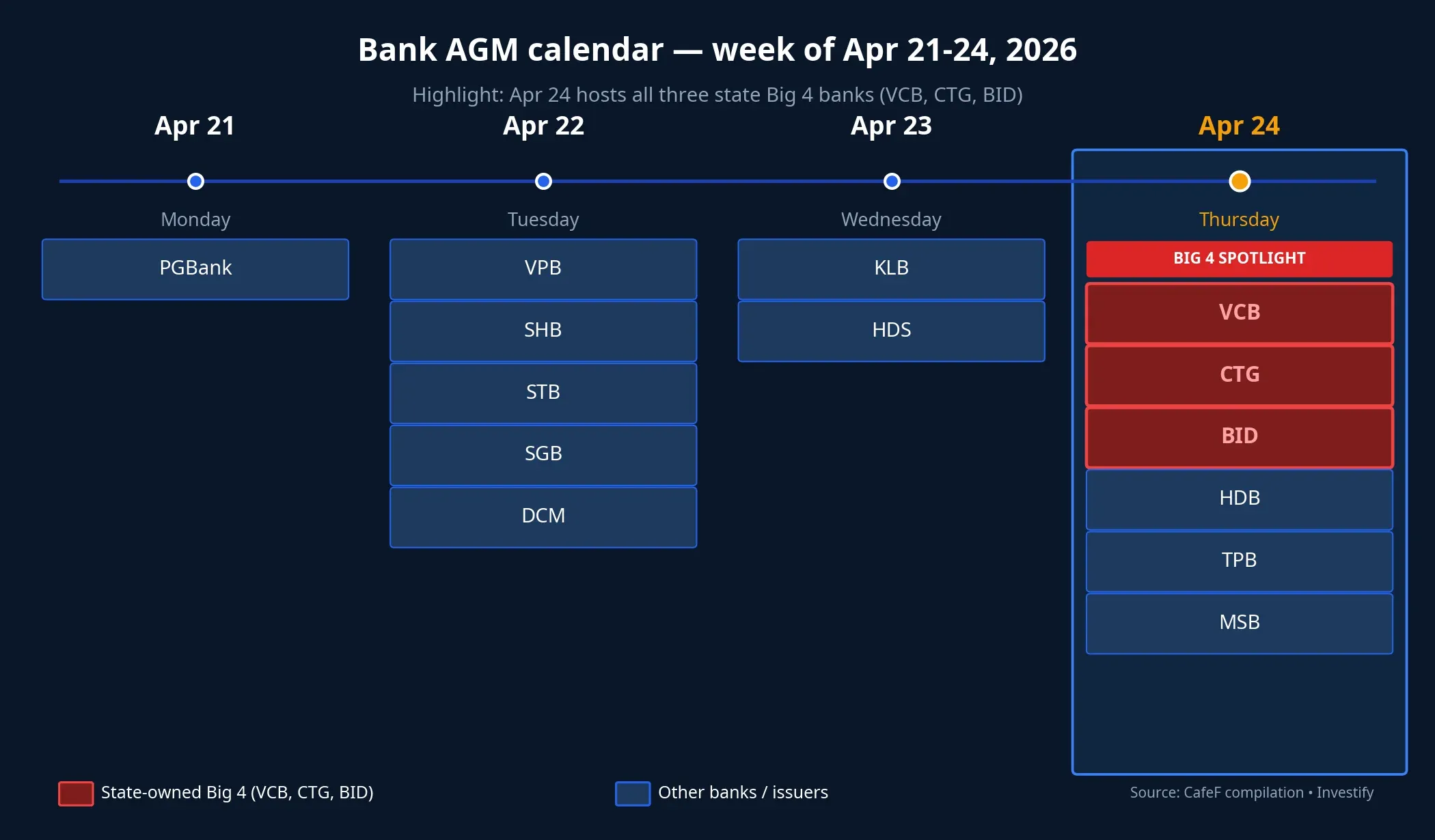
April 24 alone brings all three state-owned Big 4 banks (VCB, CTG, BID) into the same 24 hours — their AGM documents will set the framework for credit growth, profit targets and capital-raising plans for the whole system in 2026.
In parallel, Q1 earnings season is entering its peak week. MB Bank just announced pre-tax profit of VND 9,500 billion (+13.3% YoY) and approved a full-year 2026 target of VND 39,400 billion at its AGM on Apr 18. VPBank’s Q1 profit hit VND 7,900 billion (+58%), ACB VND 5,400 billion (+17%), TNG saw net profit rise 50%, PAN Group posted over VND 1,000 billion — 40 times last year’s level thanks to its Bibica divestment. That’s a lot of numbers to digest in five working days, and exactly why some retail investors will consider participating through fund instruments instead of picking individual stocks.
Forecasts are diverging — which is itself the problem
Before getting into the instruments, you need to read the forecast landscape — because the divergence in forecasts is precisely why this whole conversation matters. Per VNDirect’s 2026 strategy report released in late December 2025, the VN-Index could reach 2,099 points in 2026 — roughly 15% above current close — assuming HOSE-listed corporate earnings grow 18% YoY, average daily liquidity reaches VND 36,400 billion, FTSE upgrades in September 2026, the Fed cuts rates twice by 25bps, and credit grows 19%.
But weekly views from Vietstock and Tin nhanh Chứng khoán call the Apr 20-24 week a range-bound zone around 1,800, recommending “don’t chase” and waiting for capital-flow confirmation. The two views aren’t really in conflict: VNDirect is talking about a 12-month path, while technical analysis is talking about the next 5 sessions. But both lead to the same conclusion for retail investors — the near term demands high selectivity at the single-stock level, and the probability of misreading one specific Q1 report this week is not small.
This is why the three approaches below share a common feature: none of them require you to be right on every individual ticker.
Option 1: Passive ETFs — track the index, low fees
Passive ETFs are the choice for anyone who wants market beta without having to decide on specific stocks. Three major ETF groups on HOSE worth knowing:
- DCVFMVN30 (E1VFVN30) — tracks the VN30 basket of the 30 largest-cap stocks. Management fee around 0.65%/year, highly diversified, closely correlated with the overall market.
- DCVFMVN Diamond (FUEVFVND) — tracks the VN Diamond basket of stocks that have hit their foreign ownership limit. Management fee around 0.8%/year, more concentrated in private banks, retail and tech.
- SSIAM VNFINLEAD (FUESSVFL) — focused on the financial group: banks, brokers, insurance. High sensitivity to bank sector moves during earnings season.
The connection to next week is straightforward: if the bulk of AGMs and peak earnings fall on banks (9 of the 13 AGMs listed are banks), then a VN30 or VN Diamond ETF automatically absorbs the impact through the weight of VCB, CTG, BID, MBB, TCB, VPB in the basket. Put simply, you don’t need to know exactly which report is good or which resolution is favourable — the basket weights do the allocation work for you. The trade-off: if the “don’t chase” view is right and the market drifts sideways, the ETF will do the same, maybe down slightly alongside the index.
Option 2: Active equity mutual funds — pay a pro to pick stocks
This is the choice for anyone who doesn’t want to read 30 Q1 reports but still believes that picking the right stocks in a divergent environment can beat the index. Q1/2026 data from Investify research shows active equity mutual funds are spread across more than 12 percentage points between the leader and the laggard — a meaningful range, reflecting that portfolio quality really matters when the index drifts sideways.
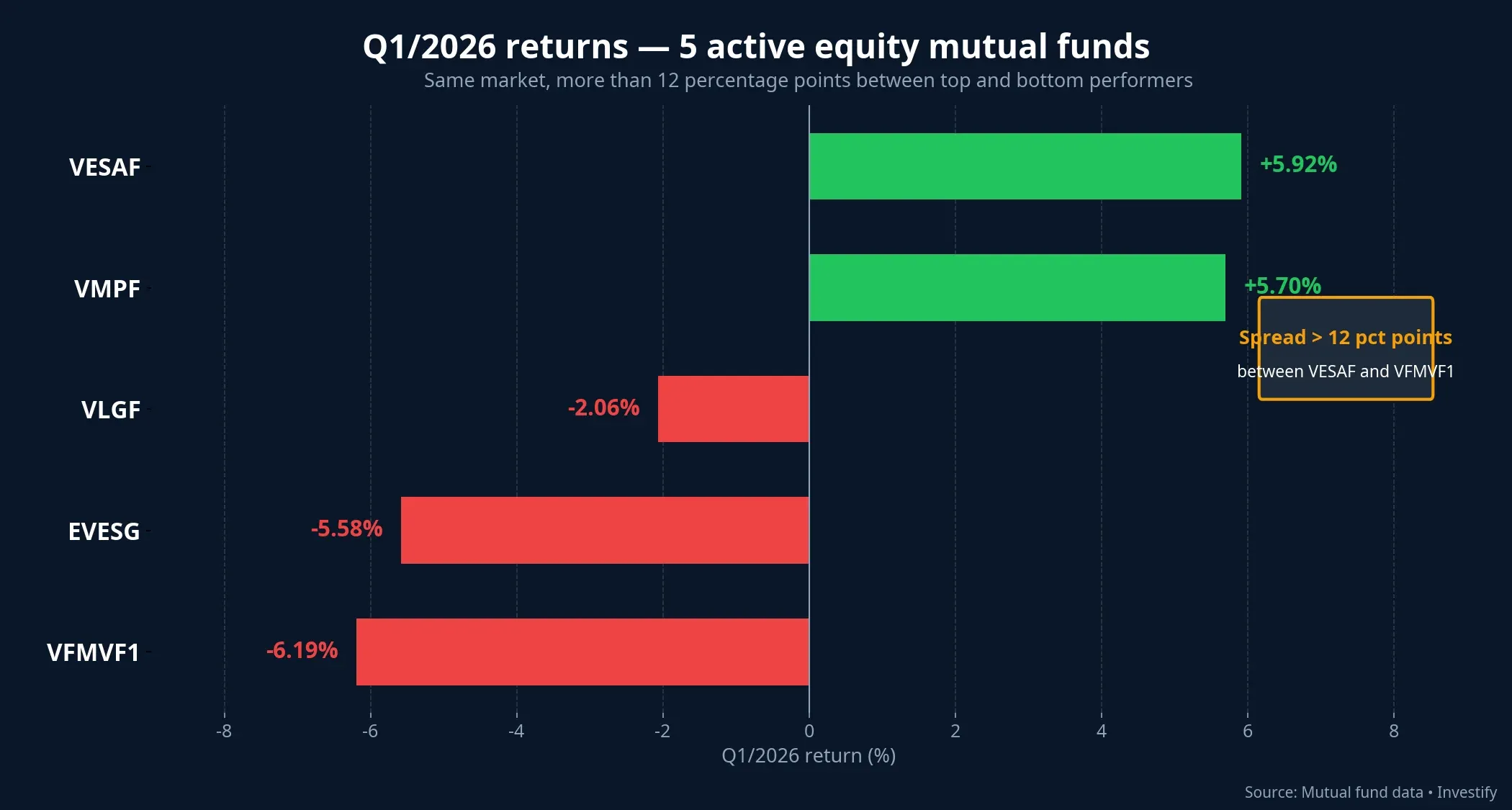
The largest active equity funds show very different performance:
| Fund | AUM (VND bn) | Mgmt fee | Q1/2026 | Top 5 holdings |
|---|---|---|---|---|
| VFMVF1 (DCDS) | 5,874 | 1.95% | -6.19% | BID, MWG, HPG, TCB, VRE |
| VLGF | 4,802 | 1.50% | -2.06% | MWG, CTG, MBB, FPT, NLG |
| VESAF | 2,529 | 1.75% | +5.92% | DGC, MBB, BVH, PNJ, HPG |
| EVESG | 2,447 | 1.30% | -5.58% | VIC, ACB, VCB, MBB, HPG |
| VMPF | 2,395 | 1.75% | +5.70% | MBB, HPG, PNJ, GMD, CTG |
The gap between VESAF (+5.92%) and VFMVF1 (-6.19%) is more than 12 percentage points — two funds of the same type in the same market, but very different portfolios lead to very different outcomes. The 1.5-1.95%/year fee is precisely what you pay to have a professional manager read Q1 reports for you. The key thing to remember: there’s no guarantee this year’s winner keeps winning next year, and one quarter is not enough to conclude anything about a manager’s skill.
Option 3: Balanced funds — lower volatility when the index drifts
When the market is forecast to drift sideways around 1,800 in the near term, a balanced fund is a way to reduce portfolio swings. The typical structure is 40-60% equities with the rest in government bonds and high-grade corporate bonds — meaning the portfolio is already risk-diluted from the start.
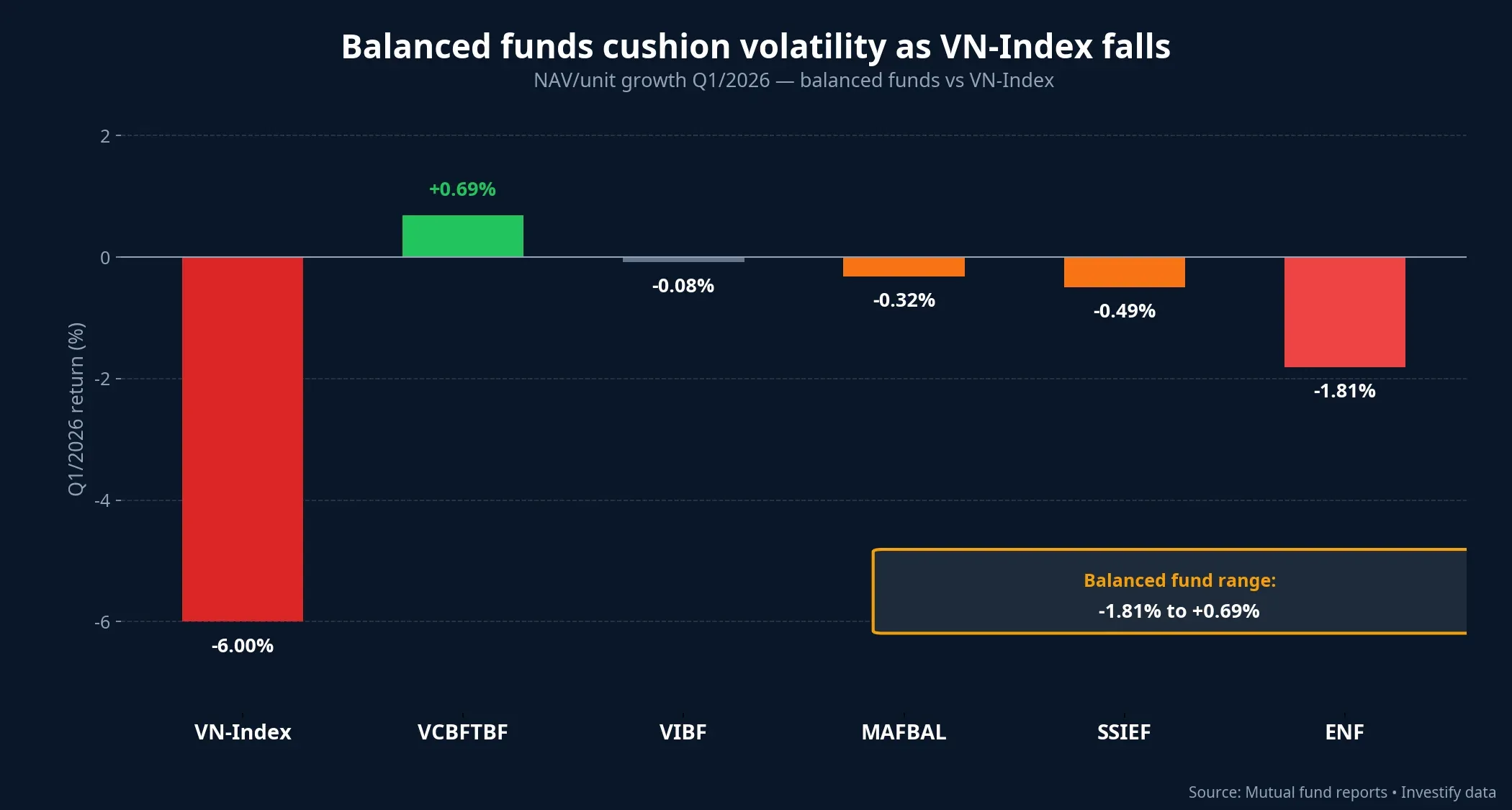
Compared with the VN-Index dropping 6% in Q1/2026, balanced funds swung only in a -1.81% to +0.69% range — meaningfully lower volatility. The trade-off is obvious: when the market rallies hard, a balanced fund lags a pure equity fund because the bond weight pulls performance lower.
| Fund | AUM (VND bn) | Mgmt fee | Q1/2026 |
|---|---|---|---|
| VIBF | 1,440 | 1.75% | -0.08% |
| SSIEF | 1,364 | 1.75% | -0.49% |
| VCBFTBF | 767 | 1.50% | +0.69% |
| MAFBAL | 322 | 1.20% | -0.32% |
| ENF | 292 | 1.50% | -1.81% |
How does this touch your wallet? If your goal is to keep the portfolio from swinging hard before trend confirmation, a balanced fund fits a defensive appetite. If your goal is to beat the market, a balanced fund is not the optimal tool.
3 things to check before picking a fund
Before you open the fund distribution app and transfer money, there are three things worth checking carefully to avoid later surprises:
- Total fees, not just the management fee. Beyond the annual management fee, many funds charge a subscription fee (0-2%), an early-redemption fee (usually 0-2% if you redeem within 12 months) and a performance fee. For example MAFBAL has a 1.2% management fee — but if the early-redemption fee is 2%, redeeming within year one will eat most of the expected return.
- At least 3 years of track record, not just one quarter. VESAF’s Q1/2026 return of +5.92% looks impressive, but one quarter tells you nothing about long-term skill. Look at both the volatility and the 3-5 year average return, especially how the fund handled years when the VN-Index fell.
- Check that the portfolio doesn’t overlap with stocks you already hold. If you already own VCB, CTG, MBB in your brokerage account, adding VNFINLEAD or EVESG increases bank concentration rather than diversifying. Conversely, a VN Diamond ETF can add FPT, PNJ to a portfolio that’s mostly banks.
Why this isn’t a buy/sell recommendation

These three instruments don’t replace your investment decision. They’re a framework that helps retail investors participate in earnings season without having to be right on individual stocks. The Apr 20-24 week could end closer to VNDirect’s scenario (a re-rating toward 2,099 across 2026), or fall into the range-bound scenario that technical analysis is warning about for the next 5 sessions. In either case, ETFs and mutual funds reduce dependence on picking one specific stock correctly — in exchange, you accept an annual fee and give up the chance to sharply beat the index.
Signals worth watching this week: capital-raising plans and credit targets at the VCB, CTG, BID AGMs on April 24 will set the 2026 framework for the entire banking group — a factor that carries heavy weight in most ETFs and mutual funds in Vietnam. You don’t need to read all 13 resolutions, but knowing that April 24 is an important marker is enough to not miss the big picture.