
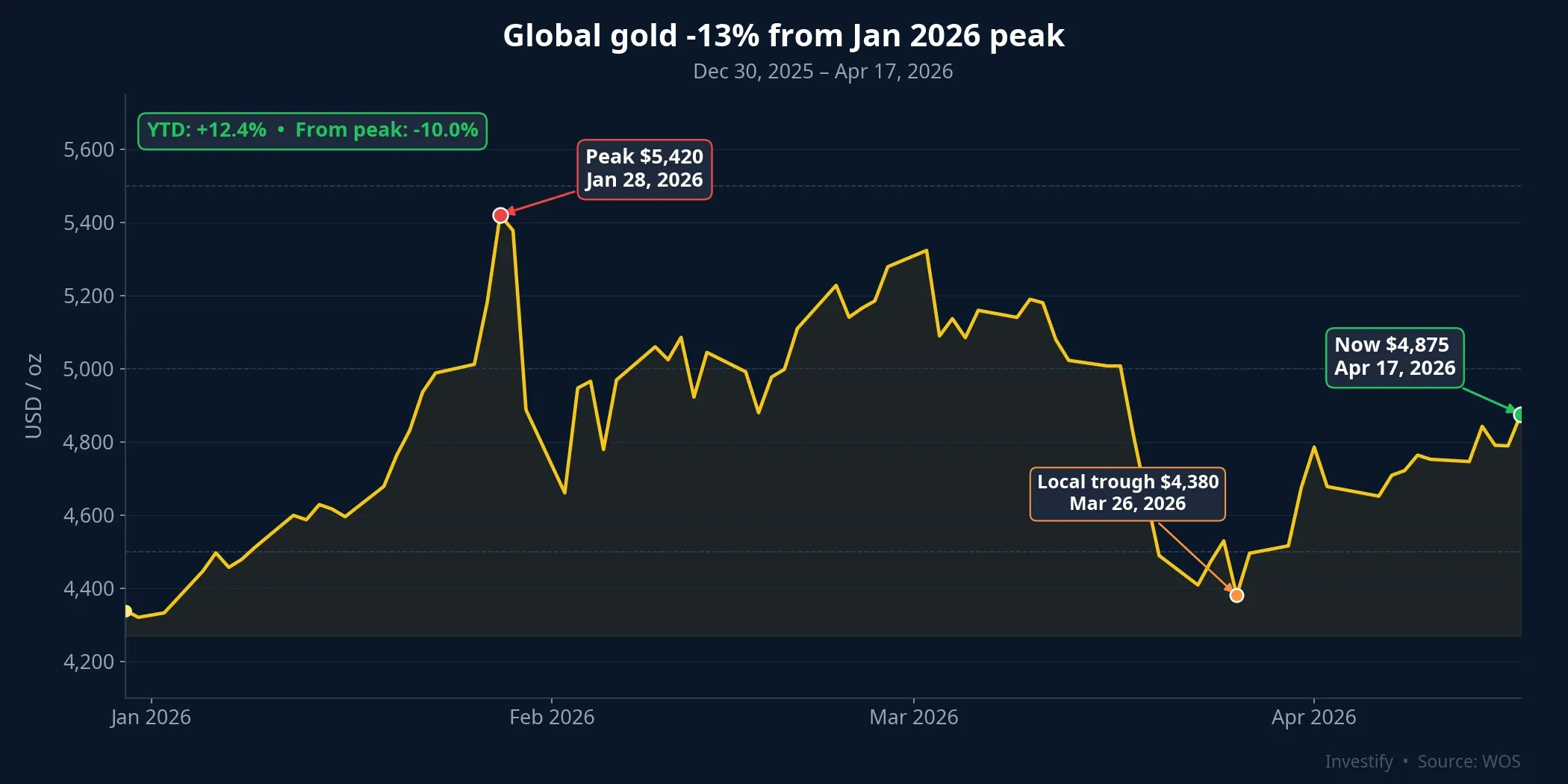
The big picture for gold across the past 12 months can be captured in three chapters: a 2025 rally that nearly doubled the price, a peak around $5,600/oz in late January 2026, and a 13% pullback that brought spot back to $4,875/oz on April 17, 2026. The World Gold Council (WGC) has just published its Gold Outlook 2026 with four macro scenarios for the remainder of the year — a good moment for Vietnamese investors holding SJC bars, 9999 rings, or gold fund units to re-check their positions.WGC
Chapter 1: 2025 — gold’s strongest year since the 1970s
The 2025 rally rested on three parallel pillars rather than a single driver. The most visible pillar was central bank flow: total central bank demand in 2025 reached roughly 863 tonnes, led by China (a 16-month consecutive buying streak), Poland, and Uzbekistan. This is not speculative money — it is national-scale reserve restructuring.
The second pillar was USD weakness and expectations of Fed easing. When real yields fall, the opportunity cost of holding gold (a non-yielding asset) falls too. The Fed’s easing cycle that began in the second half of 2025 provided the macro backdrop throughout Q4 2025 and January 2026. The third pillar was geopolitical uncertainty — shocks around the Middle East, supply-chain disruptions, and trade tensions kept safe-haven demand sticky.
The peak of this chapter was set at the end of January 2026. According to Fortune, spot gold reached roughly $5,600/oz on January 29, 2026.Fortune That print closed more than a year of near-uninterrupted climbing and opened the door to chapter two.
Chapter 2: Q1 2026 — a 13% correction, but an orderly one
From the ~$5,600/oz peak, global gold fell to $4,875/oz by April 17, 2026 — down about 13% from the high. Two moments stand out inside the correction: gold lost 9.11% in a single session on January 30 as part of the ETF flow took profit, and the local trough printed at $4,380/oz on March 26 (about 22% below the January 28 closing peak) before partially recovering.
This is the clearest correction of the entire up-cycle, but importantly it is an orderly correction. There has been no systemic panic selling, institutional flow has come out in waves rather than one rush, and the price has bounced at support zones. In gold’s long up-cycles — 1974–1980, 2001–2011, 2019–2020 — 10–20% pullbacks occurred multiple times without breaking the trend. The current 13% drop sits inside a normal range.
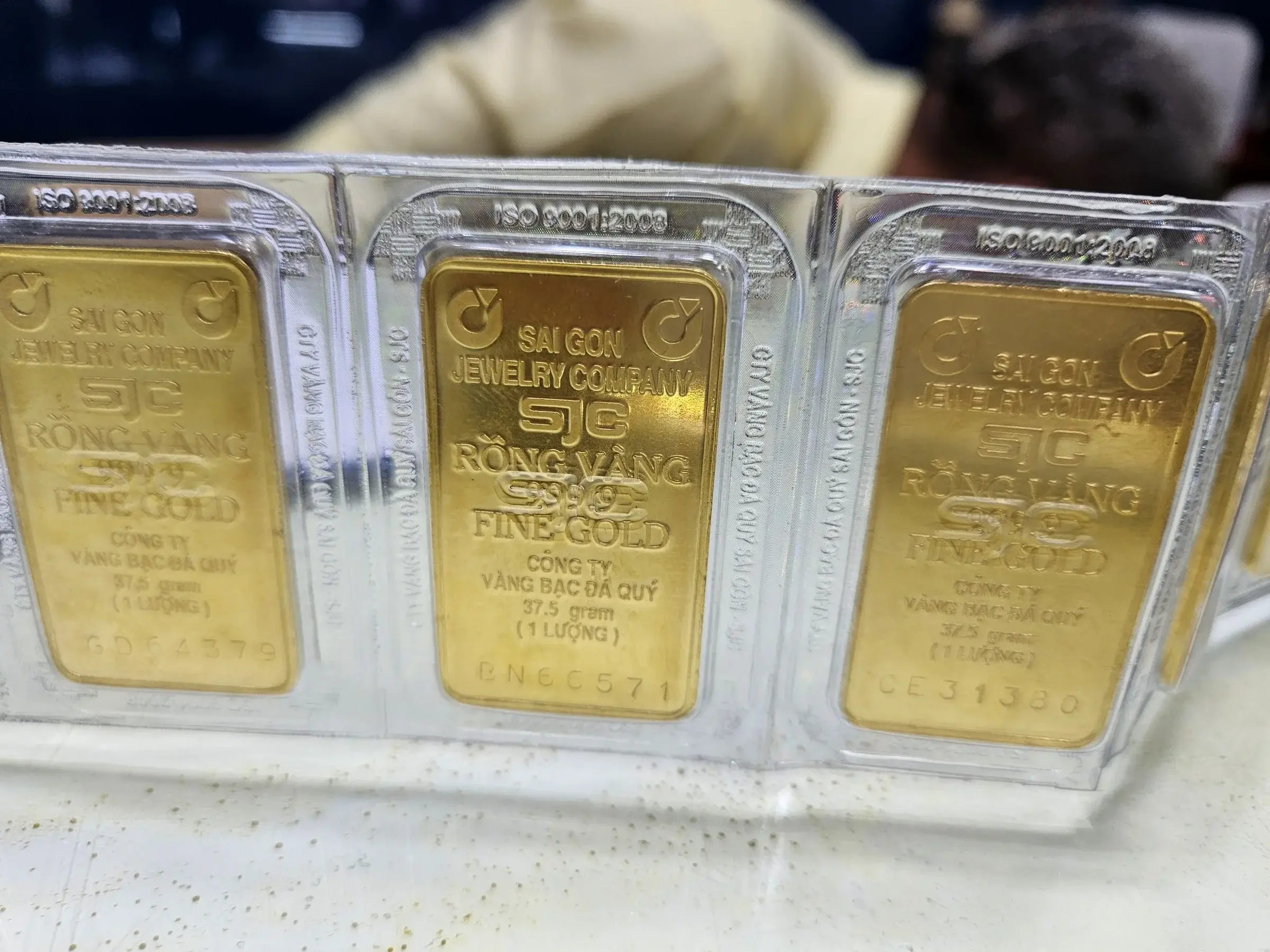
The Vietnam story diverges from the global one. SJC bars reached 190.9 million VND/tael on March 2, 2026 before easing to 172 million VND/tael on April 18, 2026 — a 9.9% pullback, milder than the world-gold move. SJC 99.99% rings closed April 18 at 170 million VND/tael, tracking the bar price. Year-to-date in 2026, SJC is up about 12.6% (from 152.8 million on December 31, 2025 to 172 million on April 18, 2026), while global gold is up 12.9% over the same window — meaning the SJC-versus-world premium has compressed materially.
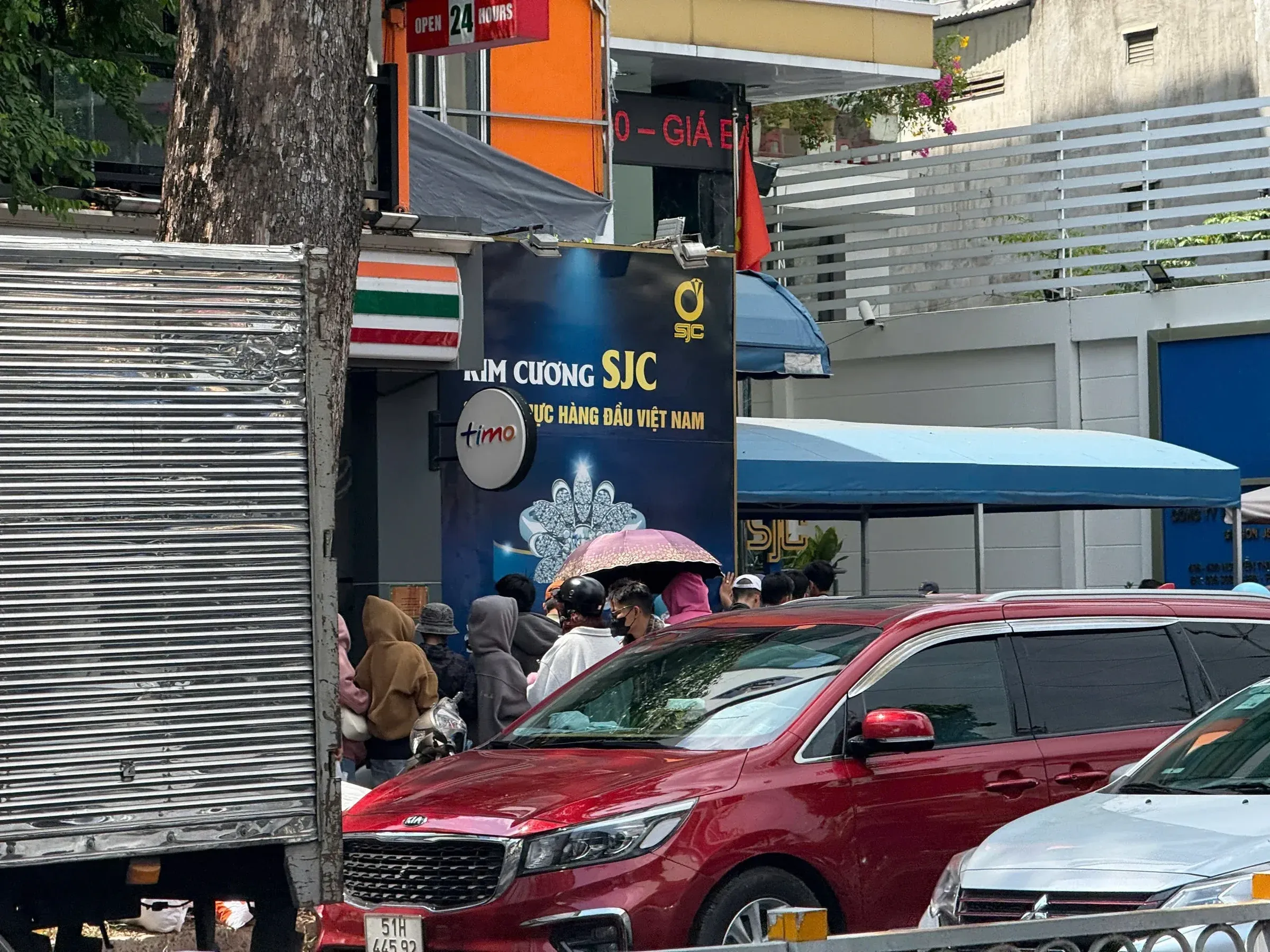
This premium compression is a direct consequence of a policy shift: Decree 232/2025 ended the SJC monopoly on gold-bar production, and the State Bank of Vietnam has received 11 applications for manufacturing licenses from credit institutions and gold-trading firms.SBV For investors, this is a structural change — the “monopoly rent” embedded in the SJC price for years is being dismantled. Long term, SJC will track world gold more tightly; during the transition, short-term volatility may rise.
Chapter 3: The rest of 2026 — WGC’s four scenarios
The WGC Gold Outlook 2026 report lays out four macro scenarios, each tied to a specific set of triggers and a price range relative to today’s level.Investing News
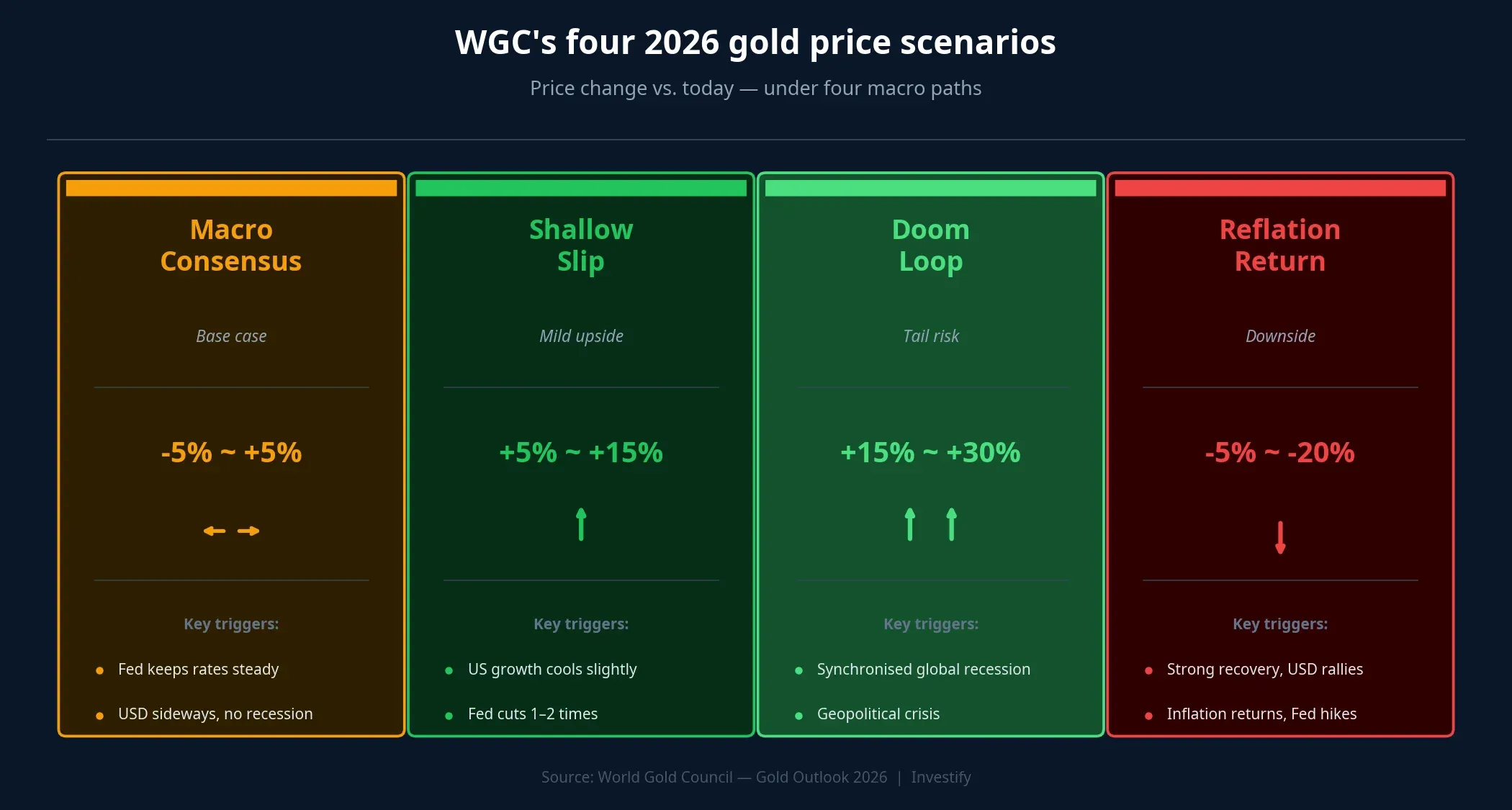
Macro Consensus (base case, -5% to +5%). Triggers: global GDP holding at 2.7–2.8%, Fed cuts another ~75 bps, USD sideways or slightly firmer, inflation inside target. This is the “push on, but cautiously” scenario — gold trades around the established peak, with range width depending on the pace of Fed easing.
Shallow Slip (+5% to +15%). Triggers: US growth cools faster than consensus, risk appetite softens, Fed cuts more than expected. A weaker USD and lower real yields would drag down the opportunity cost of holding gold. This is the “mild dip then grind higher” scenario.
Doom Loop (+15% to +30%). Triggers: synchronised global recession, severe geopolitical shock (e.g., Iran/Hormuz escalation, large supply-chain breaks), Fed forced into aggressive easing. WGC describes this as a fat tail — low probability but high impact; the top end of this scenario could push gold above $6,300/oz.
Reflation Return (-5% to -20%). Triggers: the Trump administration’s fiscal-and-industrial mix delivers upside growth, inflation reflates, and the Fed may have to reverse course and hike. A firmer USD and higher nominal yields raise the opportunity cost of holding gold. This is the only scenario where gold declines meaningfully.
WGC assigns the highest probability to Macro Consensus and Shallow Slip — meaning the bull bias is still the default, only the intensity differs. Doom Loop and Reflation Return are the two tail risks, each requiring close monitoring of its triggers.

What this means for Vietnamese investors
The three main gold channels in Vietnam serve very different objectives:
- SJC bars offer the deepest liquidity and easiest authentication, but the bid-ask spread widened to 15–25 million VND/tael at times in 2025. Suitable for long-term holding, not short-term trading.
- 9999 rings (PNJ, DOJI, BTMC, SJC 99.99%) have a 2–3 million VND/tael bid-ask and track world gold more closely. Better for individual investors who want low entry-exit cost.
- Gold fund units have very low spreads, require no physical custody, and charge management fees; well suited for periodic accumulation and multi-asset portfolios.
Mapping the four WGC scenarios to portfolio sizing, the logic is: if you lean toward Macro Consensus or Shallow Slip — the two highest-probability paths — hold your current gold weight and add on pullbacks rather than chasing the bounce. If Doom Loop is your concern, gold can serve as a tail-hedge inside the portfolio, but tilt only modestly given that prices are already at historical highs. If you lean toward Reflation Return — the only scenario where gold declines — reducing weight and rotating into equities or fixed-income products with locked yields is the more coherent move.
Three variables that decide which scenario plays out
Across all three chapters, the long-term support for gold is unchanged: strategic demand from central banks. WGC estimates central bank demand in 2026 could reach about 1,070 tonnes, up roughly 18% from 2025 — this flow is largely insensitive to short-term price swings and continues to absorb a meaningful amount of supply out of the free market.WGC
The near-term triggers come down to three macro variables: the pace of Fed easing (which tips the outcome between Macro Consensus and Shallow Slip), USD direction (a strong USD pulls gold toward Reflation Return), and geopolitical temperature (a serious escalation opens Doom Loop). These three variables will determine which WGC scenario gold travels through for the rest of the year — and they are the three signals to watch in the weeks ahead.