

May 28, 2026 ended with a striking contrast on the exchange floor. The VN-Index retreated to 1,863.67 points, down 10.76 points or 0.57%; the real estate sector fell 1.19%, one of the weakest groups of the day. Yet on that same board, VHM closed at VND 157,700, up VND 10,300 and precisely at the HOSE daily price limit, making it the strongest-performing blue chip in the session.CafeF
The volume data tells the broader story: 8.9 million shares changed hands, noticeably above the 5–7 million daily average of the preceding two weeks. Foreign investors were net sellers, buying 1.72 million shares while offloading 1.95 million for a net sale of approximately 230,000 shares. The buying that pushed VHM to the ceiling came entirely from domestic investors, who accumulated the stock at exactly the moment the rest of the sector was retreating.

Immediate Catalyst: The VINfast Separation Resolution of May 26
On May 26, 2026, Vingroup’s Board of Directors passed a resolution to restructure VINfast. A new entity, Vietnam Joint Stock Company VINfast (VFVN), was incorporated at the Dinh Vu – Cat Hai Economic Zone in Hai Phong, with registered capital of approximately VND 5,184 billion.NguoiQuanSat Vingroup expects to hold 89.62% of VFVN once the preferred share conversion at VFTP is completed.
The mechanics of the separation matter more than the registered capital figure. A new group of investors will take over two manufacturing plants in Hai Phong and Ha Tinh, along with approximately VND 182,000 billion in financial obligations as of end-Q1 2026.NguoiQuanSat The divestment of the manufacturing segment is valued at approximately USD 530 million.Kenh14 Post-restructuring, VFVN retains the “asset-light” side: R&D, intellectual property, the brand, and the sales network; the production entity becomes a standalone manufacturer that assembles vehicles on order.
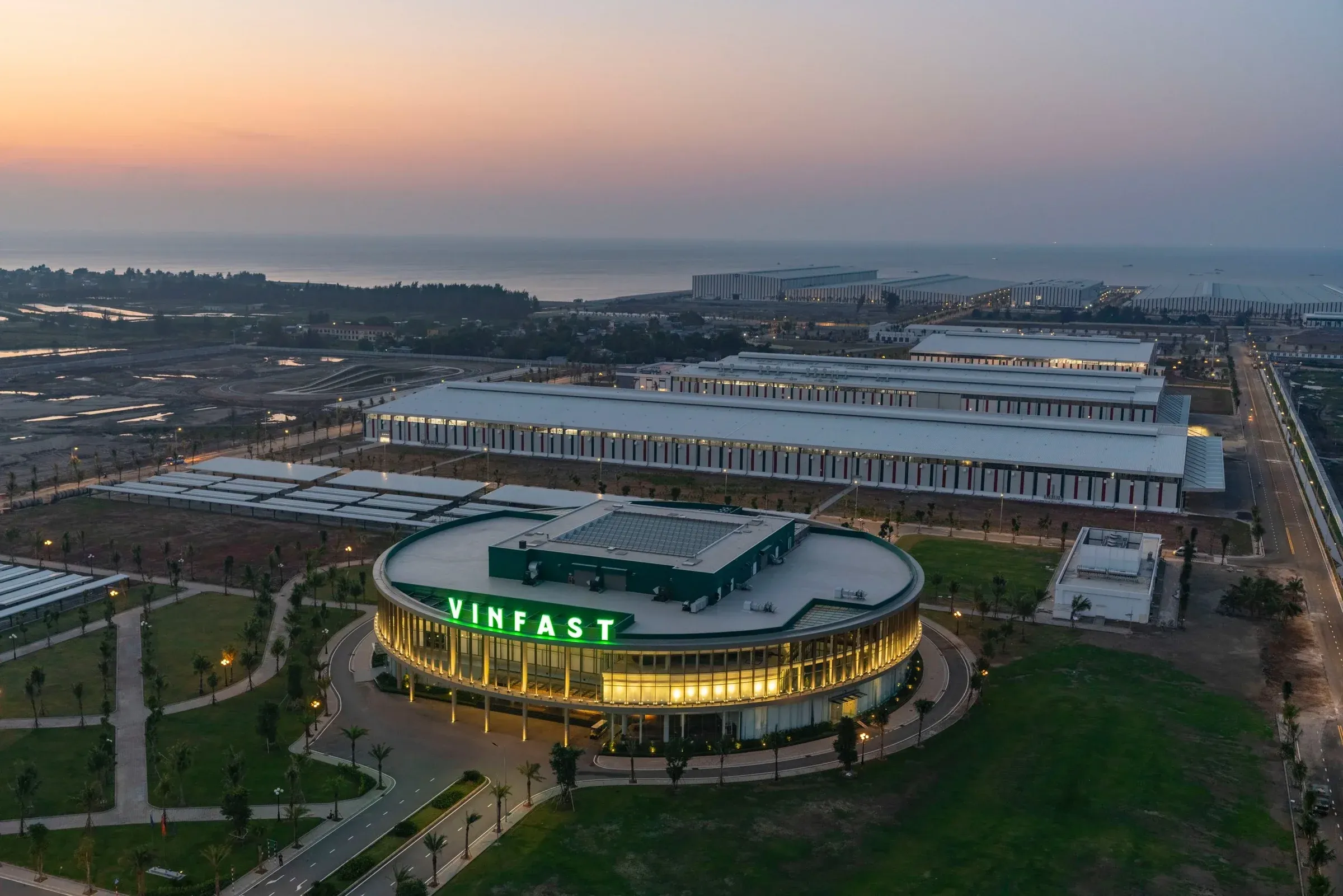
Why does VINfast news move VHM, when the two companies are not directly linked operationally? The answer lies in what analysts call the “conglomerate discount.” When Vinhomes shares an ecosystem with a unit carrying tens of trillions of dong in accumulated losses, investors price VHM below its intrinsic value: they worry about cross-entity cash flow risk, about real estate revenues being redirected to subsidize car sales, and about cross-guarantee obligations that could pull the entire group into difficulty. Moving approximately VND 182,000 billion in liabilities and the entire manufacturing segment to an entity where Vingroup holds a majority stake — but which is not a fully consolidated subsidiary for risk purposes — severs that linkage. The market read the signal and responded accordingly.VietnamFinance
Four Catalysts That Built Up Since April
The VINfast catalyst did not arrive in a vacuum. Four factors had been accumulating in the market’s consciousness since April.
On April 21, 2026, Vinhomes’ Annual General Meeting approved a net profit after tax target of VND 60,000 billion, up 38% from 2025 results, and revenue of VND 285,000 billion, up 56%. This is the highest plan ever set in the company’s history. Notably, the targets were raised just one day before the AGM: the net profit was lifted by VND 10,000 billion and revenue by VND 35,000 billion compared to the initial proposal.CafeF

At the same meeting, shareholders approved a cash dividend of approximately VND 24,644 billion, a payout ratio of 60% of registered capital at VND 6,000 per share, marking the first dividend distribution in three years.DanViet The AGM also approved a 100% stock dividend, meaning each existing share receives one new share. Mr. Pham Thieu Hoa, Chairman of the Board of Directors of Vinhomes (VHM), highlighted three flagship projects for the year: Hai Van Bay in Da Nang, Ha Long Xanh in Quang Ninh, and the University Urban Area in Ho Chi Minh City.
Additionally, Vinhomes successfully issued bonds in May 2026 for debt refinancing, signaling that the company’s capital markets access has normalized. Looking at the full picture: a record-high profit target, sufficient cash flow to pay the first dividend in three years, a functioning bond market channel, and now the removal of the VINfast liability burden from the group’s risk perimeter. The four catalysts did not all emerge at once, but by May 28 they converged clearly enough in investors’ minds.
Valuation After the Move
At the closing price of VND 157,700 and trailing twelve-month EPS of approximately VND 14,746, VHM’s P/E stands at around 10.7x. P/B is approximately 2.37x on book value per share of roughly VND 66,427. Against the real estate sector median — at approximately 8.5x P/E and 0.7x P/B — VHM trades at a clear premium on both metrics.

That premium does not make VHM expensive in absolute terms. The gap is consistent with its leadership position: Vinhomes is Vietnam’s largest residential real estate company by market capitalization, with margins that consistently outperform the sector and a project pipeline that most peers cannot match. Investors are paying up for asset quality and execution track record.
The trading pattern over the past 30 sessions deserves careful attention. VHM has hit or nearly hit the daily price limit four times: April 20 (+6.93%), April 28 (+6.94%), May 7 (+6.95%), and now May 28 (+6.99%). Between those sessions, the stock corrected 3–5%. Each ceiling session is tied to a specific news event: the dividend announcement, bond issuance, and the VINfast spin-off. This pattern indicates that buying flows into VHM are news-driven rather than a steady, fundamentals-based accumulation.

What to Watch Next
The VHM revaluation story is open, but far from complete. The remaining arc depends on three items worth monitoring.
First: Q2 results. This is the first real test for the VND 60,000 billion net profit target. If delivery revenue in Q2 falls significantly short of expectations, the market will begin questioning whether the full-year plan is achievable.
Second: VFVN’s legal structure. The cross-guarantee arrangements between the parent Vingroup and the new manufacturing entity are what investors need to parse from official filings. If Vingroup continues to guarantee the full approximately VND 182,000 billion in obligations through the transition period, the conglomerate discount shrinks but does not disappear.
Third: Vingroup’s AGM documents. The complete picture of the group structure post-separation will only be clear once Vingroup (VIC) publishes its annual plan and VFVN-related disclosures at its shareholder meeting.
At the current price level, a P/E of around 10.7x already prices in part of the growth expectation and the VINfast burden removal. The remaining upside depends on the pace of profit target execution and progress on the three new flagship developments. Q2 earnings will be the first meaningful signal, expected around late July.