

On May 28, 2026, Anthropic closed a $65 billion funding round at a $965 billion post-money valuation, becoming the first private AI company to surpass OpenAI, which was last valued at approximately $730 billion.CNBCTechCrunch To put the scale in perspective: FPT Corporation, the largest technology company listed on the Vietnamese stock exchange, currently carries a market cap of roughly VND 122,000 billion (approximately $4.8 billion). Anthropic is valued at about 200 times FPT, despite being only five years old and never having posted a profitable fiscal year.
The $965 billion figure is extraordinary. But it is not a dot-com-era bubble built on nothing. Behind it sits a specific valuation mechanism, and understanding that mechanism is the first step to reading AI stocks properly — whether they trade in New York or Ho Chi Minh City.

What Anthropic does and how it earns revenue
Anthropic was founded in 2021 by Dario Amodei, the company’s CEO and co-founder, and Daniela Amodei, President and co-founder, along with a group of former OpenAI researchers.Wikipedia The company was built around a core focus on AI safety research, with Claude — its large language model — as the primary commercial product competing directly against ChatGPT.
Unlike Dell or Micron, which sell hardware and count revenue by shipment, Anthropic has no factories. The company sells the reasoning capacity of its AI models. Revenue comes from two main streams: API fees charged per volume of data processed when developers call Claude, and long-term enterprise subscription contracts. Its standout product, Claude Code, a programming assistance tool, already generates over $2.5 billion in annualized revenue and holds roughly 54% share in the enterprise coding segment.TechCrunch
Real revenue, growing exponentially
This is the most important point to absorb. Anthropic is not a dot-com-era shell built on ideas without revenue.
The standard measure in software businesses is the annual revenue run rate (ARR): take the current month’s revenue and multiply by 12 to estimate the annualized pace. It reflects real momentum and is commonly used before a company has stabilized annual revenue.
At the start of 2025, Anthropic’s ARR stood at approximately $1 billion. By August 2025, it had jumped to over $5 billion.VentureBeat By early 2026, ARR reached $30 billion. As of May 2026, it hit $47 billion, with the company projecting it will exceed $50 billion by end of June.CNBC The entire journey from $1 billion to $47 billion happened in 16 months. Full-year 2025 revenue was approximately $10 billion. The multiplier of roughly 80x since early 2025 is the real foundation of the near-$1 trillion valuation.
Notably, Anthropic is expected to record approximately $10.9 billion in revenue for Q2 2026, and is on track to post its first profitable quarter.CNBC “Never had a profitable year” does not mean “never will.” The picture is changing rapidly.

Why $965 billion: revenue multiples, not P/E
Most retail investors are accustomed to evaluating stocks through P/E: price divided by earnings per share. FPT currently trades at roughly 11x earnings, meaning its stock price represents about eleven years of current profits. This is a conventional and well-grounded valuation framework for a business generating stable cash flows.
But P/E is useless for Anthropic because the company has no profit yet: the denominator is zero or negative. Instead, venture-stage markets use Price-to-Sales (P/S), or valuation divided by revenue. Set $965 billion against the $47 billion ARR, and Anthropic is trading at roughly 20 times current revenue.
A 20x P/S ratio is very high by any standard. It is only rational under one condition: investors believe revenue will continue to grow substantially over the next few years. The implicit logic is straightforward: if ARR doubles again in the next two years, today’s 20x multiple compresses naturally to around 5x without any price decline. The market is not paying for what Anthropic is today; it is paying for what investors believe it will become.
One key caveat deserves emphasis: expectations are expectations, not confirmed earnings. P/S carries no hard accounting floor the way P/E does. If ARR growth decelerates, the 20x multiple can compress quickly — not because the business got worse, but because the growth narrative no longer justifies the premium.
Risks ahead of the October IPO
Anthropic has set a target of listing publicly in October 2026, aiming for a valuation of at least $900 billion and raising over $60 billion.ECIKS The latest round included Google (committed up to $40 billion) and Amazon ($5 billion), alongside major funds including Coatue, GIC, and Sequoia. The roster of participants signals strong conviction among sophisticated institutional capital.
Three risks are worth tracking carefully. First, competitive intensity in AI is accelerating: OpenAI, Google Gemini, and an expanding field of open-source models are steadily narrowing the quality gap. Second, expectation-driven valuations are the most fragile kind: one quarter of ARR growth below forecast can reverse market sentiment without any deterioration in the underlying business. Third, policy risk is real: in early 2026, the U.S. Department of Defense placed Anthropic on a supply-chain risk list and directed agencies to stop using Claude, stemming from disagreements over AI safety policy.Jewish Insider That episode was resolved, but it illustrates how regulatory headwinds can emerge without warning.
Dan Ives, Global Head of Technology Research at Wedbush Securities, called Anthropic’s valuation “just the tip of the spear” in the AI theme.CNBC That is an optimistic read, and it should be weighed accordingly: an analyst’s thesis, not a confirmed result.
Reading Vietnamese AI stocks correctly
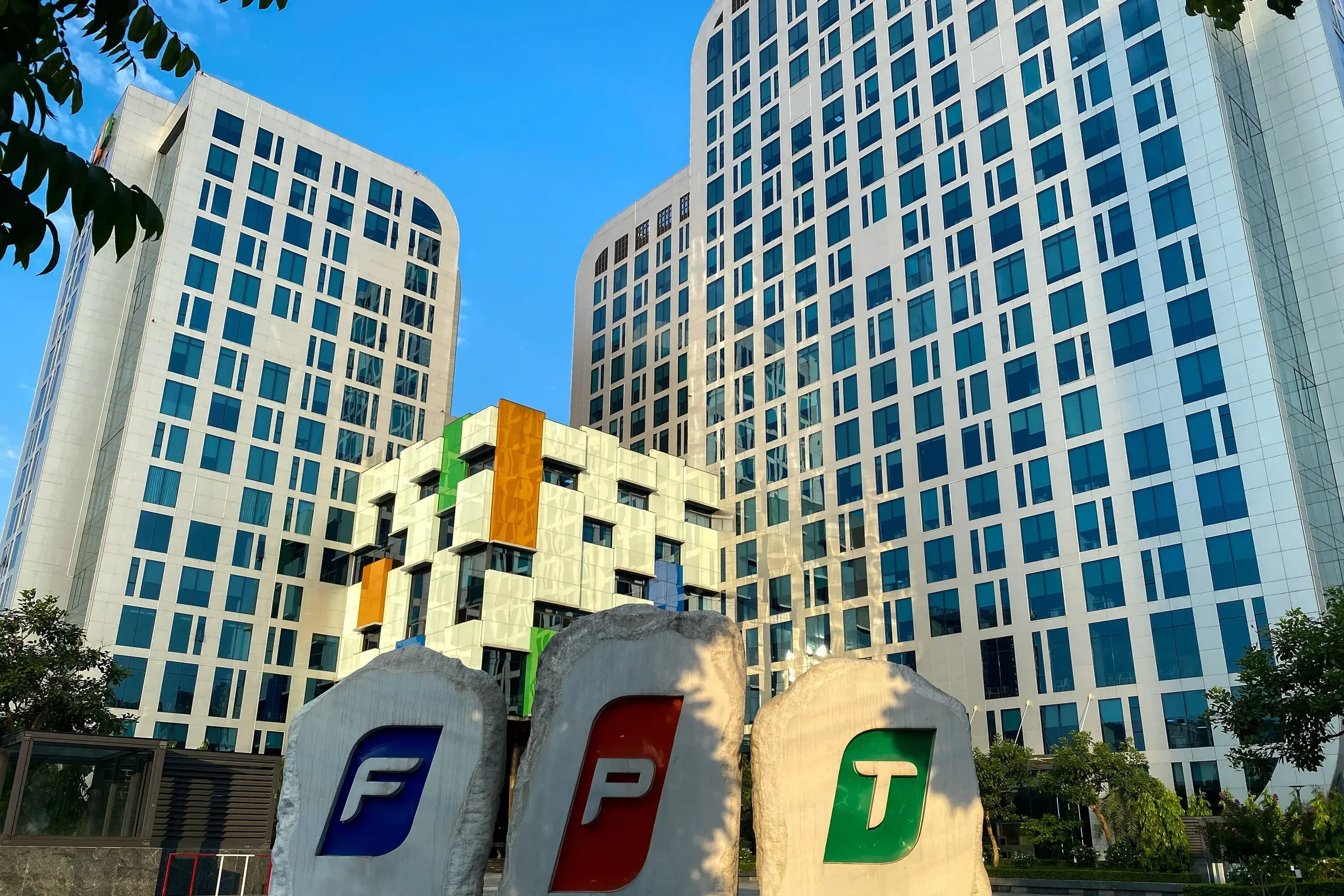
The Anthropic story carries a directly usable lesson when evaluating domestic technology stocks that are positioning themselves around AI. Three names come up repeatedly: FPT, CMC Technology (CMG), and VNG (VNZ). Looking at the market cap picture: FPT sits at roughly VND 122,000 billion, VNZ at around VND 9,500 billion, and CMG at around VND 6,300 billion. All three have real revenue, real earnings, and valuations grounded in present fundamentals.
The meaningful detail in their financial statements is this: none of these companies currently breaks out AI revenue as a separate reporting segment. AI features more prominently in investor communications than in the numbers. Contrast that with Anthropic, which can point directly to a $47 billion ARR and $2.5 billion specifically from Claude Code. For investors interested in Vietnamese AI stocks, there is no equivalent line item to examine.
That does not make FPT, CMG, or VNZ poor businesses. It means two types of investment stories need to be read differently. FPT trades on actual, audited earnings, with a P/E of roughly 11x that reflects a genuinely grounded valuation. But if someone is buying FPT on the AI narrative and expecting Anthropic-style P/S multiples, they are layering in an additional expectation premium that currently has no revenue data to support it. The line between evidence-based valuation and keyword-driven valuation sits precisely there.

The practical test for any technology stock billing itself as an AI play is simple: how much AI revenue is actually measurable, growing at what rate, and separated from the rest of the business? Anthropic is transparent about ARR and its growth trajectory. For Vietnamese tech stocks, that question does not yet have a public answer in the financial disclosures.
What to watch in the months ahead
Two concrete milestones will stress-test Anthropic’s valuation thesis. First, whether Q2 2026 actually delivers a profitable quarter as projected. Second, how the October IPO prices the company once it faces public market investors rather than private funds: institutional buyers who can construct their own growth models and discount rates will scrutinize the 20x P/S multiple far more rigorously than venture capital did.
For the Vietnamese market, the signal worth watching in upcoming quarterly reports from FPT, CMG, and VNZ is whether AI revenue begins to appear as a distinct, measurable segment. The day that line item shows up — and grows rapidly enough — is the day the Anthropic-style revenue multiple framework starts to become applicable to domestic AI names. Until then, P/E remains the right lens.