
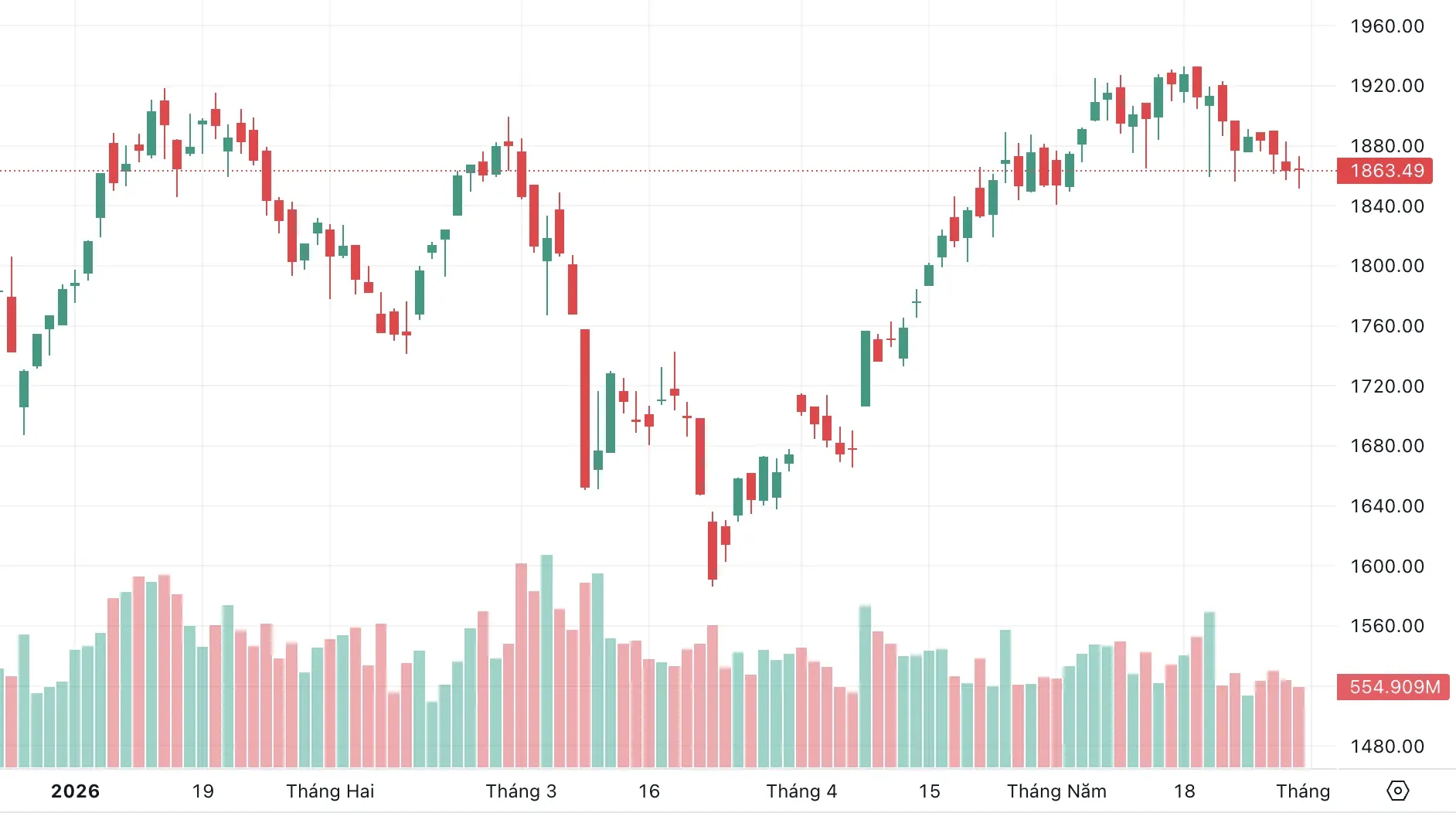
VN-Index is entering the first week of June in the kind of setup that often pushes newer investors into emotional decisions. The index is no longer sitting near 1,900, but it is also not in a disorderly selloff. After closing at 1,863.49 on May 29, down 0.73% from the previous week’s last trading session, the real question is not whether the bottom is already in. The better question is whether the 1,850 area is absorbing short-term supply well enough to hold.
Put differently, 1,850 is not a promise of a new uptrend. It is a test. If the market can stay above that zone while liquidity stops thinning out, the current move can evolve into a consolidation phase. If the index slips through support while selling volume expands, the message changes quickly: investors are becoming more willing to exit at lower prices.
1,850 matters because it is a reaction zone, not a confirmed floor
The most important short-term datapoint is that VN-Index has just shown a clear response around 1,850. On May 29, the index fell as low as 1,851.04 before recovering to close at 1,863.49. Newer investors often see that kind of intraday bounce and jump to a simple conclusion: support held, so the market must be safe again. That is too fast a read, because one reaction inside one session is not enough to confirm a new market state.
Zooming out helps. The current pullback comes after a meaningful climb from 1,817.17 on April 17 to 1,927.94 on May 18. After a gain of more than 110 points, some cooling-off is normal. The key distinction is not whether the market is correcting, but what kind of correction it is. Is the market gradually digesting supply, or is selling broadening enough to force prices toward a lower equilibrium?

That is why the 1,850 area matters more than a round number on a screen. It is where the market most recently reacted, and it also sits close to the zone where demand appeared several times in early May. If the index can hold there for a few more sessions without relying on one unusually strong rebound candle to rescue sentiment, that would be more constructive than a single sharp green day followed by immediate weakness.
ASEAN Securities is also framing the next step in a disciplined way. In its May 29 note, the firm placed near-term resistance at 1,880-1,890 and argued that the market needs to hold the 1,860-1,870 area for the next directional move to take shape.ASEAN Securities For retail readers, the practical takeaway is simple: even if a bounce appears, the hard part is whether the market can keep that bounce alive.
A technical rebound only matters if money flow stops shrinking
Many new investors look at the color of the index first and liquidity second. That is exactly how thin rebounds become traps. Prices can rise for a short period because selling pauses or because a handful of heavyweights lift the index, but without broader participation those rebounds rarely last.
The last stretch of May still looks fragile on that front. Matched volume had a few stronger sessions, but market breadth repeatedly leaned negative. On May 28, decliners outnumbered advancers by 131 stocks. On May 29, the gap was still negative by 71. In other words, the index did not collapse, but the internal health of the market still failed to show that buyers had taken control again.

That is where many F0 investors confuse support with strength. Support only means the market has not broken yet. Strength is a higher bar: liquidity needs to stop shrinking, advancers need to broaden out, and down sessions should stop producing sharply worse breadth. Until those conditions start to appear together, a rebound around 1,850 should still be treated as a supply test rather than proof that buyers have retaken the tape.
Nhân Dân reported that VN-Index finished May at 1,863.49, up a modest 0.51% from the end of April.Nhân Dân That figure is useful because it shows the market has not given back the entire prior advance. But the fact that the month still ended higher does not mean the current short-term correction is already over. Those are two different time horizons, and blending them into one conclusion creates false comfort.
The index can be propped up, but the market only heals when leadership broadens
One feature of VN-Index is that the headline number can look healthier than the underlying market when a few large-cap names keep it afloat. That does not mean the index is lying. It means the index can hide fragility underneath. Newer investors often see a mild decline or a late-session rebound and assume most stocks are stabilizing. In practice, the picture below the surface can be far weaker.
The May 29 session is a good example. GAS rose 6.98%, while VHM fell 1.08% and VCB dropped 1.27%. That split matters because it shows support was not broad-based across leadership groups. A few stocks with their own story can keep the index from looking worse, but if large banks and major property names remain under pressure, the index still lacks a sturdy base.

There is a simple test here for retail readers. When VN-Index rebounds, do not focus on one standout winner or one hot pocket of the market. Watch whether large banks, high-cap property developers, technology leaders, and major private-sector names stop falling at the same time. When more of those pillars stabilize together, the market has a better chance of moving from a technical bounce into a more credible consolidation phase.
That also fits the resistance framework from ASEAN Securities. A move back toward 1,880-1,890 cannot rely on one narrow source of support. It needs broader participation. And broader participation is not a feeling. It should show up in healthier breadth and in fewer heavyweight groups dragging the index in opposite directions.ASEAN Securities
Foreign selling is not the whole story, but it is still real pressure
Whenever the market softens, it becomes tempting to blame everything on foreign investors. That explanation is partly true, but it is not complete. Foreign flows do not determine every session on their own, yet around a sensitive level like 1,850 they still matter because they add measurable pressure and visible psychological weight.
Người Quan Sát reported that foreign investors sold a net 245 million shares in the week of May 25-29, equivalent to more than VND 5,034 billion across the market.Người Quan Sát That does not mean VN-Index must plunge as long as foreign investors are selling. It does mean domestic demand has to do more work, absorbing both short-term profit-taking and the supply coming from offshore sellers.
That is exactly why I would not treat 1,850 as a sacred line. If foreign selling eases, large caps stop moving out of sync, and liquidity does not deteriorate further, the area can hold. But if all three variables move the wrong way together, the level itself will not rescue sentiment. MBS, quoted by Tin nhanh Chứng khoán on May 31, said VN-Index may still test the 1,800 region in the first two weeks of June before conditions improve later in the month.Tin nhanh Chứng khoán
How newer investors should read the week of June 1-5
If the entire setup has to be reduced to one practical framework, it should start with market state rather than buy-or-sell reflexes. A consolidation state would mean VN-Index holds around 1,850, liquidity stops shrinking, breadth turns less negative, and leadership groups stop taking turns dragging the index lower. A deeper retest state would mean the index breaks below 1,850 while volume expands on the downside and major banks plus big property names remain weak.
That leads to one clear thesis for the new week: 1,850 is an observation zone, not a confirmed floor. Only when money flow shows that the market is digesting supply more effectively and internal conditions are improving should the level be treated as the base for a more credible rebound. Right now, the disciplined approach for newer investors is still to read liquidity and breadth before reading their own emotions.
The watch list for the next few sessions is therefore straightforward. First, how the index behaves around 1,850. Second, whether rebound sessions still come with thin liquidity. Third, whether leadership becomes less fragmented, especially in banks and large property names. Fourth, whether foreign selling loses intensity or adds fresh pressure. Until those signals start aligning, the market has not delivered a verdict. It has only presented a test for both cash holders and stock holders.