
A night when Dow Jones hits a record and Nasdaq still ends lower can look contradictory at first glance. If you read the market only through broad headlines, you may come away thinking U.S. equities are sending mixed signals. But the June 4 session was actually quite coherent once you look under the hood: money did not leave the stock market. It rotated away from the most overheated part of the AI trade and toward areas that had been left behind.
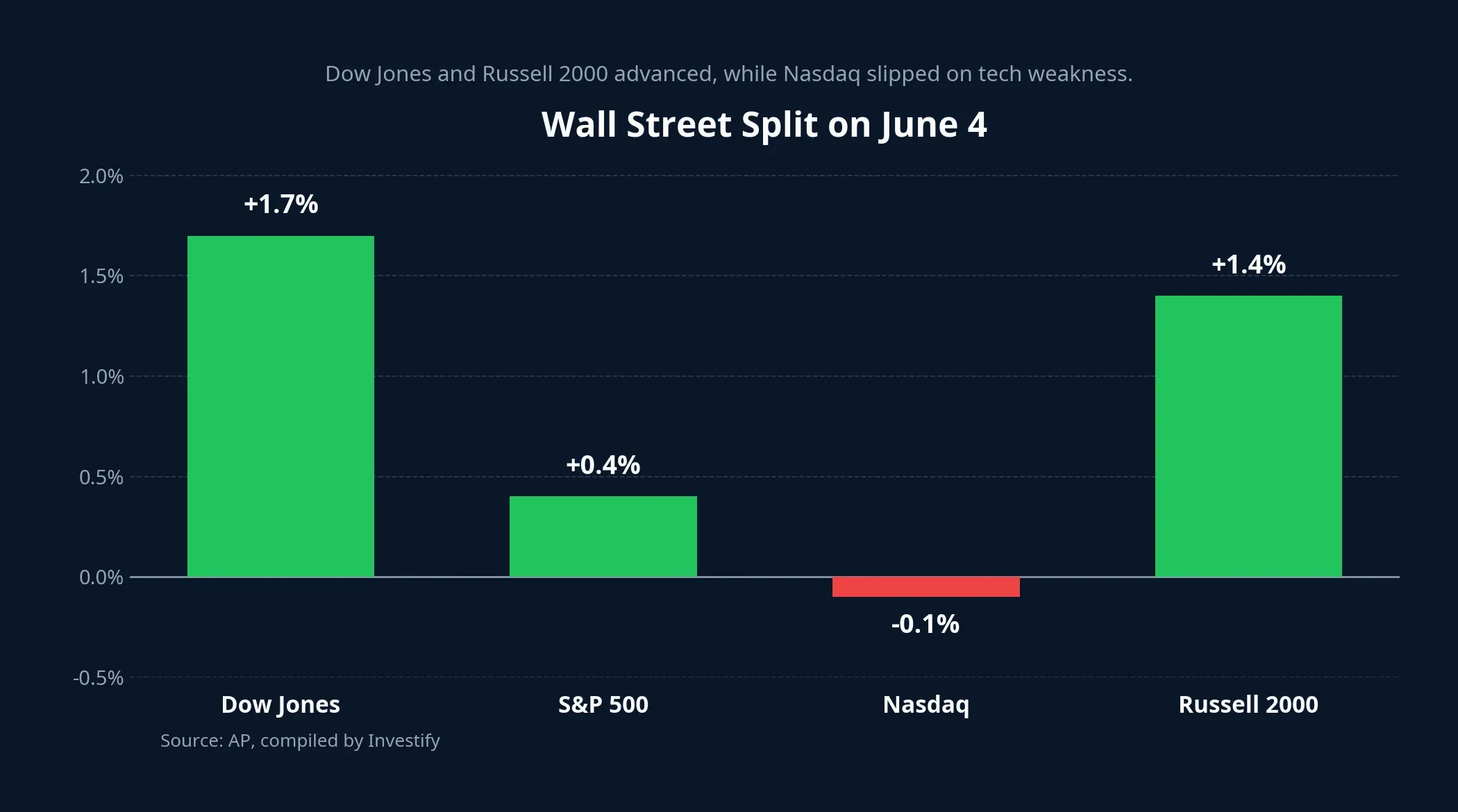
In that session, the Dow Jones Industrial Average rose 874.86 points, or 1.7%, to 51,561.93. The S&P 500 added 30.63 points, or 0.4%, to 7,584.31. The Russell 2000 climbed 41.81 points, or 1.4%, to 2,935.33. Nasdaq was the outlier, slipping 23.02 points, or 0.1%, to 26,830.96.AP If investors had been broadly de-risking, it would have been difficult to get that kind of strength in the Dow and small caps while Nasdaq was only modestly negative.
Put simply, money did not leave Wall Street. It became less eager to keep paying up for the part of the market that had already rallied the hardest on artificial intelligence, especially semiconductors, and more willing to move into banks, industrials, and smaller companies. Once you read the session that way, the apparent contradiction disappears.
This was not a classic risk-off session
The most important feature of June 4 was that the broad market still held up. The S&P 500 finished higher, which tells you the underlying bid for equities did not vanish. The Russell 2000 did even better, and that matters because small caps usually do not attract money when investors are turning defensive across the board. In other words, this was not an environment where everyone was trying to exit U.S. equities at once.
One visible catalyst was softer oil. AP reported that Brent crude fell 2.8% to USD 95.03 a barrel that day, easing some of the pressure on inflation expectations and input costs.AP For newer investors, that link is worth remembering: when oil and yields cool off, sectors that had been hurt by higher financing costs often get room to rebound first. So a stronger Dow does not automatically mean technology is leading. Sometimes it simply means the rest of the market is being repriced upward.

This is where many retail investors oversimplify U.S. indexes. They tend to read them as one block: if “America is up,” then every U.S. fund should behave more or less the same. That is not how market structure works. The Dow leans toward large, mature companies. The Russell 2000 reflects the smaller end of the market. Nasdaq is much more sensitive to growth technology, especially semiconductors and the infrastructure names tied to AI. Once those groups stop moving in sync, you have to read the composition of the market, not just the color of the close.
Why Nasdaq lost momentum while the market stayed firm
The most confusing part of the session sat inside Nasdaq. Its decline was tiny, just 0.1%, but it was meaningful because it happened on a day when the other major indexes were still constructive.AP That suggests the pressure was concentrated in one part of the market rather than spread across everything investors owned.
AP captured that point clearly by noting that some AI stocks weakened even after Broadcom delivered a strong profit report.AP That is exactly the kind of setup that trips up less experienced investors. When they hear “good results, weak stock,” the instinct is to assume something must be broken. Often the real issue is not the quality of the company’s quarter. It is the size of the expectations already embedded in the stock price.
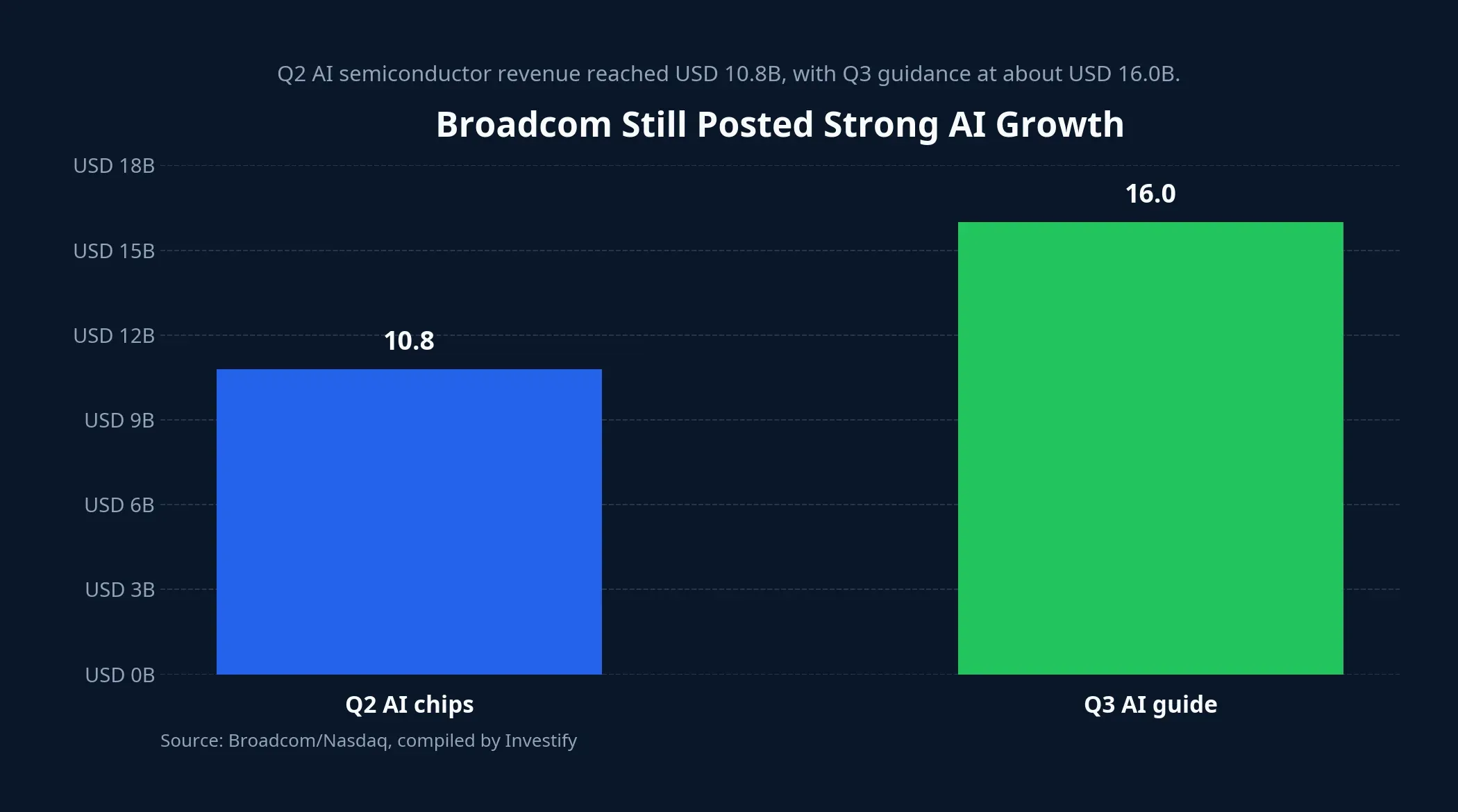
Broadcom is a good example. In the earnings release carried by Nasdaq, the company said second-quarter fiscal 2026 revenue reached USD 22.187 billion, up 48% year over year. AI semiconductor revenue alone came in at USD 10.8 billion, up 143% from a year earlier.Nasdaq On the numbers alone, that is not a weak quarter.
Broadcom also said third-quarter revenue is expected at approximately USD 29.4 billion, up 84% year over year, while AI semiconductor revenue is projected at about USD 16.0 billion.Nasdaq So the growth story is still very much alive. What the market appears to be reassessing is not whether growth exists, but whether that growth is still enough to exceed the extremely high bar that investors had already set for semiconductor names.
What the June 4 session means for fund buyers
For Vietnamese investors following U.S. funds, the biggest takeaway is not whether the Dow or Nasdaq wins the next trading day. The more useful lesson is understanding what kind of risk sits inside the product you own.
Think of it this way. If you hold a broad-market fund that tracks something like the S&P 500, you still have technology exposure, but you are not entirely dependent on technology. If banks, industrials, and smaller companies start recovering, a broad index fund can keep its balance. By contrast, if your portfolio leans heavily toward Nasdaq or thematic technology funds, the swings in semiconductors will show up much faster and much more directly.
That matters because the word “index” can create a false sense of diversification. Some index funds track the entire market. Others track a very narrow slice of it. When the AI narrative is hot, the payoff from a tech-heavy vehicle can arrive quickly. But once the market starts separating genuine growth from expectations that have become too crowded, a green close for Wall Street as a whole can still be an uncomfortable day for investors who are too concentrated in technology.
There is also a constructive point here. This move does not yet look like money abandoning U.S. equities altogether. If investors were moving into a full defensive posture, it would be hard to explain a strong gain in both the Dow and the Russell 2000. That is why June 4 looks more like an internal rotation inside Wall Street than an early warning that the broad market is about to crack.
At the same time, it would be a mistake to stretch this into a call that the AI boom is over. Broadcom is still reporting growth levels that most companies would struggle to approach.Nasdaq A more disciplined reading is that the market is not abandoning AI. It is becoming less willing to pay any price for every stock associated with AI. That is a major difference between a growth trend that remains intact and a part of the market that has become overly crowded.
The core thesis is rotation, not retreat
If this session has one clean takeaway, it is that Wall Street is rotating away from the hottest corner of the semiconductor trade and back toward the broader market. That interpretation fits all three of the key facts at once: the Dow hit a record, the Russell 2000 rallied strongly, and Nasdaq was the only major index to finish lower.AP
For fund investors, the real lesson is not to predict which index will win tomorrow. It is to understand the layer of risk hiding inside the label. “Investing in America” can mean owning a broad market with multiple drivers, or it can mean owning a narrower basket whose returns are tightly tied to semiconductor expectations.
The signals worth tracking over the next few sessions are straightforward: whether non-tech groups can keep carrying the tape while oil and yields stay calmer, and whether semiconductor leaders quickly reclaim market leadership after this repricing. If the broad market remains firm while chip names continue to face a tougher valuation test, the rotation thesis grows stronger. If the Dow and Russell 2000 also roll over, the story stops being about internal divergence and starts becoming a broader market risk.