

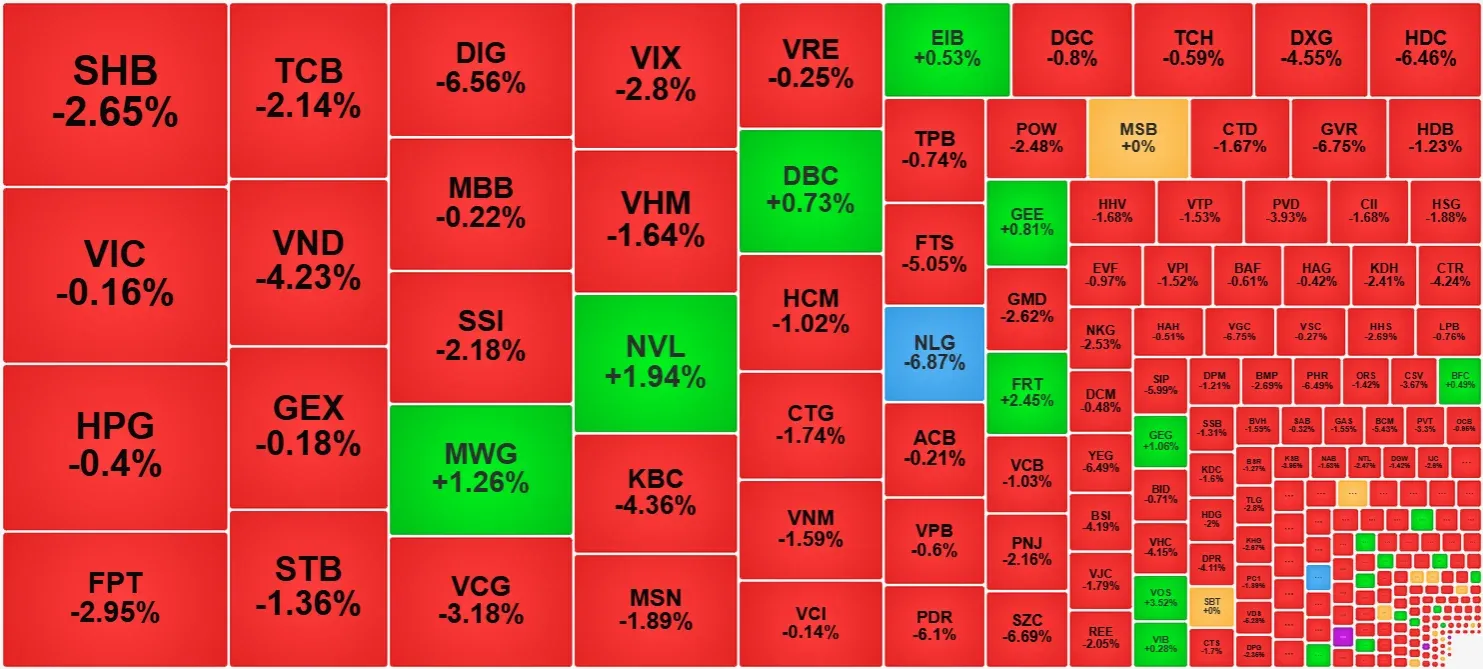
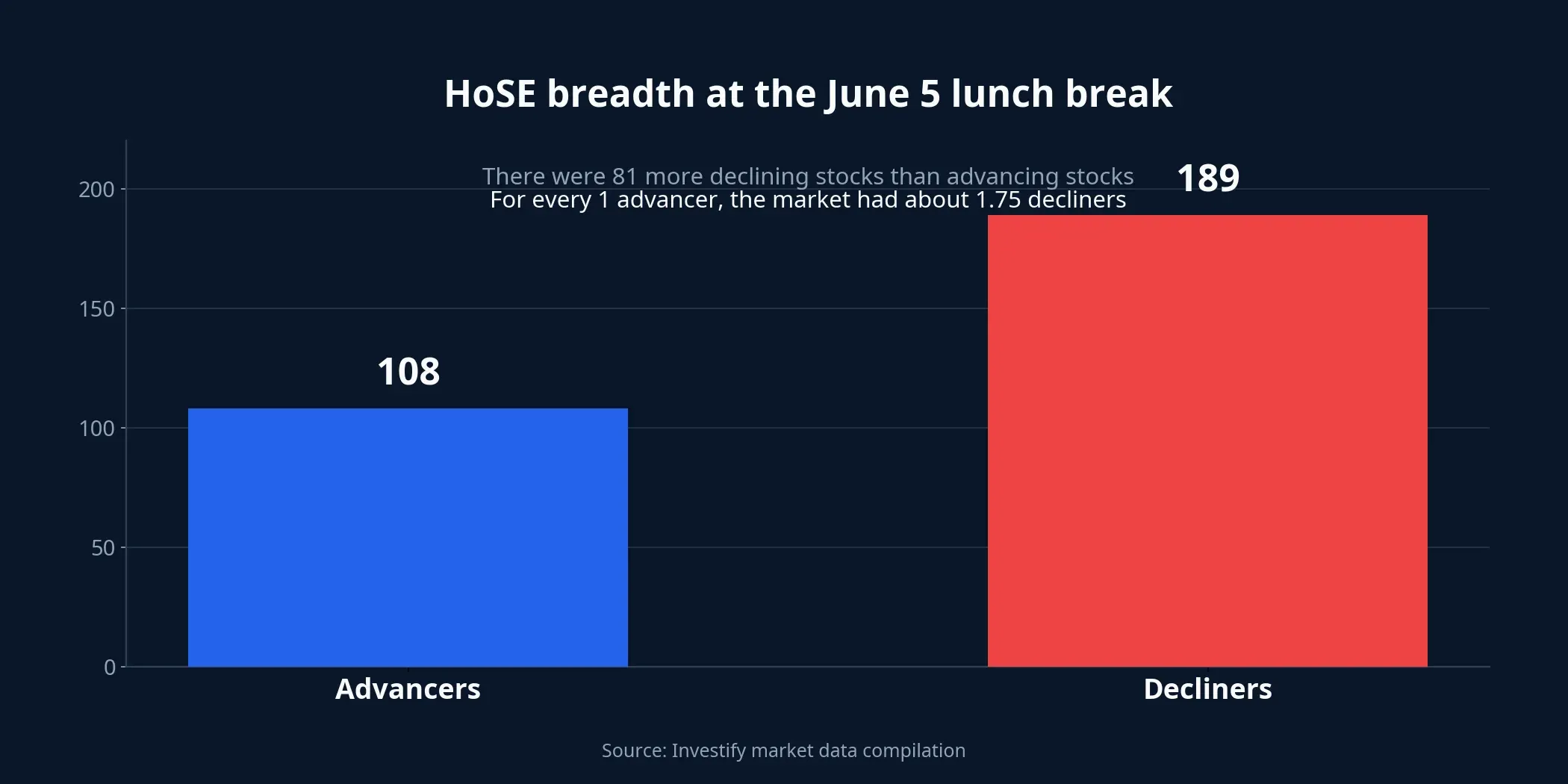
The June 5 morning session delivered the kind of contradiction that often traps newer investors. VN-Index climbed to 1,843.09, up 0.63%, but HoSE still had only 108 advancing stocks against 189 decliners. In plain terms, the tape was still red in aggregate. A few large-cap names were simply strong enough to keep the headline index in positive territory.
That distinction matters more than it looks. A green index can make the market feel safer than it really is, especially after a weak stretch. But an index move only tells you that support exists somewhere in the market. It does not automatically tell you that the average stock has turned healthy again.
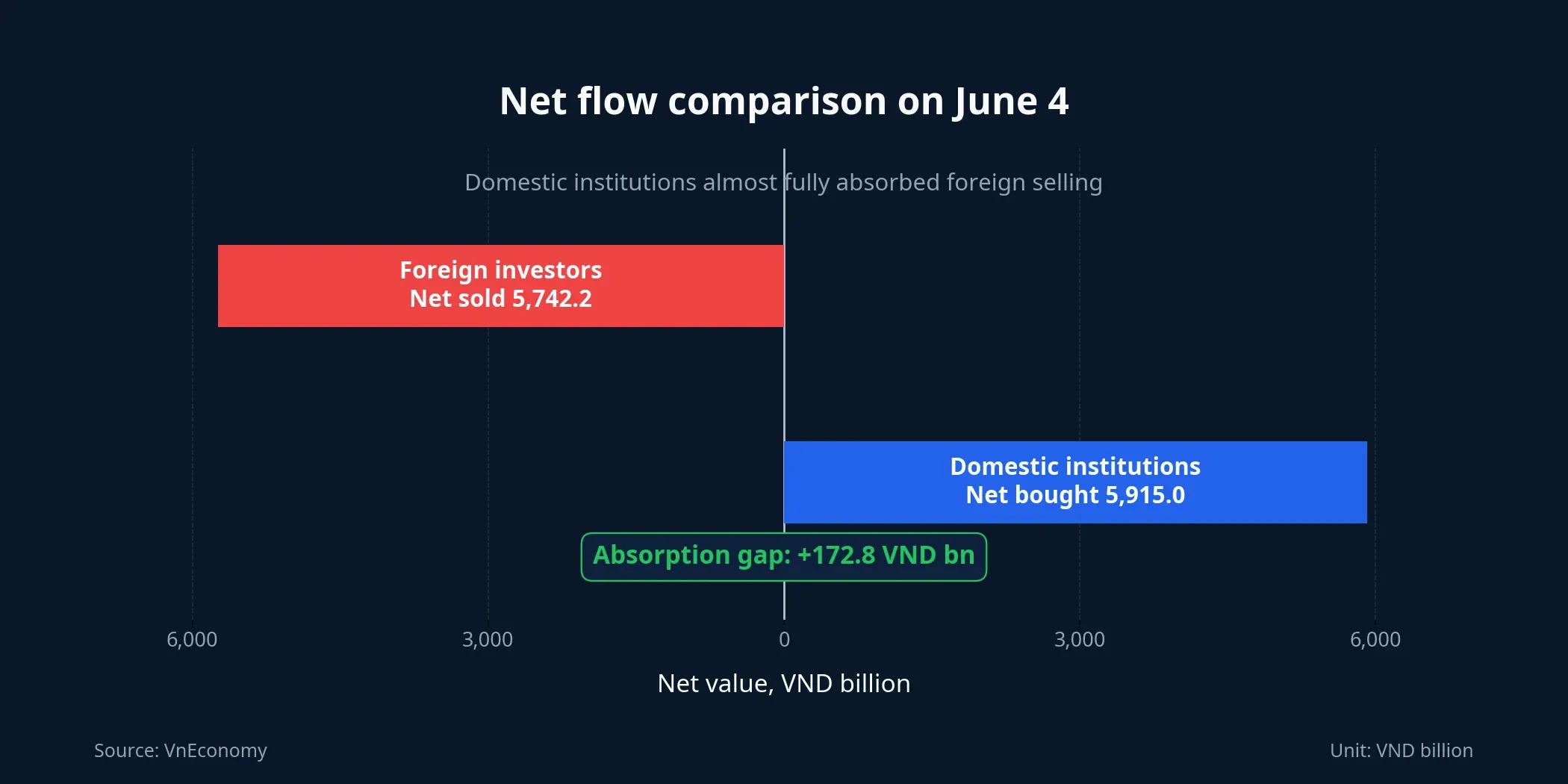
The backdrop from June 4 explains why this is the right frame. VnEconomy reported that foreign investors were net sellers of VND 5,742.2 billion, while domestic institutions were net buyers of VND 5,915.0 billion.VnEconomy At first glance, that looks encouraging. Local money was willing to absorb almost the entire amount that foreign investors dumped into the market.
The more useful reading is narrower. VnEconomy also said block trading in VIC alone reached VND 4,997.4 billion in that session.VnEconomy CafeF separately reported nearly 25.5 million VIC shares traded in negotiated deals, worth nearly VND 5,000 billion.CafeF In other words, a large share of the “domestic institutions stepped in” story was concentrated in one huge transaction in one heavyweight stock, not in broad-based demand across the board.
Market Breadth Is Still The First Filter
If you only have a few seconds to judge whether an up move is credible, breadth should be the first thing you check. Breadth compares the number of rising stocks with the number of falling stocks. When the index is green but losers still outnumber winners, that usually means the move is being carried by index heavyweights rather than by broad participation.
At the June 5 lunch break, that gap was not trivial. HoSE had 81 more decliners than advancers, which means the market was running at roughly 1.75 decliners for every 1 advancer. A healthier rebound usually needs two things at the same time: the index moving up and the average stock no longer leaning so heavily to the downside.
June 4 showed a similar pattern. VN-Index closed at 1,831.55, up 0.69%, but the market was still sharply split; Nhân Dân’s end-of-day infographic counted 136 gainers, 162 decliners and 62 unchanged stocks on HoSE.Nhân Dân The market did not break, but it was not a broad confirmation day either.
That is why the honest takeaway is not “the hard part is over.” The evidence fits a more cautious conclusion: the market is showing better support than before, but confirmation is still missing. For retail readers, that difference is critical because one setup calls for patient observation, while the other invites emotion-led chasing.
Domestic Absorption Is Positive, But Not Enough
Domestic institutions absorbing almost all of foreign selling still matters. It shows that large local buyers have not abandoned the market and that defensive psychology has not taken complete control. Without that demand on June 4, the psychological damage from a session with more than VND 5,700 billion in foreign net selling could have spread much more widely across the tape.
The problem is what we should not infer from that data. The numbers allow us to say the market had support. They do not yet allow us to say that large money has returned across the market. The reason is simple: the absorption story is still dominated by a negotiated VIC transaction, while the rest of the board remains visibly fragmented.
That changes how the June 5 afternoon should be read. If VN-Index stays green while most stocks fail to follow, the market is probably still living off support from a narrow group of names. If buying starts to spread into more sectors later in the day, then the “domestic absorption” story begins to look more like a genuine recovery signal.
Another mistake worth avoiding is the idea that strong local buying automatically lifts the average stock. That is not always how the tape works. Sometimes large money does something much more practical: it prevents the market from breaking further while the rest of the board still needs time to test real supply and demand.
Banks Are The Next Real-Time Test
If breadth is the market-wide snapshot, banks are the stress test for the rally. The group carries heavy weight inside VN-Index and often reflects domestic risk appetite more clearly than other sectors. A quality rebound does not require every bank stock to surge, but it does require the group to stop looking fragile.
That was not yet the case on June 5 morning. TCB rose 0.95%, while VPB and MBB were flat. ACB fell 0.57%, VCB lost 0.48%, BID dropped 0.94%, and CTG slipped 0.15%. Read plainly, the sector still did not provide a uniform confirmation for the green headline index.
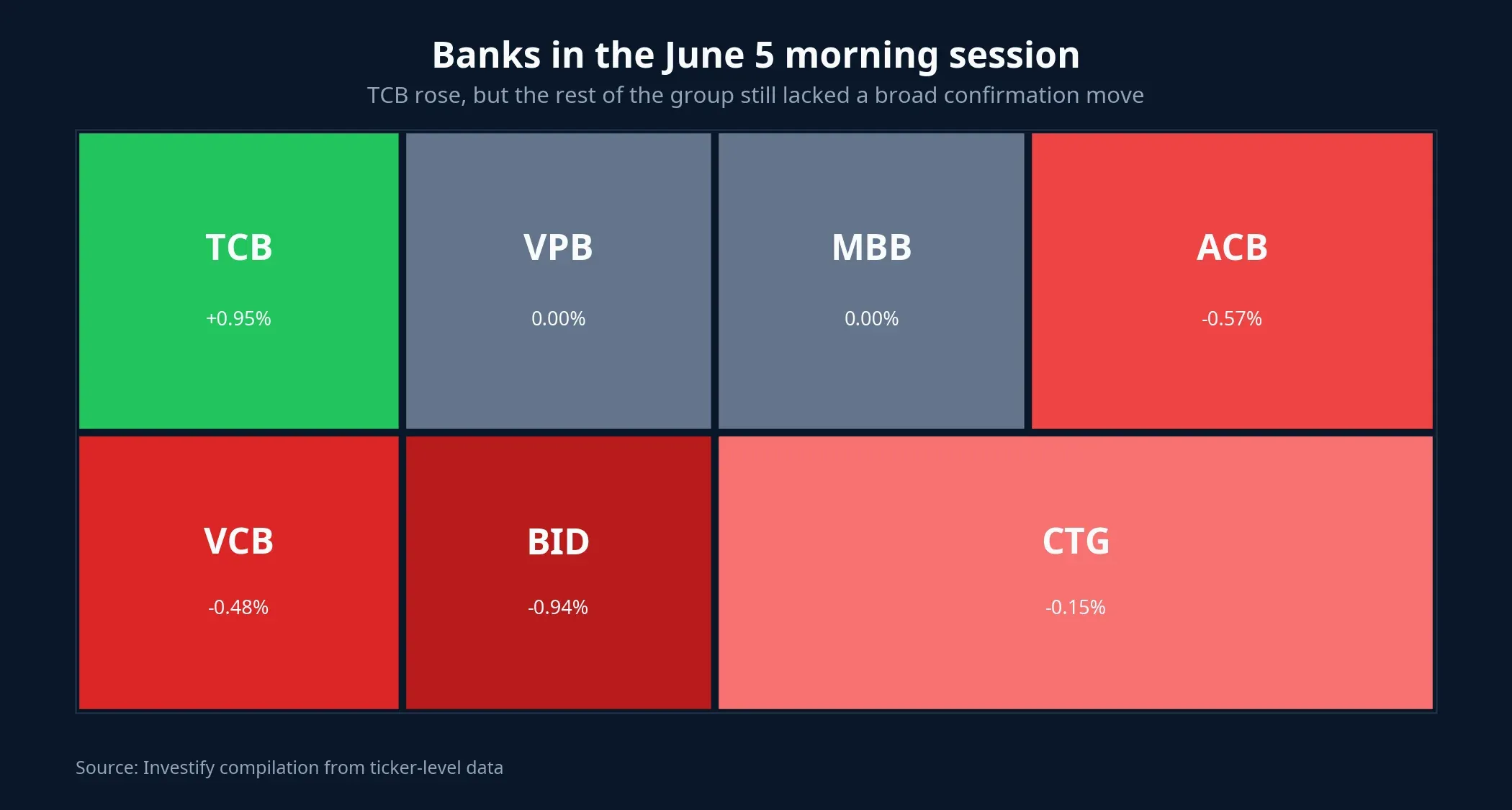
This is where newer investors should build the habit of observing structure instead of reacting to headlines. If more banks turn positive in the afternoon, or at least stop being sold into the close, that would suggest buying is spreading beyond a few isolated pillars. If the index stays green while the big banks remain soft, the market is still in an “index support” phase rather than a true “broad recovery” phase.
The list of names that saw heavy foreign selling on June 4 supports that view. VnEconomy said the heaviest foreign net selling hit MWG, ACB, VPB, VHM, TCB, CTG, VNM, GMD and FRT, while domestic institutions posted notable net buying in ACB, STB, VHM, MWG, HDB, CTG, VPB, GMD, MSN and VIX.VnEconomy That is a selective support list. It reinforces the case that money is defending specific pressure points, not sweeping across the entire board.
How To Read The Afternoon Session
A better framework than asking whether a green index means it is time to buy is to follow a sequence. First, check breadth: is the gap between advancers and decliners narrowing. Second, check the banks: are more names turning green, or at least avoiding renewed selling late in the session. Third, watch the large caps that took foreign selling on June 4: are they holding up because of genuine demand or only because of short-term support.
That sequence sounds basic, but it protects newer investors from one of the market’s most common traps: treating the index as a proxy for their whole portfolio. A portfolio tilted toward mid-caps, brokerages, property developers or retail names can still feel weak even when VN-Index is in the green. The market may have stopped deteriorating, but that is very different from saying the average position is safe again.
The cleanest thesis for June 5 morning is therefore not “the market has recovered.” It is “the market is being held up, and confirmation still has to be earned.” If breadth improves in the afternoon, the banking group becomes less fragmented, and the key names that absorbed foreign selling keep holding their ground, the green index will deserve more trust. If those signals fail to appear, the move in VN-Index should be read as a sign of support, not as proof that most stocks have already regained their footing.