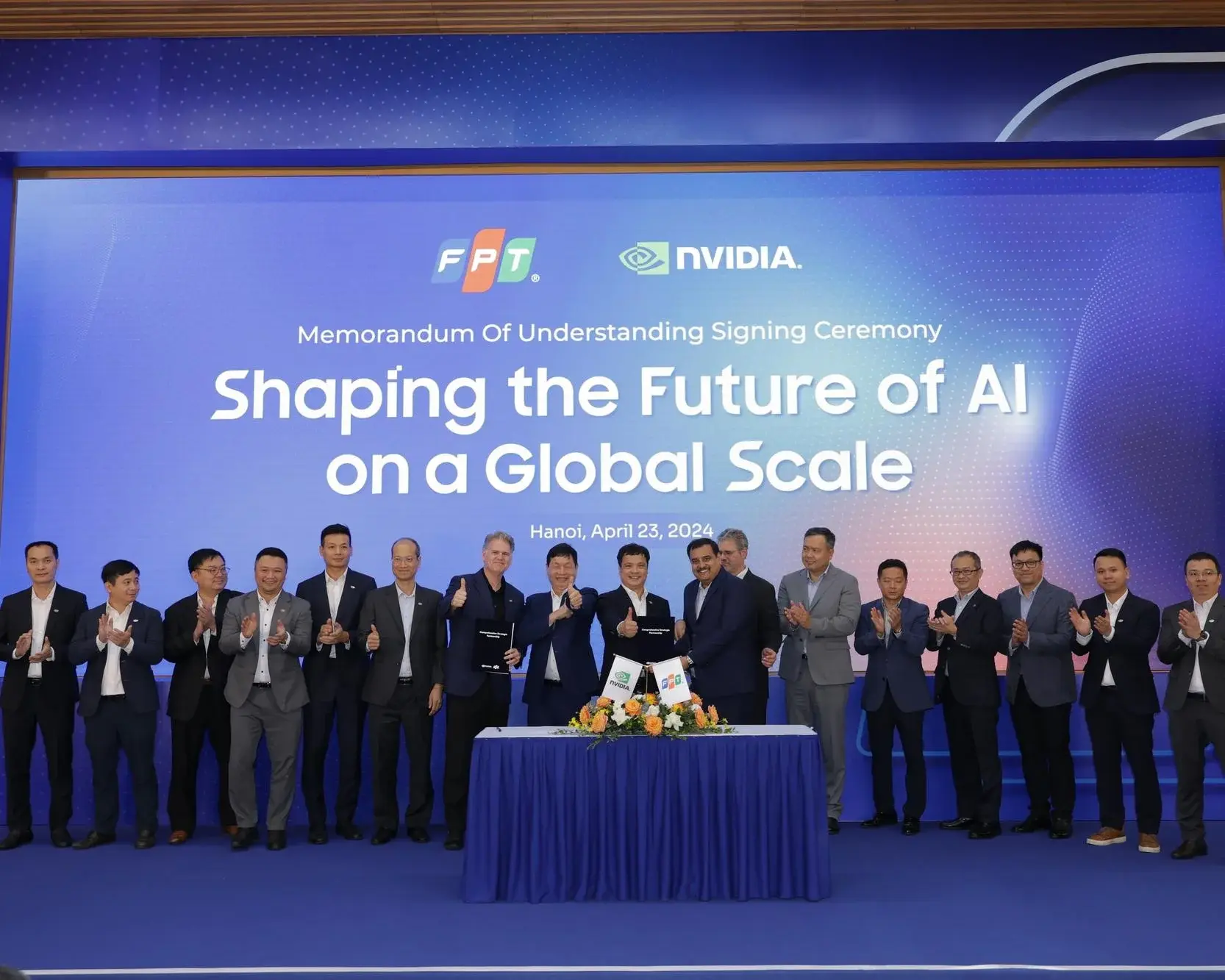

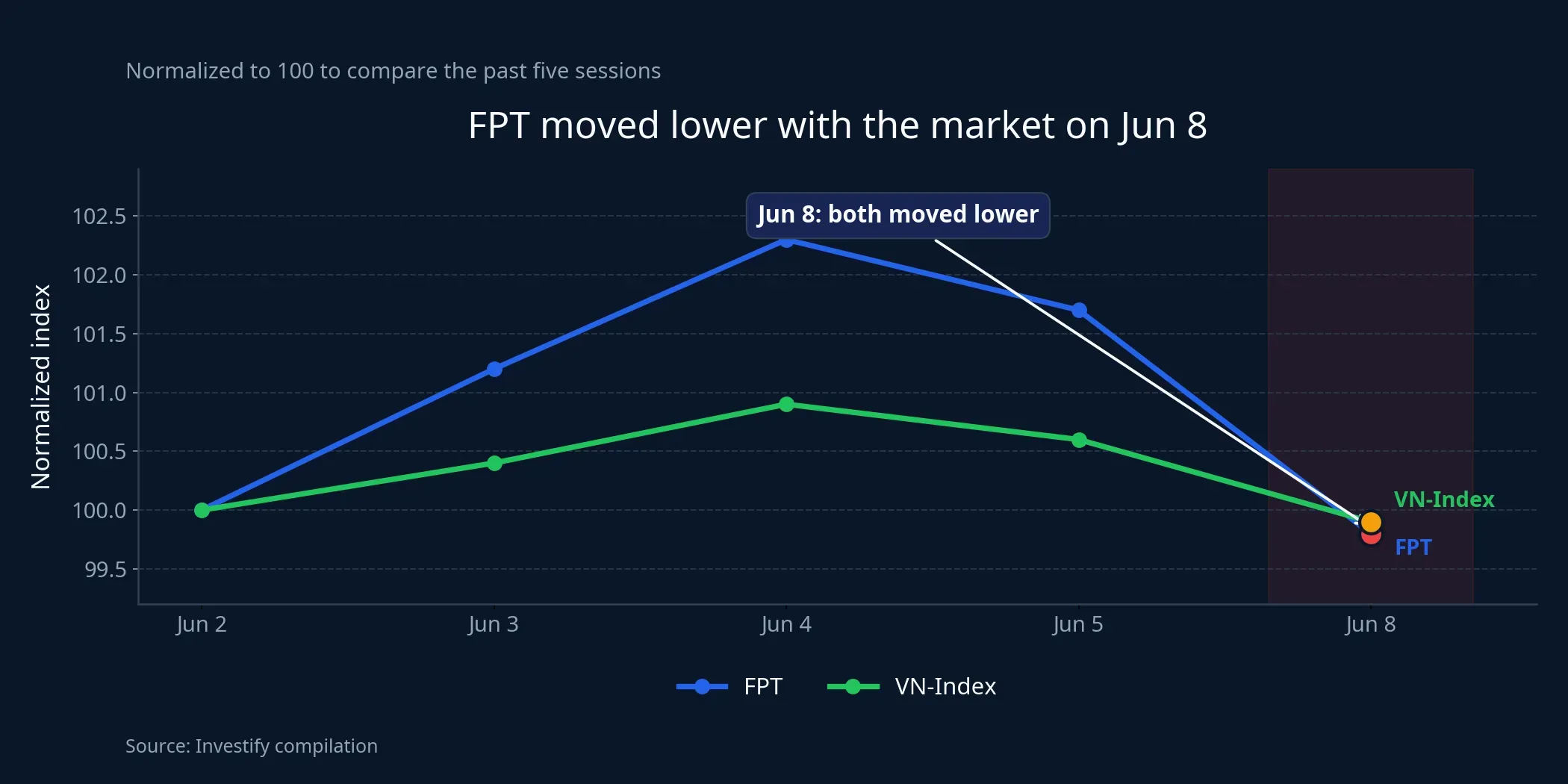
On June 8, FPT closed at VND 73,000 per share, down 2.67%. The VN-Index fell almost the same amount, down 2.63% to 1,790.53. At first glance, that makes FPT look like just another technology stock caught in a broad market selloff. The more important development this week, however, was not the price action. It was the kind of asset FPT has just added to its AI stack.
What FPT gained is a new Vietnamese-language data layer for AI. What shareholders need to know is how that layer could turn into money. Nemotron-Personas-Vietnam gives FPT more raw material to tell enterprise clients it is not merely selling GPU capacity or contract coding. But raw material is only the beginning. Revenue shows up only if the data moves into fine-tuning, industry deployment, and paid contracts.
900,000 profiles are still not revenue
According to the June 5 release, FPT and NVIDIA launched Nemotron-Personas-Vietnam, an open dataset designed to support sovereign AI development in Southeast Asia and licensed for commercial use.PRNewswire On Hugging Face, the dataset is listed as having been released on June 4, 2026 under a CC BY 4.0 license.Hugging Face In scale terms, it is meaningful: 900,000 synthetic personas, each with 31 fields, built to reflect Vietnamese language, culture, workforce patterns, and economic context.PRNewswire
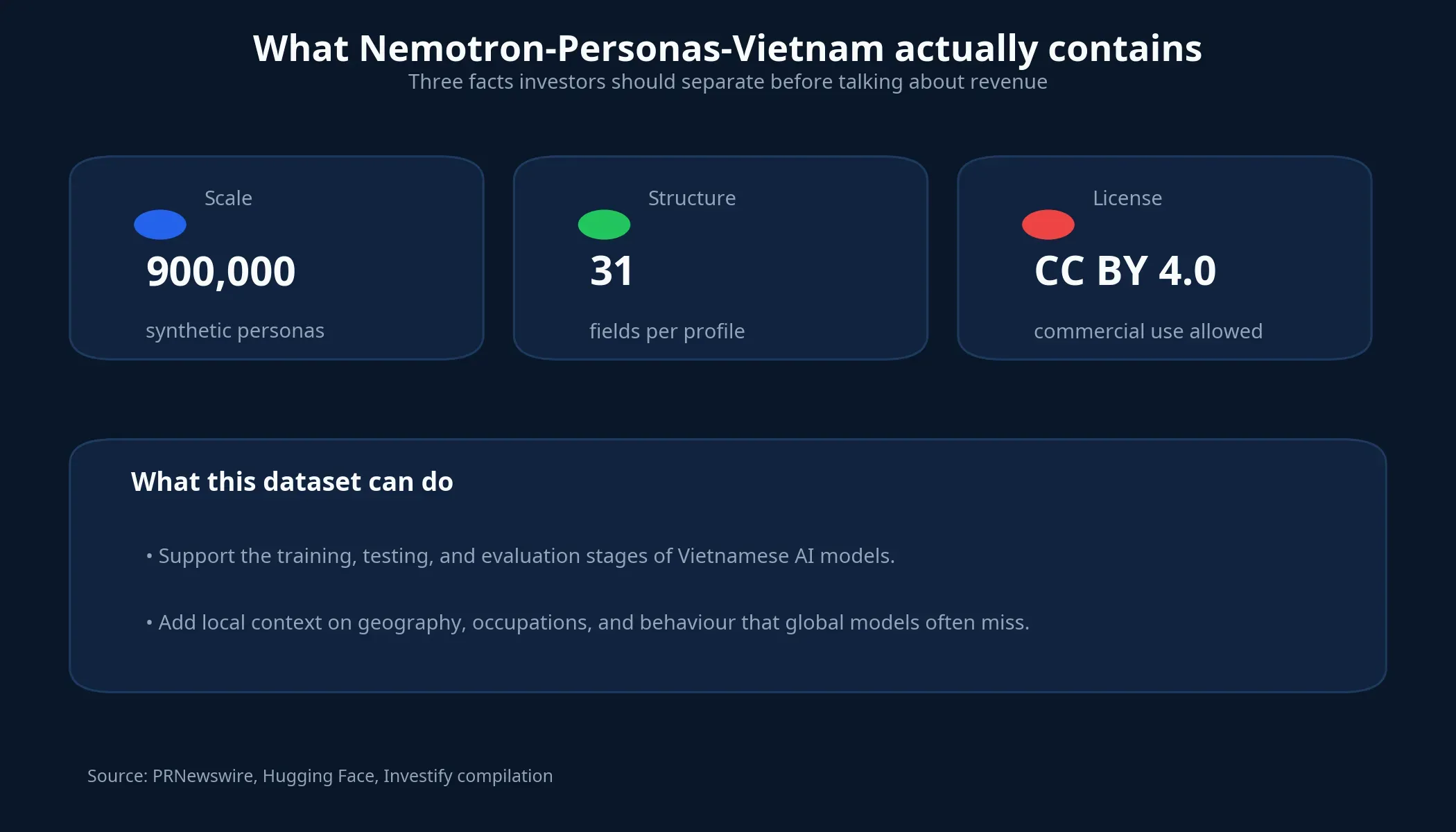
The key word there is “synthetic.” This is not FPT customer data, and it is not a proprietary transaction dataset that can be monetised as a stand-alone data product. Hugging Face describes it as being generated from Vietnamese demographic, geographic, and behavioural distributions, drawing on sources such as the 2024 population and housing census, the 2024 Vietnam Household Living Standards Survey, and contributions from FPT Smart Cloud and the Quantum AI & Cyber Security Institute.Hugging Face In plain English, these are artificial users designed to feel more Vietnamese than generic placeholders.
That distinction matters for investors. A global model may already speak fluent Vietnamese, but it can still miss the nuances of occupation, region, income, spending habits, or how people ask questions in a specific setting. For a bank, a hospital, a retailer, or a public-service workflow, that gap is not cosmetic. It is often the difference between an impressive demo and a system that can hold up in production.
The data matters only if it travels with infrastructure
The first monetisation path is not the ownership of 900,000 profiles. It is the ability to use that dataset to fine-tune models more precisely for each enterprise use case. A lending assistant at a bank needs a different conversational structure from a retail customer-service bot. A medical question-answering tool cannot be optimised with the same contextual layer as an internal assistant for a manufacturer. Local data helps training, testing, and evaluation move closer to Vietnamese operating reality, but only if it is inserted into a real fine-tuning workflow.
That is why the new dataset should be read together with FPT’s infrastructure story, not as a stand-alone partnership headline. In a strategy update published on May 27, FPT Software said its AI Factory infrastructure had already processed more than 1.1 trillion tokens, fine-tuned more than 70 AI models, and reached approximately 70% utilisation. The platform currently supports 43 AI cloud services and more than 18,000 engineers, scientists, and business users globally.FPT Software
Those numbers do not prove that Nemotron-Personas-Vietnam will generate revenue immediately. They do show that FPT already has a pipeline capable of turning data into service offerings. If FPT were selling only GPU capacity, it would be competing mainly on price, uptime, and hardware scale against global cloud providers. Once local data, model fine-tuning, and deployment teams are added, the competitive question shifts upward: who can solve a Vietnamese or broader Asian enterprise use case faster, more cheaply, and with better context?

That shift matters because it changes FPT’s position in the AI value chain. If the dataset lives only on Hugging Face, most of its value is branding and developer goodwill. If it is pulled into AI Factory, used in testing and evaluation, and then folded into deployments for banking, insurance, retail, or public-sector clients, the economics change. At that point, FPT is no longer selling machines alone. It is selling business outcomes that sit closer to real workflows.
The biggest risk is that the dataset remains a good story
Investors still need to separate strategic signalling from commercial proof. Nemotron-Personas-Vietnam could help FPT in at least three ways: improve model testing quality, shorten enterprise presales cycles, and strengthen the company’s local-AI pitch against foreign platforms. What the current source material does not show is whether any of those advantages have already turned into specific contracts or separately disclosed revenue.
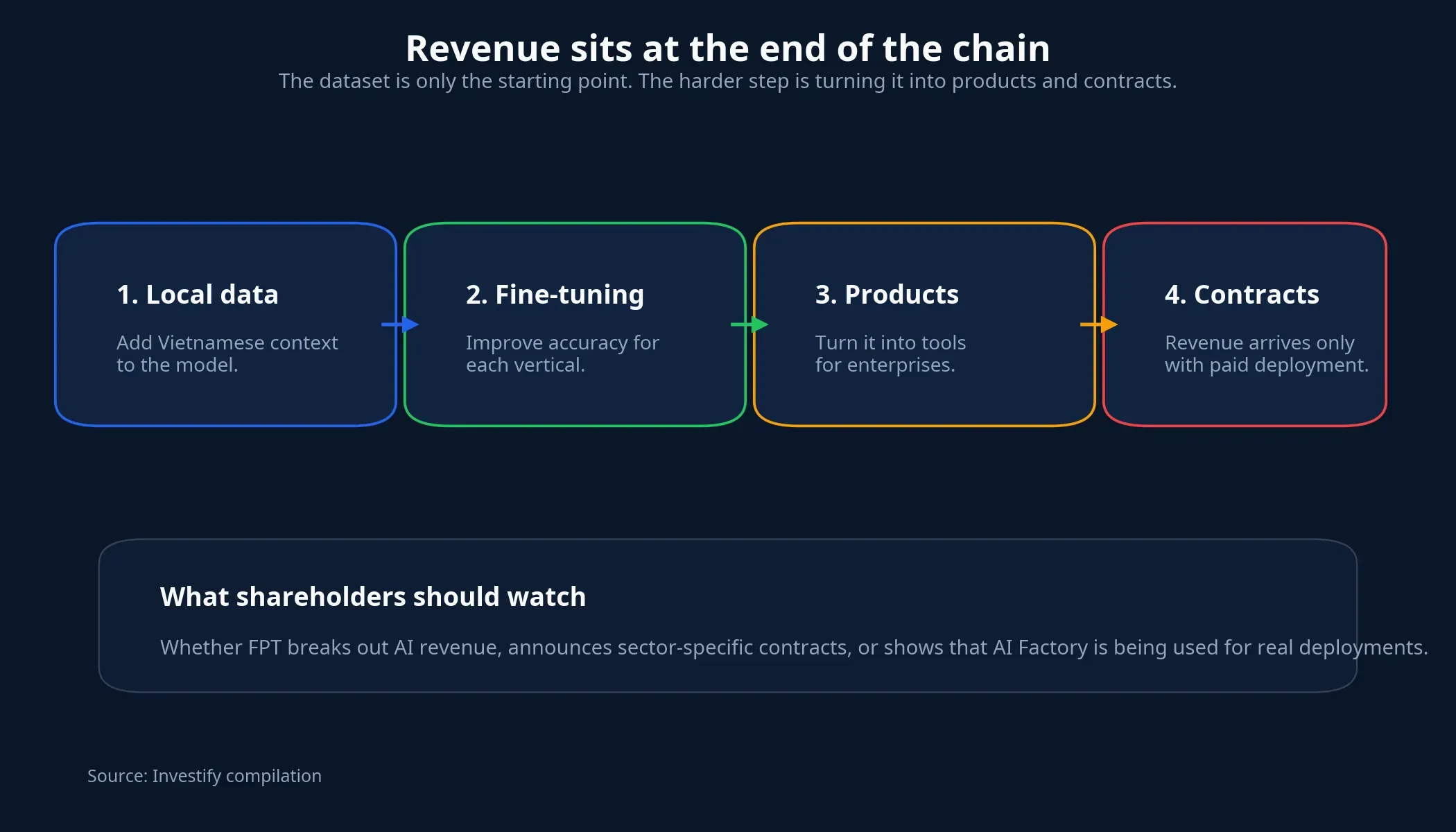
The real risk sits in the gap between “having the raw material” and “selling the product.” Synthetic data can look cleaner on paper than it performs in reality. If the underlying distributions are not sufficiently close to live behaviour, models may learn a polished version of Vietnam that still misses the edges of real-world user behaviour. Hugging Face is explicit on this point: the dataset is intended to support the model-development community, not to function as a stand-alone revenue product.Hugging Face
Another reason for caution is that markets do not value every AI announcement the same way. Many technology stocks have enjoyed a burst of optimism after announcing partnerships. More durable valuation support usually appears only when a company proves two things: real customers and repeatable revenue. For FPT, the new dataset may become a useful sales asset. If it does not pull through into industry-specific contracts, however, the benefit to the equity story is likely to remain limited.
What the June 8 decline says, and what it does not
A 2.67% drop in FPT on June 8 is not enough to say investors rejected the data story. The stock moved almost in lockstep with the VN-Index’s 2.63% decline that day, suggesting that broad market sentiment mattered more than any single AI announcement. In other words, the June 8 tape was not a clear market verdict on Nemotron-Personas-Vietnam.
Still, the decline is a useful reminder. Stocks do not reward an attractive narrative forever. They reward the ability to turn that narrative into cash flow. In technology, the distance between a strong demo and a large contract is often longer than investors expect, especially when infrastructure, sales, and implementation costs are still being absorbed in an increasingly competitive AI market.
The clearest conclusion for now is that FPT has added a valuable local data asset, but that asset sits at the strategic layer rather than the revenue layer. That framing does not diminish the dataset. It puts it in the right place inside the monetisation chain. Over the next few quarters, the signals worth watching are whether FPT announces more sector-specific AI contracts, whether it discloses AI-related revenue more clearly, and whether AI Factory continues to show high enough utilisation for this new data layer to be used in live deployments. If those links begin to appear, the data story starts moving from plausible to profitable.