

The Pentagon’s updated list does not turn Alibaba or BYD into untouchable stocks overnight. But markets rarely stop at the companies named in the headline. A move like this usually forces investors to apply a higher policy-risk discount to the broader Chinese tech and EV complex, and that shift can spill over into how growth stocks across Asia are priced before fundamentals move at all.
For Vietnamese investors, this is not mainly a story about whether Alibaba stock becomes untradeable. The more useful question is whether Asian markets are starting to demand a bigger policy-risk discount for growth narratives tied to Chinese tech, and whether that shift makes Vietnam’s opening more cautious. That is the core thesis here: this is first a test of risk appetite, not yet a direct shock to Vietnamese corporate fundamentals.
What the new list actually changes
AP reported that the Pentagon’s latest update added Alibaba, BYD, Baidu, and Unitree to the list of Chinese companies the US considers linked to the Chinese military. The roster now stands at 188 entities, a sign that Washington is widening scrutiny from obvious defense names to large civilian technology platforms as well.AP
The key is to read the consequence accurately. South China Morning Post noted that inclusion on the list can complicate access to US capital and dealings with the US government, but it does not automatically trigger an immediate trading ban.SCMP In other words, this creates a new layer of policy risk. It does not shut off liquidity in a single session. The first wave usually hits the named companies. The next wave reaches sector ETFs, index flows, and other growth stocks trading on similar expectations.

First signal: does Hong Kong weakness broaden out
Ahead of Vietnam’s session, Hong Kong is the cleanest screen to watch. TradingEconomics recorded the Hang Seng down 1.5% to 24,585 in the latest move, which suggests regional sentiment was already soft before the market fully digested the new US list.TradingEconomics So another weak Hong Kong open cannot be attributed entirely to this headline. The better question is whether the selling broadens out.
Hong Kong could be weak for several reasons at once, from pressure on Chinese tech to profit-taking after a prior run. If Alibaba, BYD, and related EV names fall while the wider Hang Seng Tech complex stays relatively stable, the reaction may still be stock-specific. If internet platforms, EV makers, and Chinese tech trackers all weaken together, markets are repricing the sector’s risk premium more broadly. For Vietnam, that matters first through sentiment rather than revenue.
Second signal: is the US separating China risk from US tech
Investify’s internal market data shows the Nasdaq rose 0.9% on June 9, while the VN-Index in its latest session fell 48.37 points, or 2.63%, to 1,790.53. Put side by side, those numbers say something simple but useful: Wall Street has not yet treated this as a synchronized global shock, while Vietnam is heading into the morning from a weaker emotional base.
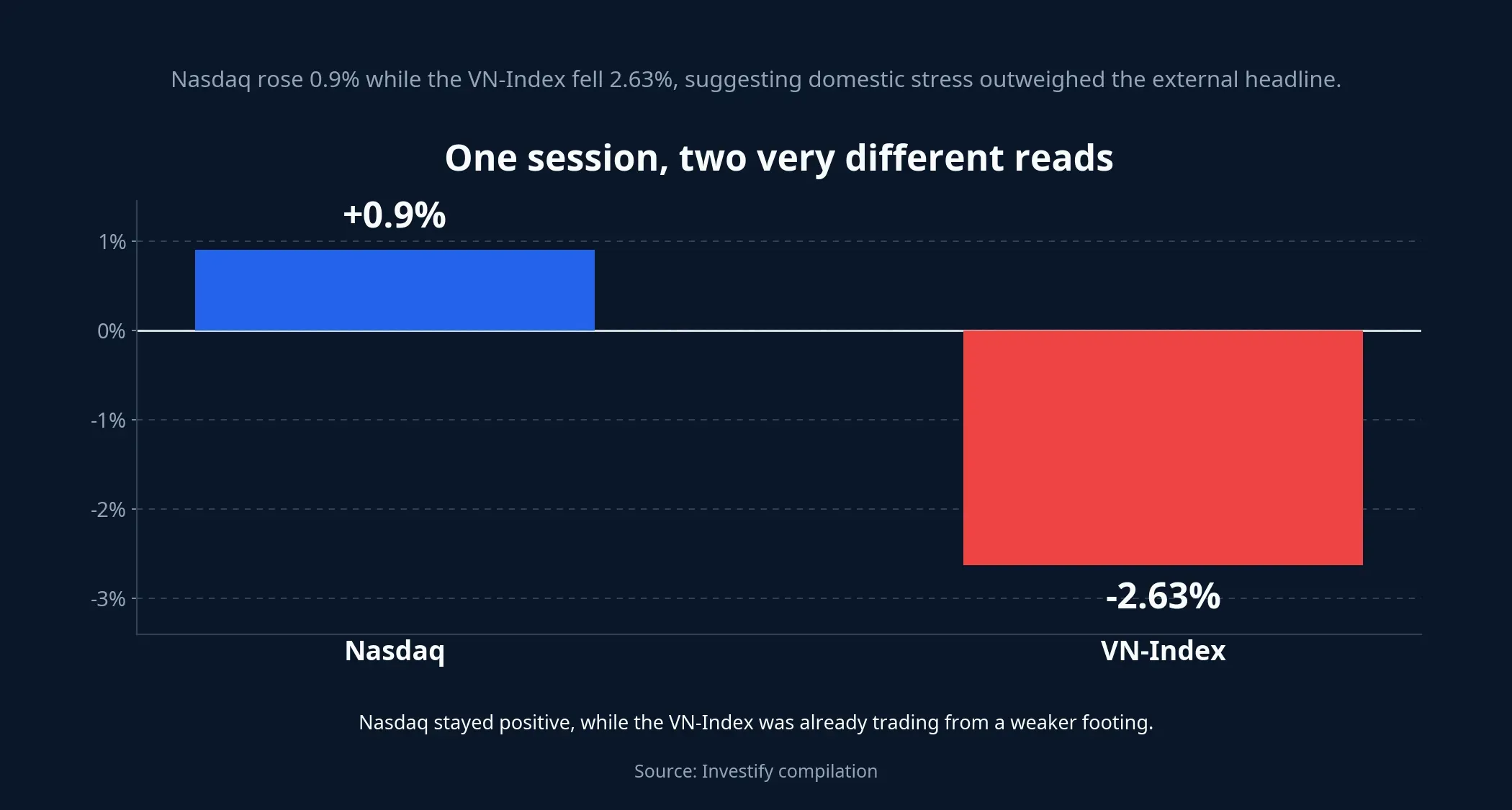
Still, a rising Nasdaq does not mean the risk is gone. One possibility is that US investors see this as a China-specific policy issue while mega-cap US tech is still supported by the AI earnings story. Another possibility is that the US market has not fully repriced the headline yet. That is why the signal to watch is not the Nasdaq in isolation, but whether it holds up while Chinese ADRs and Hong Kong tech names continue to weaken.
If US tech holds steady while Chinese names are sold, Vietnamese investors should read that as a divergence in policy risk, not as proof of a broad market panic. In that scenario, the likely spillover into Vietnam is narrower risk appetite for domestic growth stocks rather than a market-wide liquidation. If the Nasdaq, Hang Seng Tech, and EV names all weaken together, the story shifts to a wider risk-off move.
Third signal: do the VN-Index and the exchange rate confirm the spillover
After a 2.63% drop in a single session, the Vietnamese market is naturally more sensitive to external headlines. The first thing to watch at the open is not whether the index is green or red after 15 minutes. The more reliable signal is market breadth, the resilience of large caps, and whether growth-heavy pockets of the market are being sold harder than the rest.
The exchange rate is the second confirmation layer. Investify data shows USD/VND hovering around VND 26,345 per dollar and staying broadly stable over the past 30 sessions. If Asian equities weaken while the domestic exchange rate remains calm, markets are usually reacting through sentiment more than through an obvious funding squeeze.
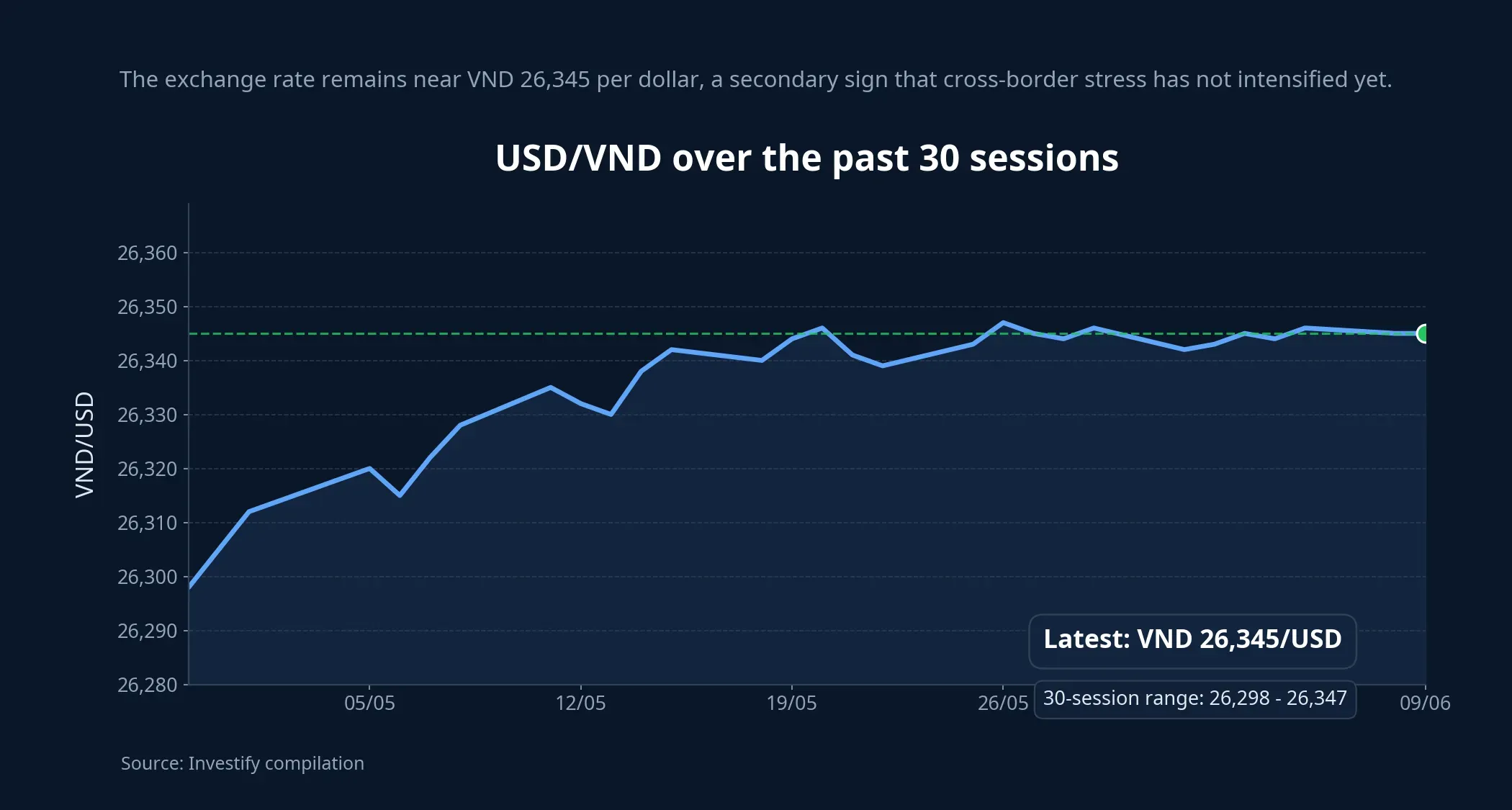
The picture changes if several signals worsen at once. If USD/VND starts climbing faster, Asian equities sell off more broadly, and the VN-Index loses support from heavyweights in the same morning, then this is no longer just a US policy headline. It becomes a regional rise in risk aversion that is being confirmed across asset prices. In other words, the Pentagon list does not decide Vietnam’s market by itself. Vietnam changes state only when several layers of evidence begin to agree.
How to read this setup without overreacting
The most common mistake for newer investors is to turn an external headline into a domestic trading command. The real question today is not “if Alibaba is weak, which Vietnamese stock must also be weak.” It is whether the region is becoming less willing to pay high multiples for growth.
The cleanest monitoring framework runs from outside in: Hong Kong first, then the US, then Vietnam. The conclusion is straightforward. The Pentagon’s updated list is not enough on its own to count as a direct shock to Vietnamese corporates, but it is important enough to force Asian markets to reprice policy risk around Chinese technology. That thesis only changes if three conditions deteriorate together: broader selling in Hong Kong, a clearer underperformance gap in Chinese tech versus US tech, and fresh pressure in the domestic exchange rate. Until those three layers line up, the more disciplined response is observation, not a rushed conclusion.