
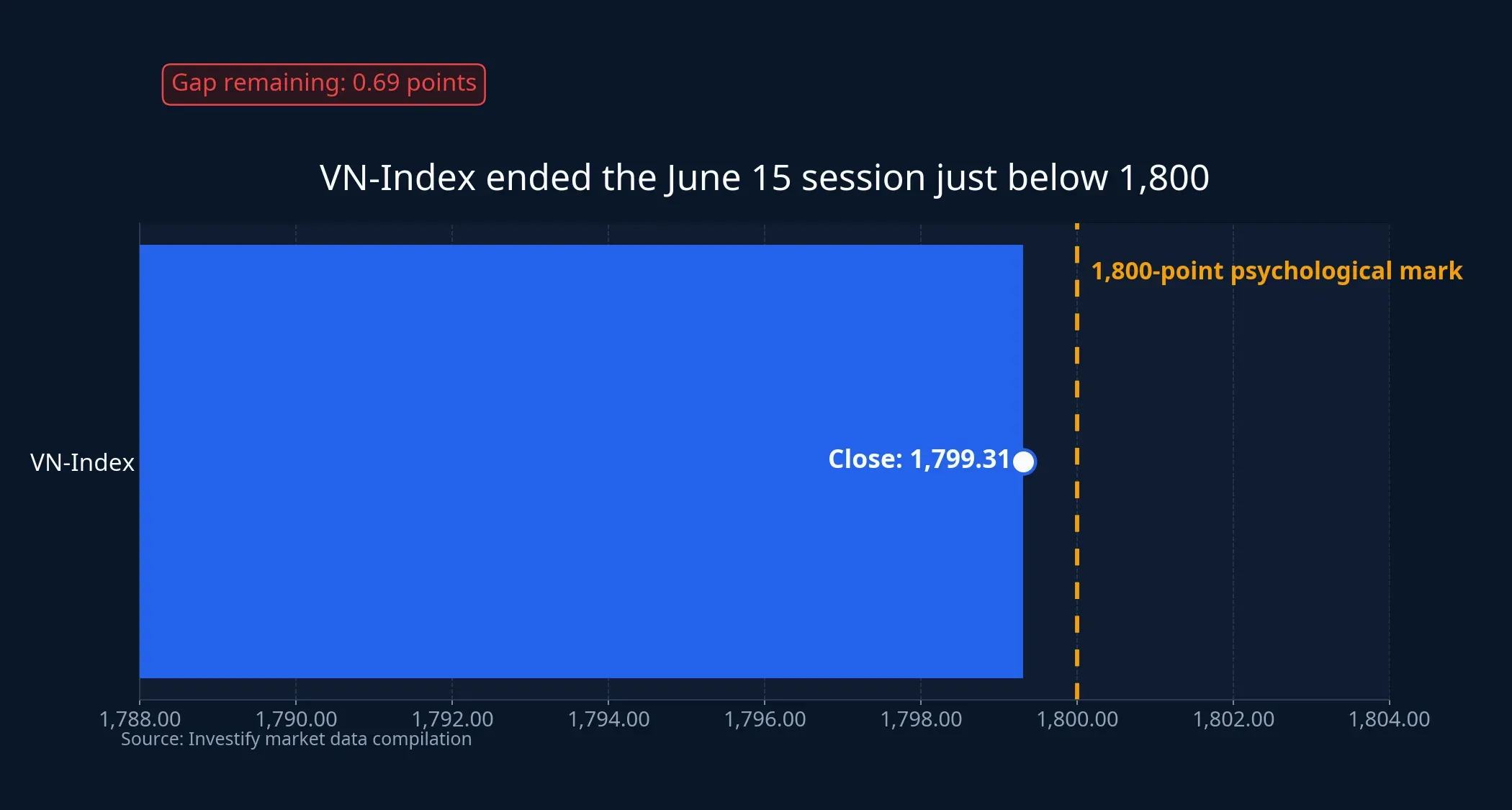
The VN-Index closed the June 15 session at 1,799.31, up 7.66 points, or 0.43%. By itself, that is not a dramatic move. A sub-1% rise does not tell investors much about durability. What stood out was where the market chose to put money first: brokerage stocks.
CTS, TCX and VPX all climbed close to 7% on the day. Larger names such as SSI, VND and VIX also gained more than 3%. If you only scan the board for the biggest green prints, it is easy to dismiss this as a quick burst of speculation. But brokerage stocks rarely lead by accident.
They usually move first when the market starts to believe trading activity could improve. That does not mean a durable uptrend is already here. It means investors are testing the most liquidity-sensitive part of the market before they commit to a broader risk-on view. That is the core takeaway from June 15.
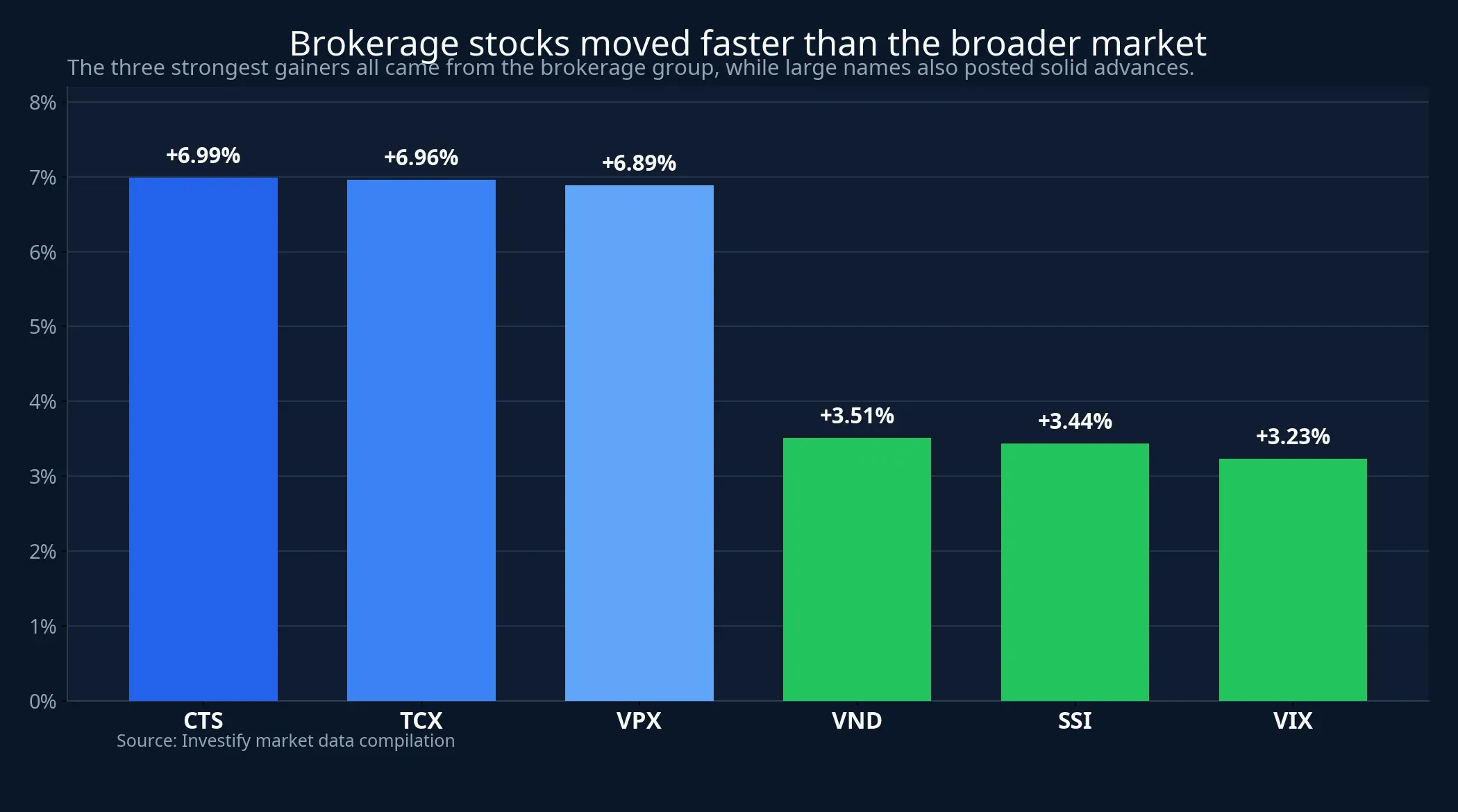
Where money went before the index looked strong
The signal was visible as early as the morning session. Báo Đầu tư Chứng khoán reported that brokerage stocks were up roughly 2.5% as a group, while HOSE breadth at midday stood at 183 advancers versus 103 decliners.ĐTCK That is not the pattern of a single stock reacting to a company-specific headline. It is money rotating into a cluster of names that benefit from the same mechanism.
That distinction matters, especially for newer investors. Many people start with the index and only then check sectors. In practice, the market often works the other way around. The index can still look modest while a sensitive group begins pricing in what traders expect to happen next.
June 15 fits that pattern. The headline index move was mild, but market breadth leaned positive and brokerage stocks advanced in sync. The disciplined reading is not “the bull trend is back.” It is “the market is testing the idea that liquidity may improve.”
Why brokerage stocks react so quickly
The logic is straightforward. Securities firms make more money when people trade more. Higher matched value supports brokerage fee income. Stronger appetite for margin can expand lending balances. A less hostile tape also makes proprietary trading less stressful.
That is why brokerage stocks behave like an early sensor for risk appetite. Investors do not buy them only because of current-quarter earnings. They buy them because they are anticipating a busier trading environment in the weeks or months ahead. If that scenario plays out, the industry’s revenue and profit lines have room to improve later on.
The downside is just as important. This group can reverse quickly if turnover fades. A technical rebound can lift brokerage stocks before the rest of the market, only for profit-taking to show up fast if fresh money does not follow through. So the sector is best read as an early signal, not as proof that the market has already healed.
VPX had its own catalyst, but the broader story was still liquidity
Among the strongest movers, VPX had the clearest company-specific trigger. On June 12, HOSE removed VPX from the list of securities ineligible for margin trading. For a brokerage stock, regaining margin eligibility widens the pool of participants and can strengthen short-term trading expectations.CafeF
That said, VPX should not be used to explain the entire group. In the fresh-source set from the past seven days, there is no similarly strong company-specific headline that fully accounts for the near-7% gains in CTS and TCX. The safer interpretation is that most of their move came from group-level trading, with investors buying brokerage names as a way to position for stronger turnover.
That helps avoid a common analytical mistake: seeing a few sharp movers and forcing one narrow explanation onto the whole sector. In reality, a session like this can reflect several layers at once, including sentiment, short-term positioning, ETF-related front-running and stock-specific news. The key question is which driver dominated. On June 15, the evidence points first to liquidity expectations.

ETF reshuffling and the 1,800 line
Another support for sentiment came from the ETF rebalancing window. SSI said the latest MarketVector Vietnam Local Index changes will take effect on June 22, while the VanEck Vietnam ETF is expected to complete its rebalance on June 19.SSI CafeF also reported that the VNM ETF portfolio was worth more than USD 546 million as of June 12, equivalent to roughly VND 14,400 billion.CafeF
ETF activity does not directly explain why CTS or TCX jumped in a single session. But it does create a period when investors know mechanical flows are coming, which tends to encourage front-running. In a market that has just bounced after a weak stretch, even a modest catalyst like that can amplify moves in the most liquidity-sensitive names.
Still, a fast reaction is not the same as confirmation. The VN-Index closed just below 1,800, only 0.69 points short. That is not a mystical level, but it is an obvious short-term sentiment marker. A clean push above it would reinforce confidence. Another failure right below it would make traders more cautious.
Turnover gives that level more context. HOSE recorded VND 11,759 billion in trading value during the morning session, up 68.35% from the previous Friday morning.ĐTCK That matters more than the headline index move, because brokerage stocks only keep their footing if real money continues to show up.
What newer investors should watch next
The first checkpoint is liquidity itself. If matched value on HOSE and across the market stays firm in the next session, the idea that money is rotating back toward risk will gain stronger support. If turnover falls away immediately after one green day, the brokerage rally will look more like an emotional response than the start of a durable shift.
The second checkpoint is breadth. A healthier rebound should not depend on a handful of brokerage names running on their own. Banks, steel stocks and larger caps need to stay broadly positive, because those groups tell you whether money is expanding across the market or simply circling inside one pocket of risk.
The third checkpoint is how the market behaves around 1,800. If the VN-Index clears that area and holds it with convincing turnover, the early move in brokerage stocks will have better support. If the index stalls again, the stocks that moved fastest are also the ones most exposed to early profit-taking.
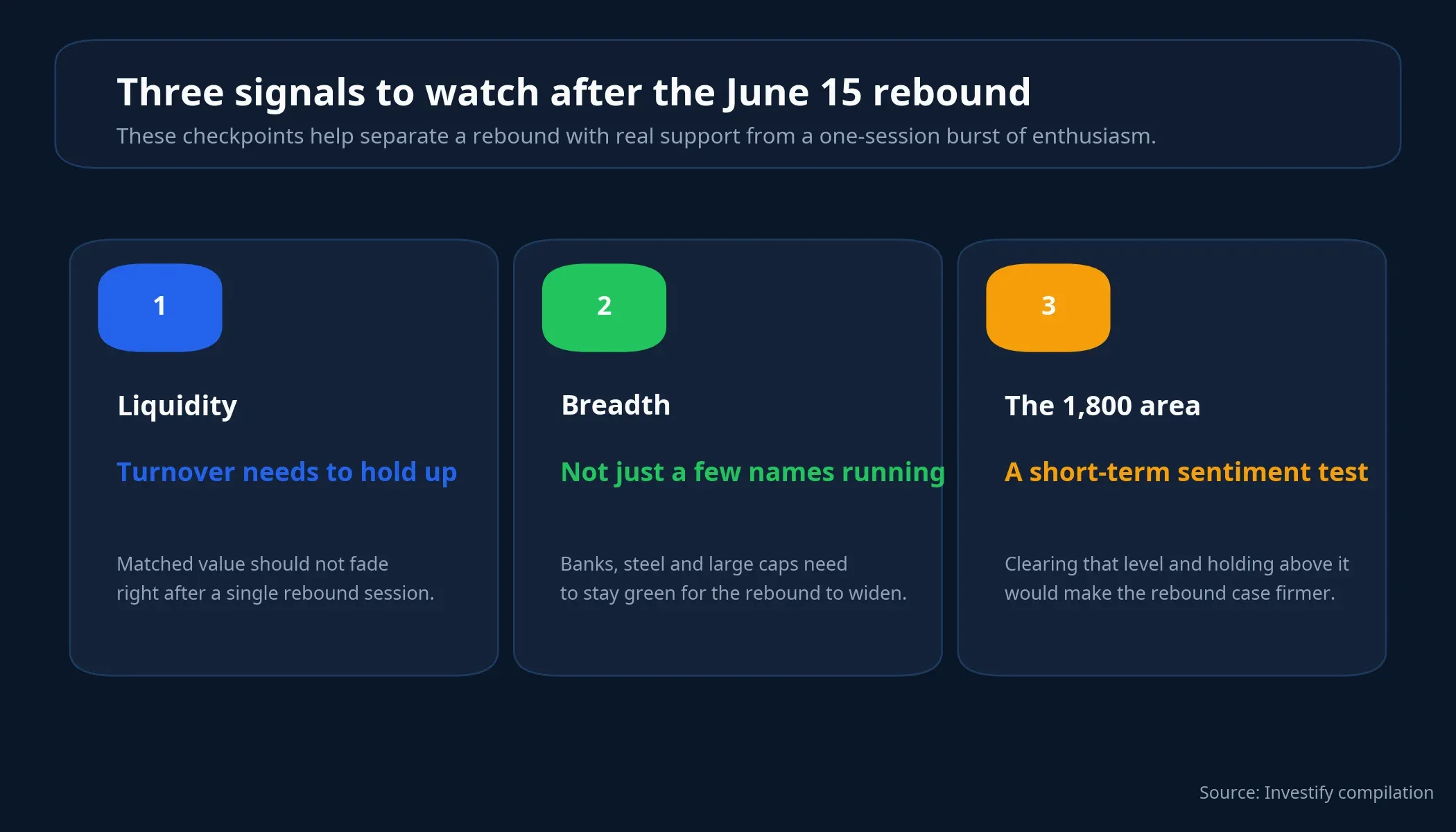
The main point is not that the VN-Index rose 0.43% on June 15. It is that the market used brokerage stocks as an early test for a possible liquidity comeback. The cleanest thesis right now is that the rebound is being tested from the inside, with securities firms acting as the first responders. That thesis becomes more credible only if three things happen next: money keeps coming in, breadth widens and 1,800 stops acting like a psychological ceiling.