

A green index is not always an easy market. On the morning of June 16, VN-Index stood at 1,805.96, up 6.65 points, or 0.37%. At first glance, that looks like the kind of session that lets nervous retail investors relax. A closer look says something more nuanced: the market was up, but the quality of the move was still uneven.
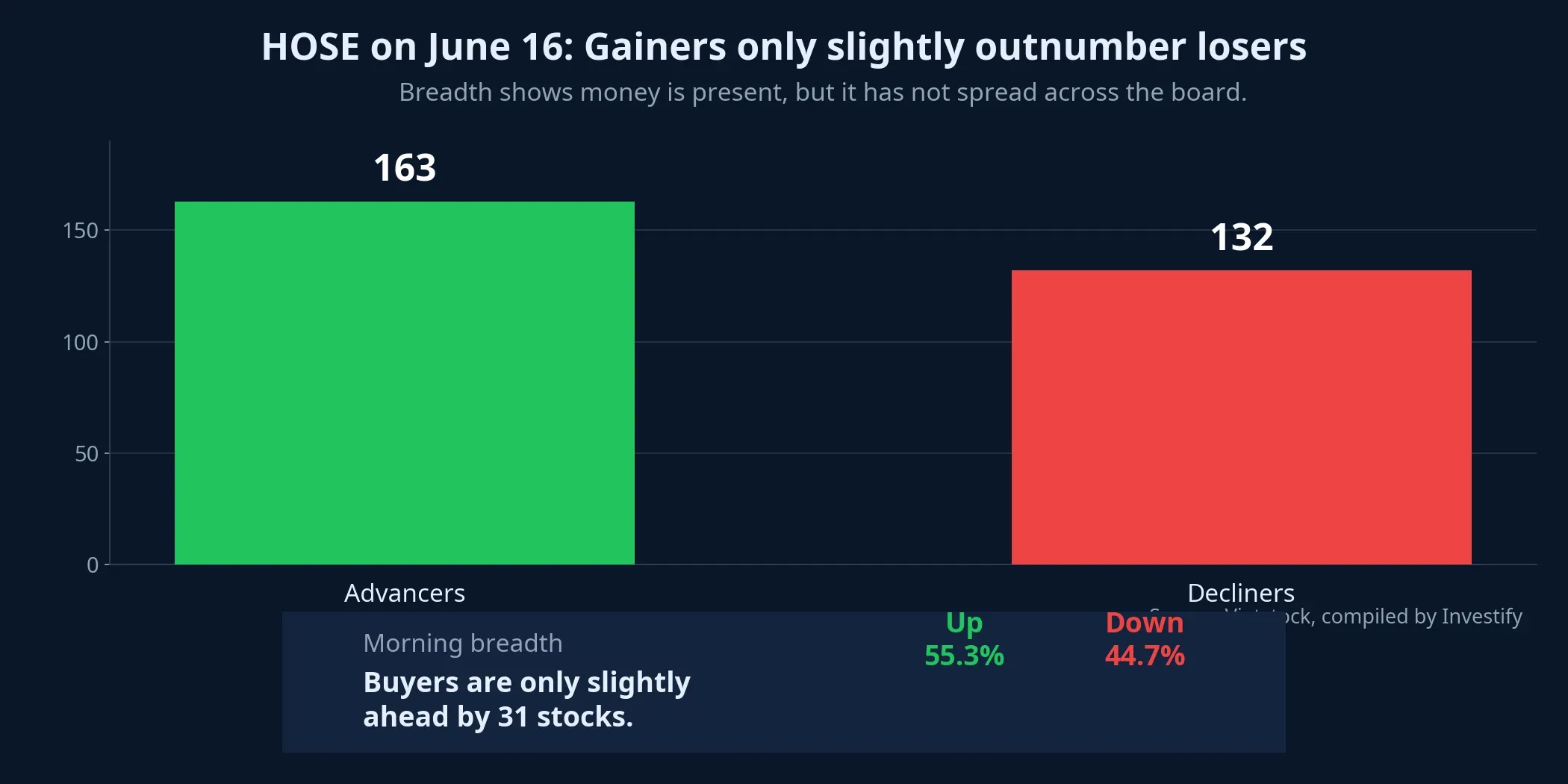
The real signal was not the headline gain. It was the way that gain was built. On HOSE, 163 stocks were up while 132 were down. Breadth favored buyers, but not by enough to say capital had returned across the board. Put simply, money was in the market, but it was not ready to flow everywhere.
The Index Was Up, but Breadth Still Matters More
Newer investors often anchor on the closing level of the index because it is the easiest number to read. That habit is understandable, but it misses the most important test of any rebound: how many stocks are actually moving with the index. When VN-Index is green while large parts of the heavyweight complex remain sluggish or negative, the rally is usually less stable than it first appears.
That is what the June 16 morning session looked like. The gap of 31 stocks between advancers and decliners says the market was not weak, but it was not yet broad either. In a tape where money has recently been rotating into specific pockets rather than lifting the full board, that distinction matters a lot.Vietstock
In other words, the green screen looked more like a test than a confirmation. It showed that buyers had not left, but it also showed they had not abandoned their defensive mindset. As long as that mindset remains in place, the index can climb while portfolios still feel difficult if they are parked in the wrong sectors.
What Actually Lifted the Market
To read the move correctly, it helps to separate two ideas that are often mixed together: heavy trading and real index leadership. A stock can trade aggressively and still move only a fraction, which means it is helping keep the market active more than it is pulling the index higher. That pattern was especially visible in banking.
SHB matched 19,456,700 shares but rose only 0.36% to VND 13,950. VPB added 0.57% to VND 26,400 on 5,619,200 shares. MBB gained 0.20% to VND 25,250 on 5,082,500 shares. Those are not weak trading figures by any measure, but the price moves were too narrow to call banking a true leadership group.
Support for the index was clearer elsewhere. HVN jumped 6.86% to VND 24,150 on 3,264,500 matched shares. TCX gained 4.42% to VND 42,550. POW rose 2.88% to VND 14,300 on 12,148,300 shares. SSI and SHS each added around 1%, suggesting that money was still willing to chase names with stock-specific stories or near-term expectations attached to them.
That does not mean the rest of the market was suddenly weak. It means investors were being selective. For newer investors, that is a crucial difference. When the market shifts into a selective rebound, the index alone is not enough. You have to see which sectors are truly pulling the benchmark higher and which ones are simply keeping it from slipping.
Why Banks Still Are Not Leading
Banks carry too much index weight to ignore. When the group is not moving in sync, a green VN-Index tends to look less convincing. The morning tape made that clear: SHB, VPB, and MBB were all up by less than 1%, while TPB fell 0.30% to VND 16,400 and TCB slipped 0.47% to VND 31,550. That is enough to stabilize the board, but not enough to create a market-wide leadership impulse.
There is also a fundamental backdrop behind that caution. In a June 9 piece citing SSI Research, CafeF said the second half of 2026 still looks like a period of tighter NIM and gradually rising bad loans for the banking sector. When net interest margins remain under pressure and asset quality deserves closer monitoring, investors are less likely to give bank stocks an aggressive re-rating after just one green morning.CafeF
That makes the cleaner interpretation fairly simple: banks were helping the market keep time, not setting the pace. A handful of mildly positive names prevented the index from looking weak, but there was no sign yet that the full group was ready to act as the locomotive. If that pattern continues into the afternoon, VN-Index will remain dependent on isolated bright spots rather than broad support.
Oil and Gas Is Still Held Back by Crude
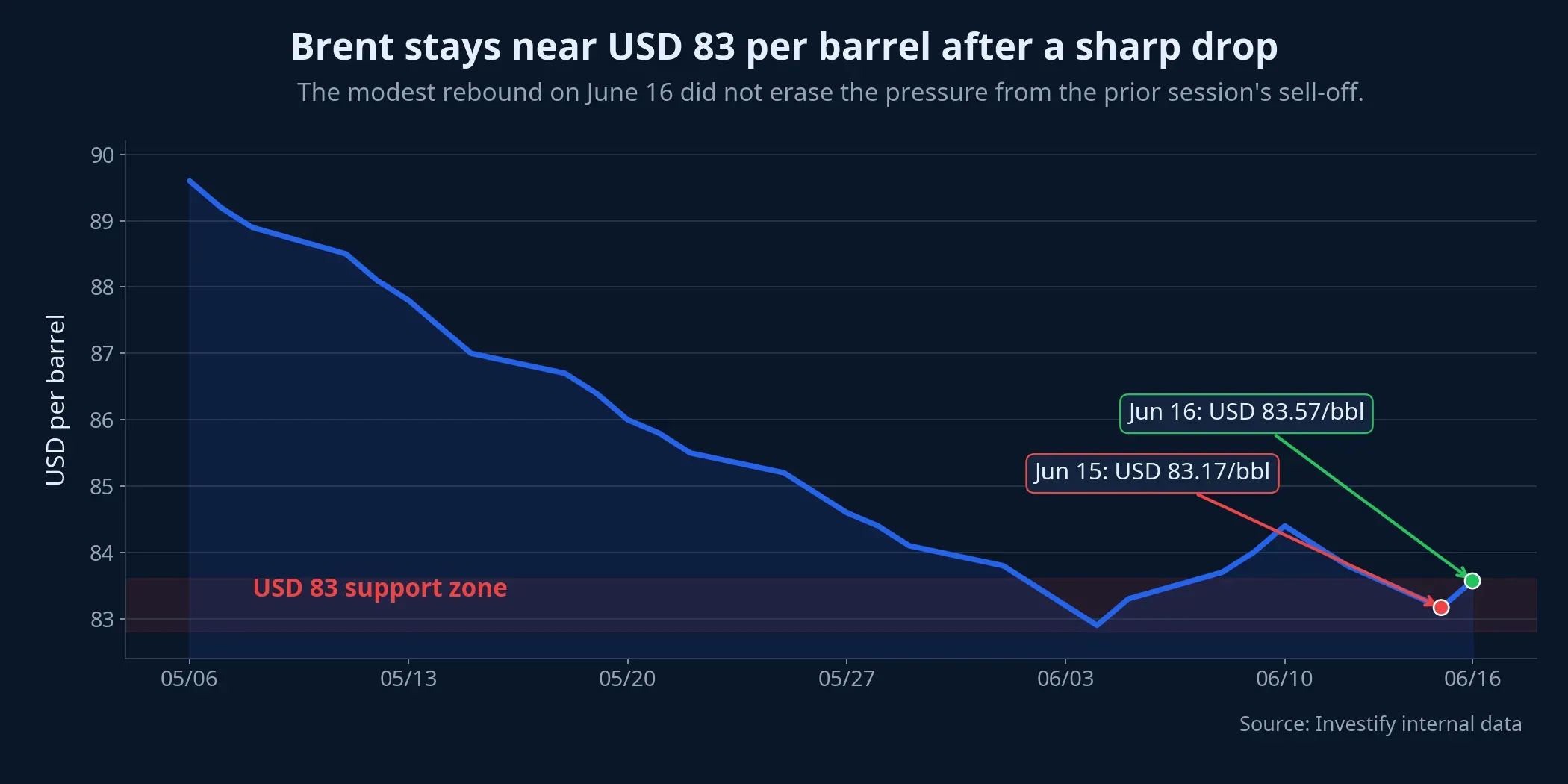
If banks were steady but uninspiring, oil and gas was still dealing with a more visible external drag. On June 15, Brent crude dropped 4.76% to USD 83.17 per barrel and WTI fell 4.87% to USD 80.75 after news that the United States and Iran had reached a preliminary agreement tied to reopening the Strait of Hormuz. That was a large enough move to weigh on sentiment toward energy shares in the next session.VietnamPlus
On the morning of June 16, Brent edged back up to USD 83.57 per barrel. That was a rebound, but only a modest one. For energy equities, investors do not react only to the spot price at one moment. They also react to the speed of the previous decline and what it might mean for near-term earnings expectations. When the commodity shock is still fresh, money usually does not rush back into the full sector.VietnamPlus
BSR fell 0.38% to VND 26,400. PLX rose 0.52% to VND 38,700 after losing 3.87% in the June 15 session. GAS added 0.24% to VND 82,800, but it had also dropped 2.94% the previous day. That pattern suggests the selling pressure was no longer extreme, but the rebound remained thin. The sector was no longer broadly red, yet it was not strong enough to reassure the market either.

That is a point newer investors should remember. When a major sector is still reacting to an external variable, a green index should not be read as proof that every risk has passed. Markets usually telegraph caution through divergence between the benchmark and its sensitive groups. That divergence was still visible on the morning of June 16.
What the Afternoon Session Needs to Prove
The right question for the afternoon is not whether VN-Index can stay green. The better question is whether the green screen can spread into more sectors. If the gap between advancers and decliners widens meaningfully, turnover expands beyond a few familiar names, and banks or oil names become less out of sync, the rebound would have a stronger foundation.
Morning turnover on HOSE reached VND 7,263.052 billion. That is enough to show that money is still active, but high turnover by itself does not prove the quality of the move. If capital remains concentrated in a narrow set of heavily traded stocks, the index can still stay green without the underlying structure improving much. For newer investors, this is exactly when breadth and sector alignment matter more than the headline trading value.Vietstock
The Cleaner Take for Retail Investors
The June 16 morning session was not a bad session. The index stayed above 1,800, advancers still outnumbered decliners, and capital continued to show up in a handful of liquid names. But there is still a wide gap between saying the market did not look bad and saying money has returned evenly across the board.
The most coherent conclusion right now is that this was still a selective rebound. Buyers have not left, but they are choosing carefully. The biggest mistake for newer investors in that setup is to see a green index and assume every portfolio has the same chance to benefit. In practice, the opposite is often true: when money moves through narrow channels, choosing the wrong sector can leave your experience of the market completely different from the benchmark’s 6.65-point gain.
Three signals matter for the rest of the day. First, whether breadth expands. Second, whether banks shift from merely stabilizing the board to offering clearer support. Third, whether oil and gas continues to absorb selling pressure after crude’s sharp drop. If all three improve, the morning gain will look more durable. If not, this session should still be read as a fragmented rebound where the index is moving faster than the quality of money underneath it.