

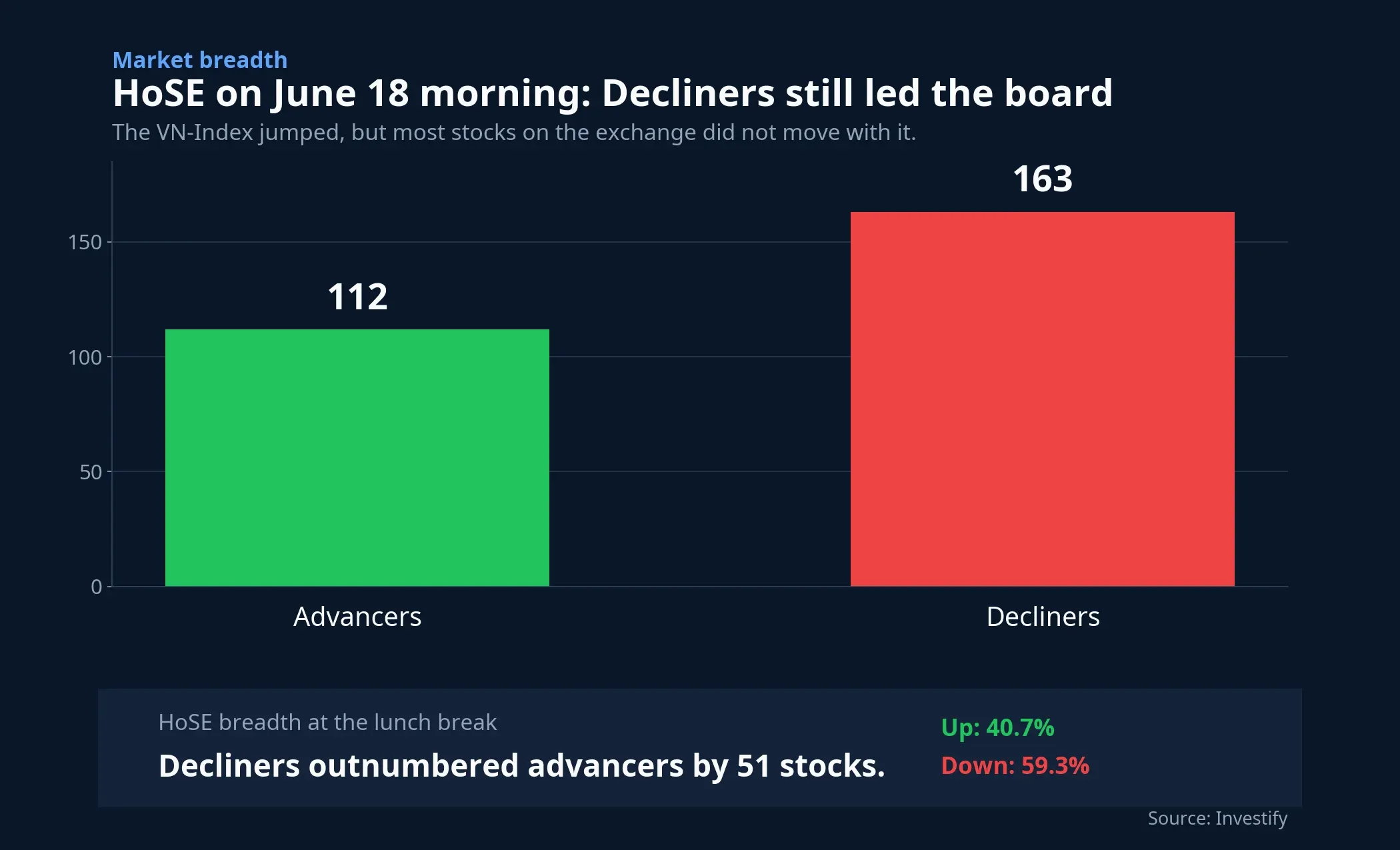
By the lunch break on June 18, the VN-Index had climbed 29.22 points to 1,835.42, a gain of 1.62%. On the surface, that looks like a strong market session. But once you look below the headline number, the picture becomes less straightforward: HoSE still had only 112 advancers versus 163 decliners.
Put simply, the index was rising faster than the average stock on the exchange. That distinction matters for first-time investors, because the experience inside a real portfolio can be very different from the confidence suggested by a sharply higher benchmark.
Why the index can rise while many stocks still fall
The VN-Index is not a simple headcount of winners and losers. It is a market-cap-weighted index, which means larger stocks have a much bigger influence on the final number. In practical terms, a few heavyweight names can lift the benchmark sharply even if a broad swath of smaller stocks is still flat or down.
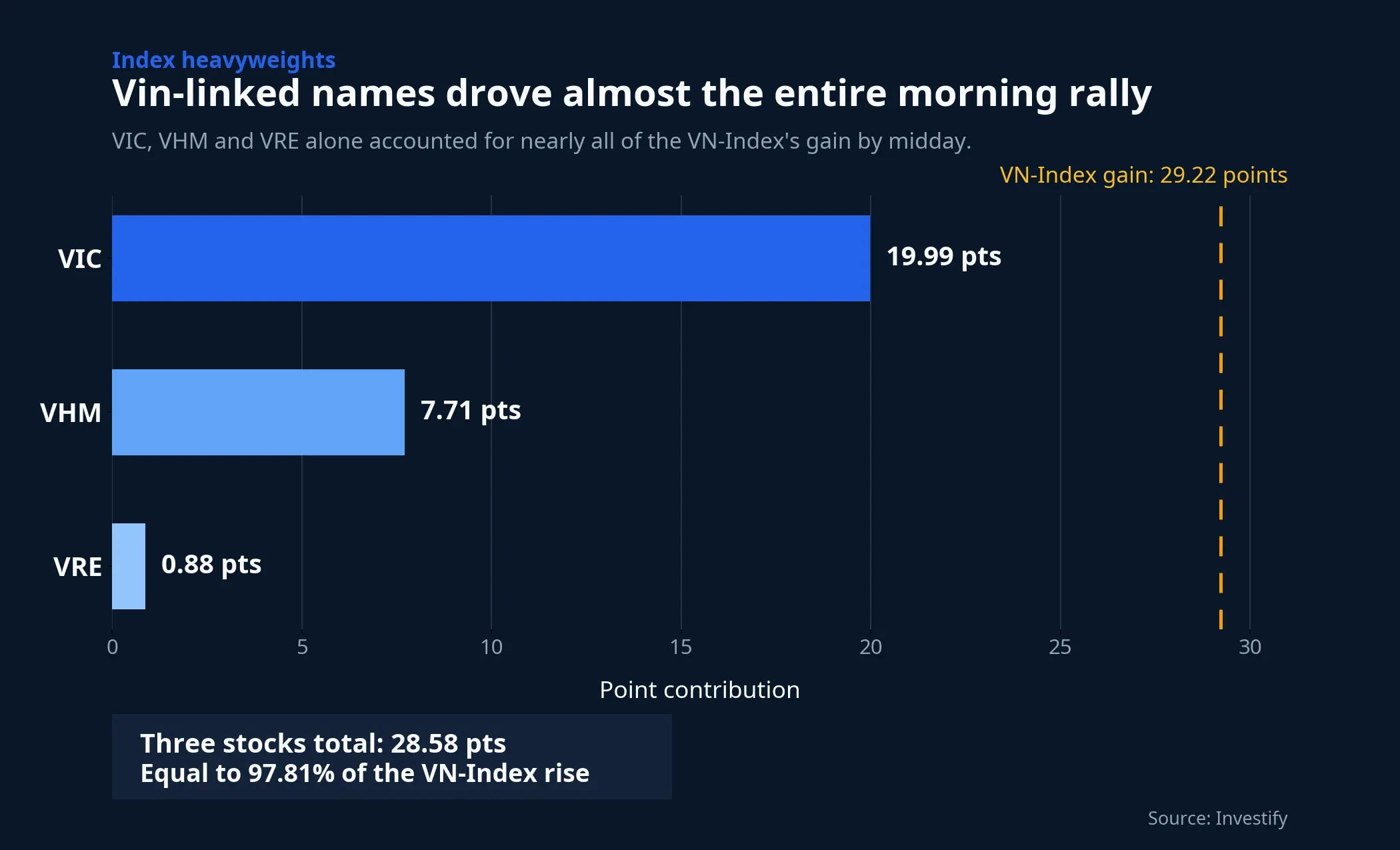
That is exactly what happened on the morning of June 18. As of around 10:45 a.m., Vietstock reported that VIC and VHM alone had contributed nearly 20 points to the VN-Index, while the biggest laggards were subtracting just over 2 points.Vietstock By midday, Investify’s internal data showed VIC contributing about 19.99 points, VHM 7.71 points and VRE 0.88 points to the index gain.
Together, those three stocks accounted for about 28.58 points, almost the full 29.22-point advance in the VN-Index. When such a narrow cluster does nearly all of the lifting, investors should read the move as concentrated strength, not yet as a broad-based market rally.
What market breadth says about the real tone underneath
Market breadth is especially useful for new investors because it answers a more practical question: are most stocks actually participating. On the morning of June 18, the answer was still no. The VN-Index was up more than 1%, but decliners continued to outnumber advancers on HoSE.
This is why local traders often describe such sessions as “green on the outside, red on the inside.” The benchmark is solidly positive, yet many individual names are still in the red or at least not rising in step with the index. That does not automatically mean the afternoon session will weaken. It simply means the headline number alone is not enough to declare that the whole market is healthy.
For newer investors, the common mistake is to treat the VN-Index as a full proxy for their own holdings. If you do not own VIC, VHM or VRE, the morning surge in the index may have little to do with your actual P&L. A strong benchmark can create the impression that everyone else is making money, even when a typical portfolio is not moving much at all.
How the Vin group was pulling the index higher
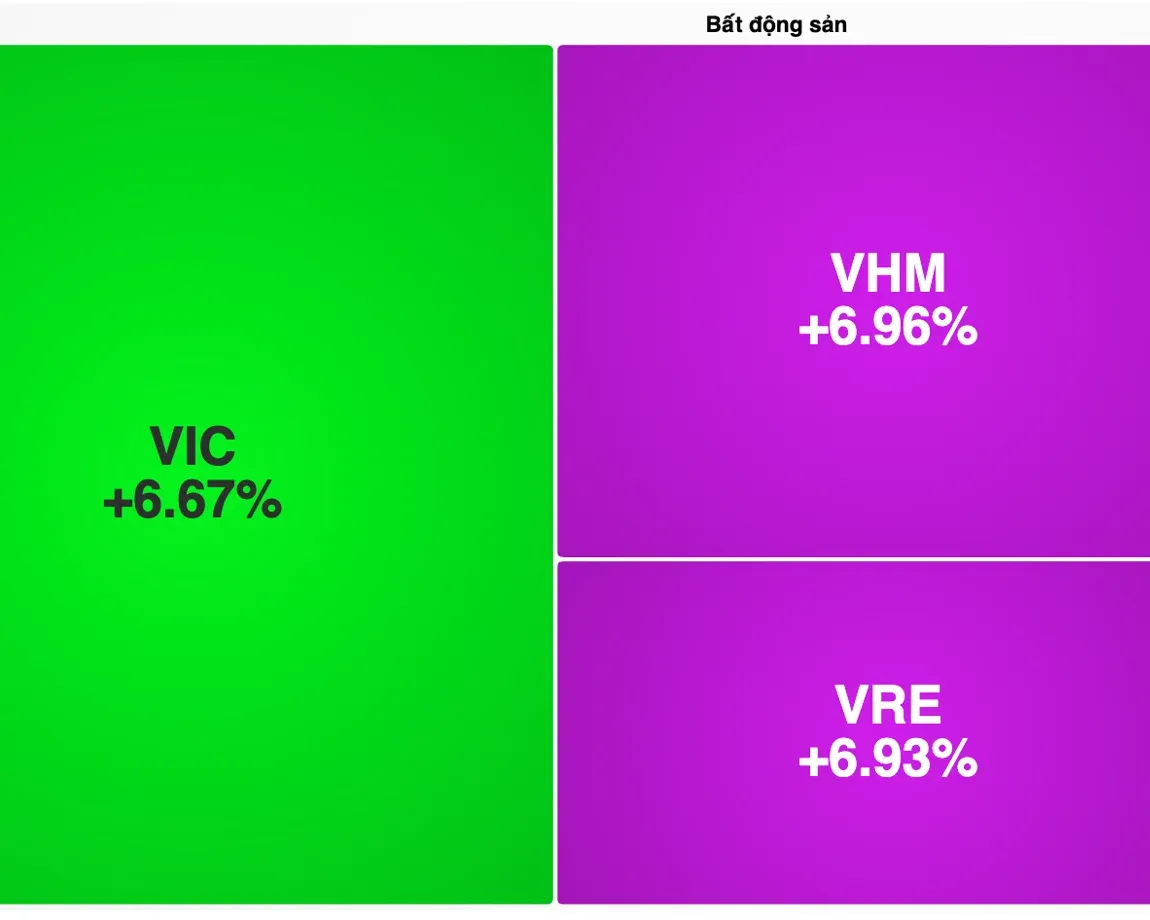
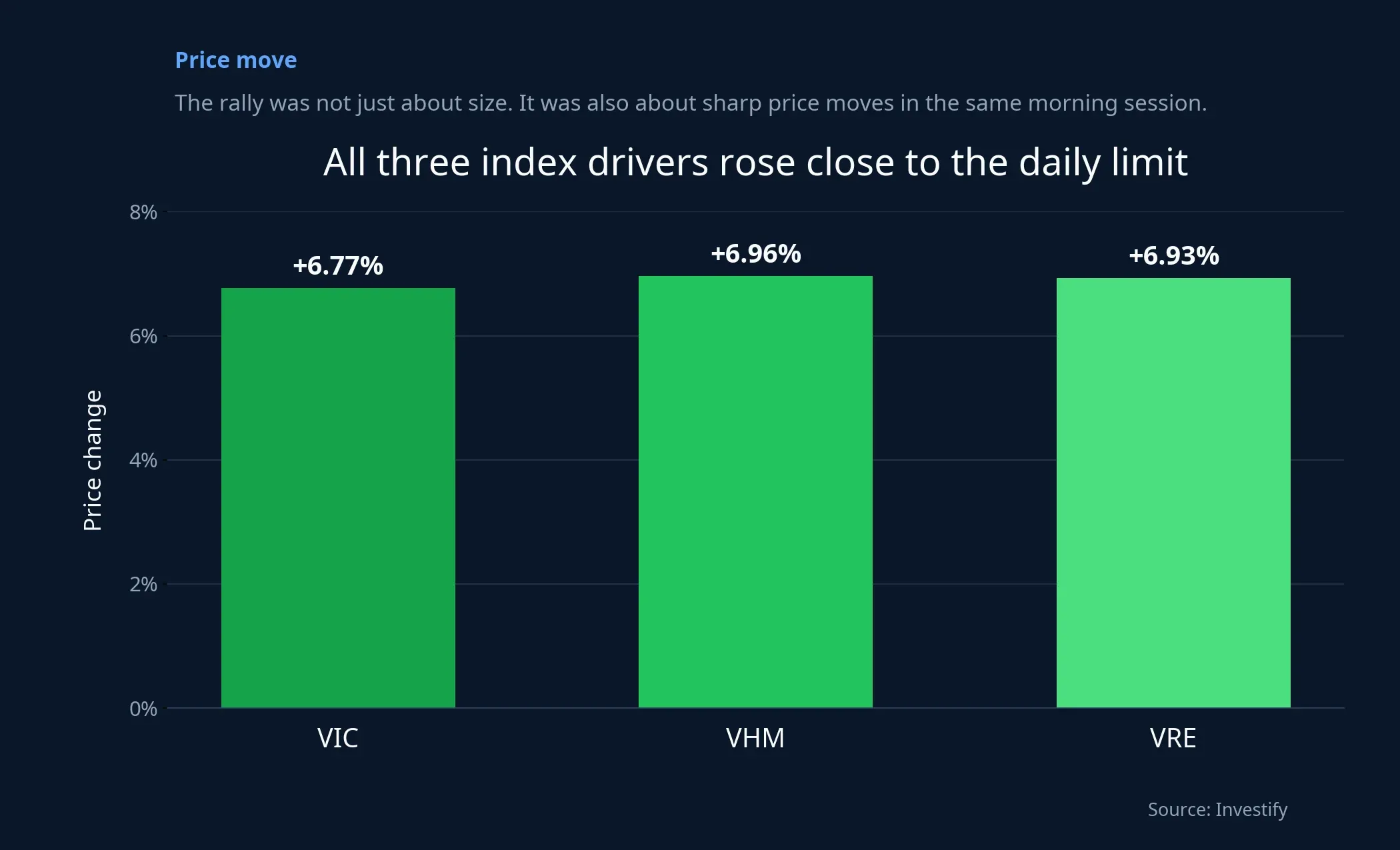
The notable part was not just that the Vin-linked names were up. It was that all three were up sharply at the same time. VIC rose 6.77% to VND 205,000 per share, VHM climbed 6.96% to VND 144,400, and VRE gained 6.93% to VND 30,100. Near the end of the morning session, Vietstock was still describing Vingroup-related shares as the main engine behind the near 30-point rise in the VN-Index.Vietstock
This mattered because the move combined price strength with index weight. Based on Investify’s morning data, VIC had a market capitalization of about VND 1,579.7 trillion. VHM stood at roughly VND 593.1 trillion, while VRE was smaller but still sizable at about VND 68.4 trillion. When stocks of that scale rise close to the daily limit together, they move the index far more than dozens of smaller decliners can offset.
That does not tell investors whether the Vin rally is right or wrong. The more important point is how to interpret the signal. A benchmark driven by a few heavyweights can still be genuinely strong at the index level. But it is not enough, by itself, to prove that money is flowing across the broader market.
What would make the rally more convincing
If investors want to know whether the afternoon session confirms the morning move, three layers matter. The first is breadth. If advancers begin to catch up with decliners, or move ahead of them, that would suggest buying interest is spreading beyond just a handful of mega-caps.
The second is sector participation. Healthy rallies rarely stay dependent on one small cluster for very long. They usually need support from banks, brokers, steel names, retailers, technology stocks, or at least parts of the mid-cap universe. Not every sector has to surge, but the market does need more than one pocket of strength.
The third is liquidity. Morning volume reached 270,409,521 shares. That figure becomes meaningful only when paired with another question: where is the money going. If trading remains concentrated in a few index leaders, the rally is still narrow. If turnover broadens across sectors, the move becomes easier to trust.
Why first-time investors often chase sessions like this
The most common emotional reaction for newer investors is fear of missing out. That is understandable because the trading screen sends a simple message: the index is strongly green, so the market must be healthy. In sessions like June 18, however, that feeling can run ahead of the underlying evidence.
The real risk is not that the index is rising. The real risk is buying into a stock outside the leading group while market money is still tightly concentrated. In that scenario, the purchase is based on the impression of a market-wide rally, but the chosen stock does not enjoy the same tailwind that is lifting the benchmark.
Another mistake is assuming that a strong morning index move will automatically broaden out in the afternoon. That can happen, but it does not always happen. Some sessions stay narrow until the close. In others, the morning leaders cool off before money has time to rotate elsewhere, and the index gives back part of its earlier gain.
Bottom line: the index is strong, breadth still needs to confirm
The most defensible conclusion from the morning of June 18 is not that the VN-Index move was fake. It is also not that the whole market has already shifted into a broad new uptrend. The better reading is that the benchmark was strong at the headline layer because a few large-cap names were doing most of the work. What remains missing is confirmation from breadth, wider liquidity and broader sector participation.
For new investors, the safer reading process is layered. Start with the index to see whether the market is being pulled up or dragged down. Then check how many stocks are actually moving in the same direction, whether money is spreading out, and whether the leaders are holding their strength. If those layers improve together in the afternoon, the rally becomes more credible. If they do not, this remains mainly a beautiful index session rather than a broadly green market day.