
Coffee prices in Vietnam’s Central Highlands were still sitting just below the VND 90,000 per kilogram mark on June 19, with Dak Lak and Dak Nong both at VND 89,600, Gia Lai at VND 89,500, and Lam Dong at VND 89,400.Vietnambiz At first glance, that may look inconsistent with the idea that Brazil has already moved into a new harvest. But commodity markets rarely move in a straight line from harvest headlines to lower spot prices.
What is holding prices up is not a vague narrative. The market is making a very practical distinction between additional supply on paper and physical supply that is actually available for prompt delivery. As long as buyers still need beans to fill orders and nearby supply is not flowing fast enough, domestic prices can stay elevated even while traders talk about a new crop in Brazil.
For newer investors, that is the key mechanism to understand. Commodity pricing sits between expectation and reality. In coffee, that middle stage includes harvesting speed, drying conditions, quality control, warehouse releases, and exporters’ delivery commitments. Right now, that middle stage matters more than the simple headline that Brazil is harvesting again.
What the VND 90,000 mark is really saying
The spread across the four key provinces is only VND 200 per kilogram. That narrow range matters because it suggests the current price level is not just a local spike at one buying station, but a broadly accepted market floor across the Central Highlands.Vietnambiz
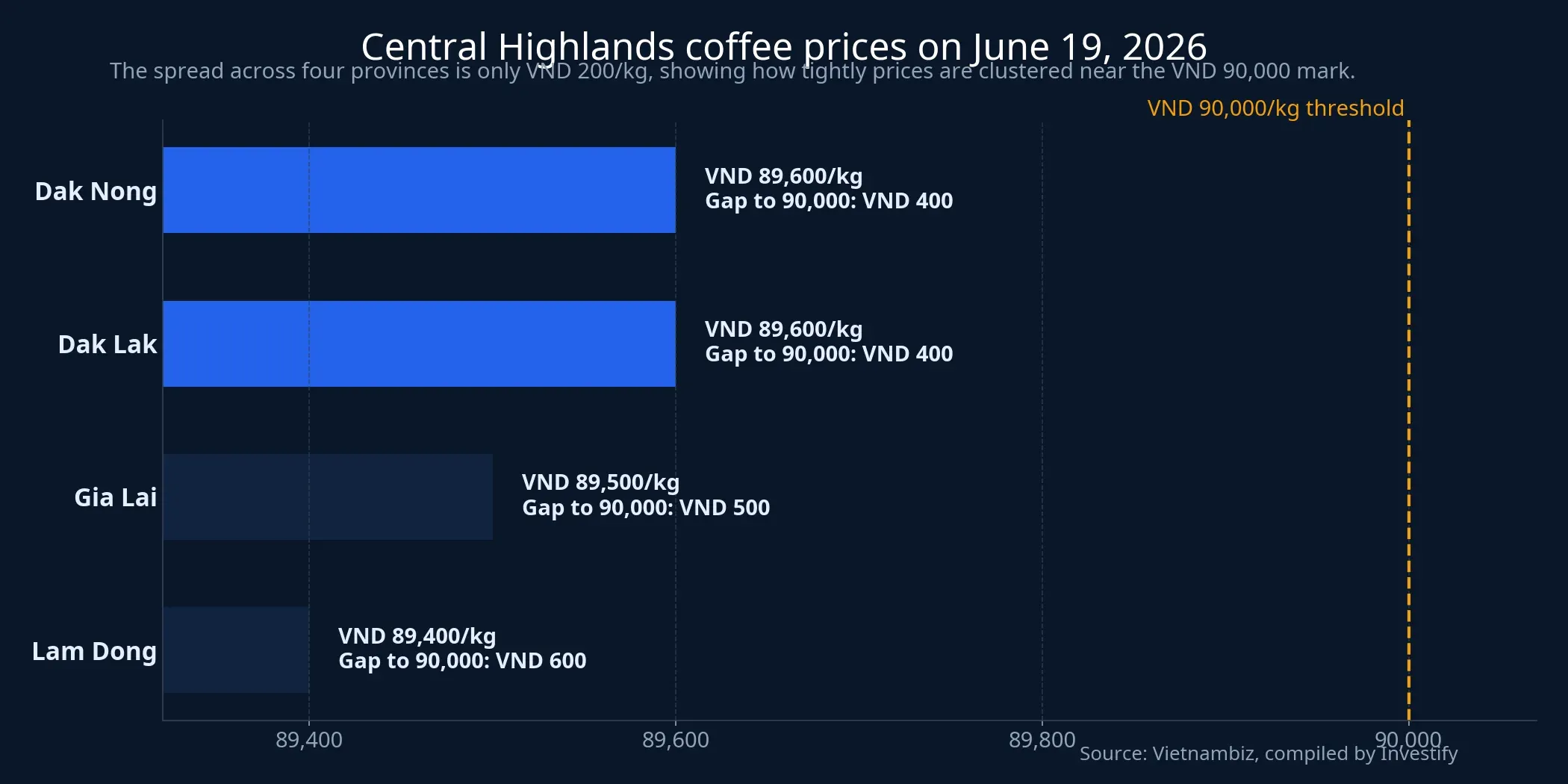
In plain terms, if nearby supply were genuinely comfortable, buyers would have more room to shop around and provincial prices would usually diverge more clearly. Instead, the market is tightly clustered just under VND 90,000, which is another way of saying that readily available beans are still not abundant.
This is where equity-style thinking can mislead first-time commodity readers. In stocks, a quiet tape can look like balance. In physical coffee, prices hovering near a round threshold while trading remains cautious can mean both sides are waiting for the other to blink. Farmers are not rushing to sell, and buyers still do not have enough evidence that prices are about to break lower.
When the market is in that state, even a modest new signal from futures or logistics can shift domestic pricing faster than the calm surface suggests. Quiet trading does not mean the risk has disappeared. It often means large decisions have simply been postponed.
Brazil’s harvest is not the same as immediate supply
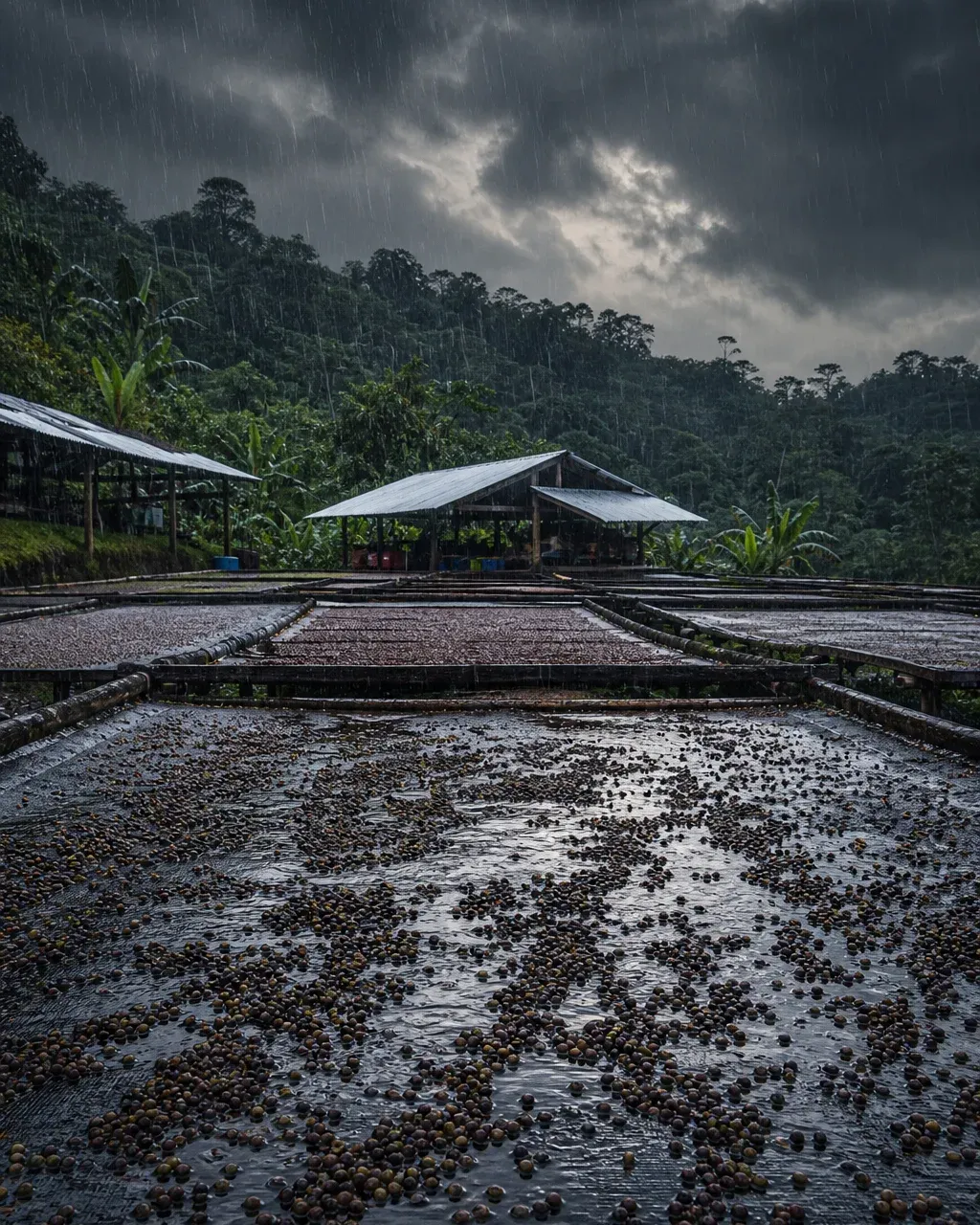
The first reason is straightforward: a new harvest in Brazil does not instantly become commercial supply available to the market. Reuters, as cited by Vietnambiz, reported that heavy rain over three consecutive days from June 11 to June 13 disrupted harvesting in parts of southeastern Brazil, including Minas Gerais, while also raising concerns around drying conditions and bean quality.Vietnambiz
That matters because the market is not only asking whether Brazil has started harvesting. It is asking whether fresh beans are moving out smoothly enough to ease nearby tightness. A large crop in theory can still arrive slowly in practice if weather interrupts harvesting and post-harvest handling. In coffee, a delay at this stage is not just a scheduling problem. It also affects moisture, quality, grading, and how quickly the crop can actually be sold.
That is why traders are still watching nearby futures closely. In its June 19 report, Vietnambiz said the July 2026 London robusta contract settled at USD 3,685 per ton on June 18, while the September 2026 contract closed at USD 3,629 per ton.Vietnambiz
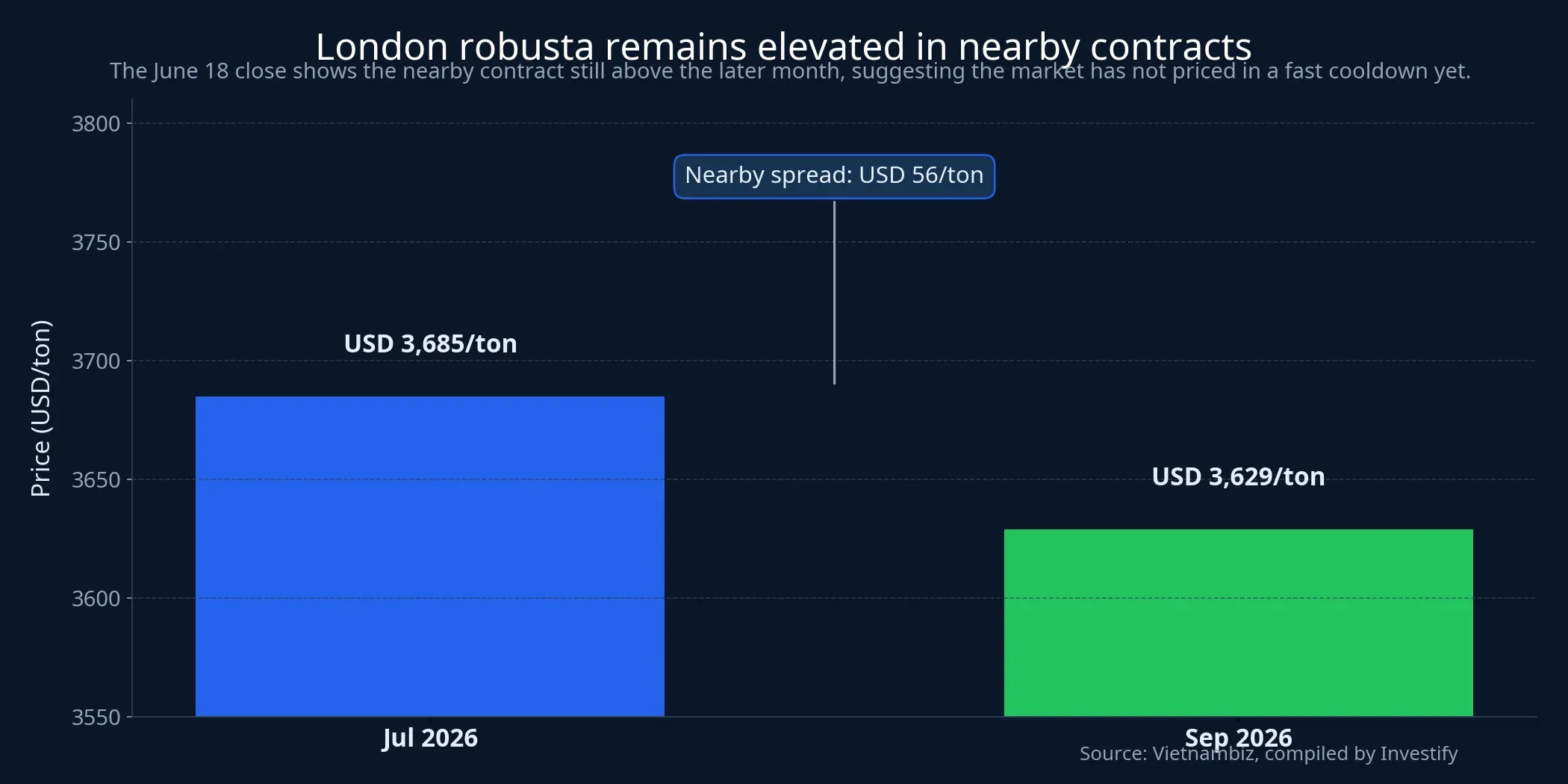
The USD 56 per ton gap between the nearby and later contract is not dramatic by itself, but it does reflect the market’s posture. If buyers were convinced that Brazilian supply would cool prices quickly, the nearby month would have a harder time holding that premium. For now, part of the market is still paying up for prompt availability.
So coffee is not responding to Brazil’s harvest with the simple formula that harvesting begins and prices immediately fall. It is responding to a supply-chain question instead: are beans arriving on time, are they coming in good enough condition, and do buyers still have to compete for the nearest available lots? Until those questions are answered more clearly, Vietnam’s domestic market has no strong reason to move far away from the VND 90,000 zone.
Export demand still creates replacement pressure
The second layer supporting local prices comes from exporters’ delivery needs. Vietnam Agriculture reported that in the first five months of 2026, Vietnam exported 927.3 thousand tons of coffee worth USD 4.23 billion. Export volume rose 7.8% year on year, but export value fell 13.5%, while the average export price dropped to USD 4,557 per ton, down 19.7%.Vietnam Agriculture
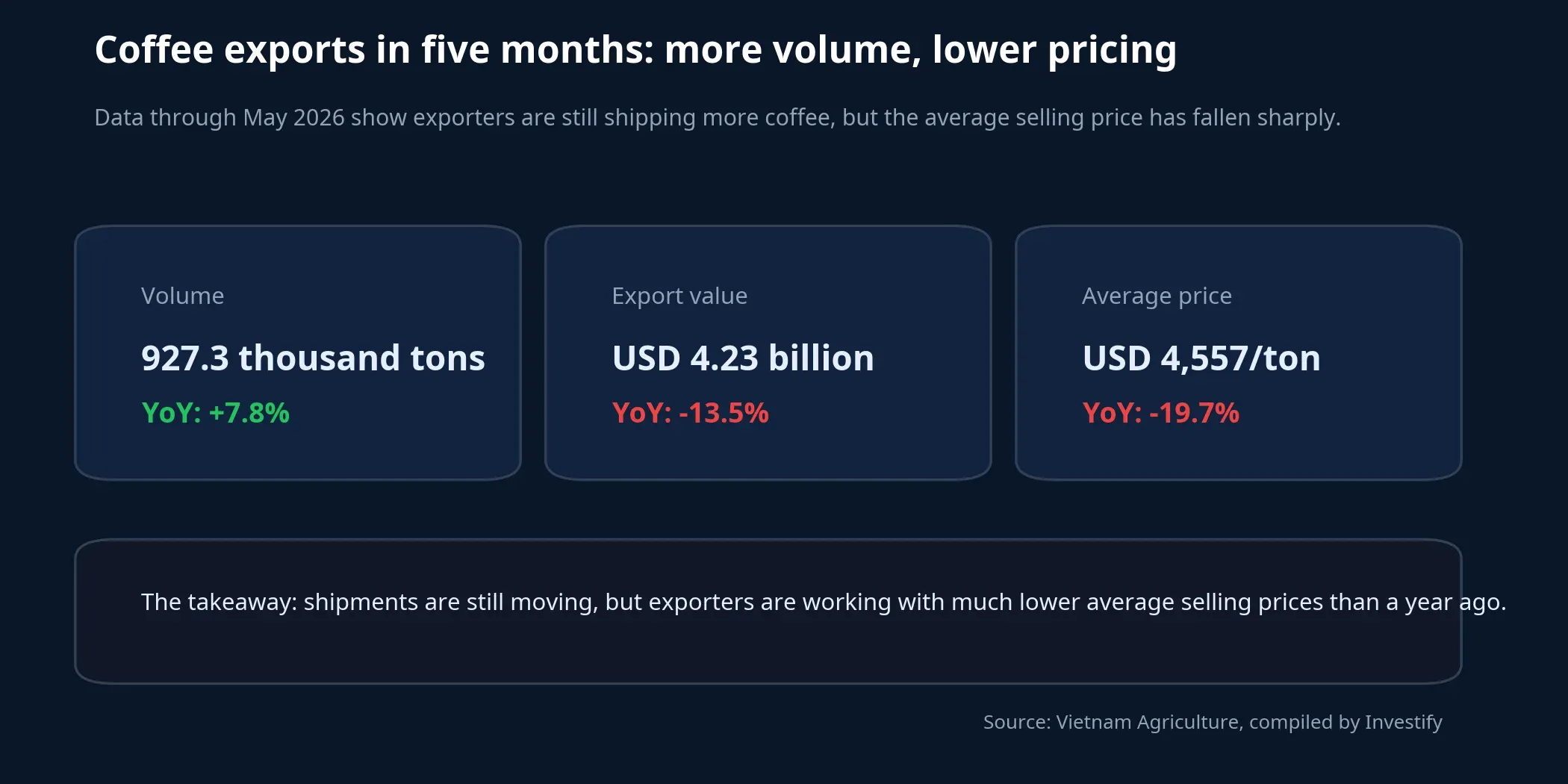
The point is not just that exports are still rising in volume. The more important takeaway is that exporters are still pushing beans into the market while working with much lower average selling prices than a year ago. When export prices fall faster than domestic procurement prices, margins can come under pressure unless companies secured supply early enough.Vietnam Agriculture
For a newer investor, the simplest way to frame this is to think of an exporter as someone who has already promised delivery and still needs to source part of the product. If international prices fall sharply, that replacement buying gets easier. But if domestic prices stay firm while buyers still need to ship on time, the replacement pressure does not disappear. It just turns into pressure on cash flow and margins.
That is why the current story is not only about whether farmers are withholding beans. Behind the local quote board sits a broader inventory-management problem. The longer the market believes Brazil’s supply will arrive only gradually, the harder it is for local buyers to wait for a materially lower price before stepping in.
What investors should watch next
If this entire setup has to be reduced to a few practical indicators, I would focus on three. The first is nearby London robusta. If the July contract keeps trading above later months, the market is still assigning a premium to prompt delivery risk. That would make a fast drop in domestic prices less likely.
The second is Brazil’s weather and harvesting pace. At this stage, the relevant question is no longer whether harvesting has begun, but whether the crop is moving out consistently. Only when the market sees smoother harvesting and fewer concerns around quality will the case for a deeper price cooldown become stronger.
The third is the relationship between export volume and average selling prices for Vietnamese exporters. If shipments remain solid while average prices keep falling, the market will pay closer attention to hedging, inventory positions, and replacement buying. That is not just a detail for listed companies. It is an early sign of where pressure is building inside the coffee chain.
The core thesis is straightforward: Vietnam’s domestic coffee market is still being supported by tight prompt supply, not overruled by the headline that Brazil has entered harvest. The bearish risk is real, but it becomes materially stronger only if two things happen together: Brazil’s harvest flow improves and nearby London robusta weakens clearly. Until then, prices holding near VND 90,000 per kilogram still have a coherent fundamental basis.